Why a Bloodhound Trails a Person Rather Than a Path
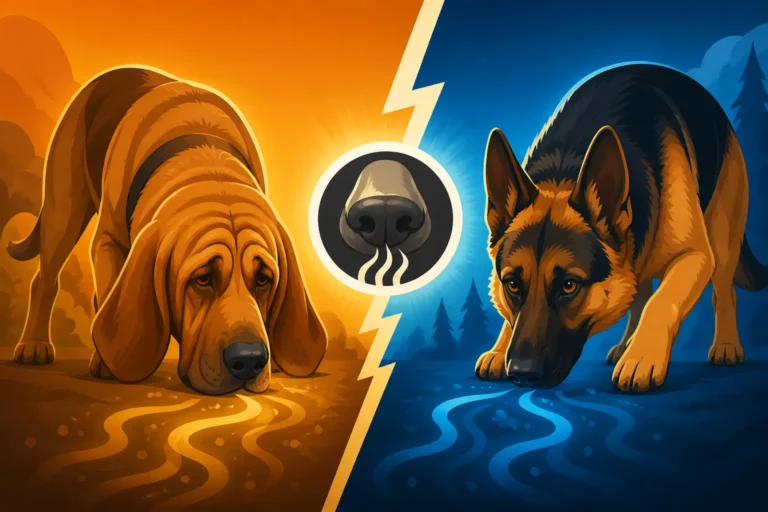
One of the most profound joys and challenges of owning a Bloodhound is understanding their incredible nose. Many people mistakenly think a Bloodhound is simply following footprints or a general disturbance on the ground, almost like a visual track. But anyone who has seen these magnificent dogs work knows it's far more complex than that. This guide will delve into the fascinating science and instinct behind why your Bloodhound is wired to trail a person specifically, rather than just a generic path, and what that means for you as an owner or handler.
The Invisible Blueprint: Understanding Human Scent
It’s easy for us humans to forget that we are constantly emitting a cloud of unique personal information. Every step we take, every breath we exhale, every brushing of our skin against the air leaves behind an invisible, yet incredibly rich, fingerprint of who we are. For a Bloodhound, this isn't abstract; it's a tangible, followable trail.
What Makes "Human Scent" Unique
Imagine your own personal body odor – not just the strong stuff after a workout, but the subtle, constant emissions that are uniquely you. Human scent is a complex cocktail of volatile organic compounds (VOCs), skin cells, bacteria, hormones, and even bits of clothing fiber, sweat, and breath vapor. It's not just one single smell; it's a dynamic, ever-changing signature that no two people share exactly. This intricate blend is far more specific and identifiable than the general scent of disturbed earth or crushed grass.
Think about it: when you walk, you're not just flattening grass; you're also dropping thousands of microscopic skin cells, exuding microscopic sweat particles, and leaving behind bacteria from your skin flora. These elements combine to create a distinct aromatic signature that is entirely different from the scent of a squirrel that just ran across the same spot, or a car tire that rolled over it. This specificity is key to the Bloodhound's work; they're not looking for "animal here" or "something moved here," they're looking for "THIS particular person was here."
The Constant Shedding of Scent Cells
We shed skin cells by the millions every day, and these cells carry our unique biochemical markers. This constant shedding creates a continuous, albeit sometimes diffuse, trail. When a person moves through an environment, they are essentially laying down a microscopic carpet of their own cellular material, blended with sweat and oils. This isn't like a blob of paint dropped once; it's a continuous, molecularbreadcrumb trail.
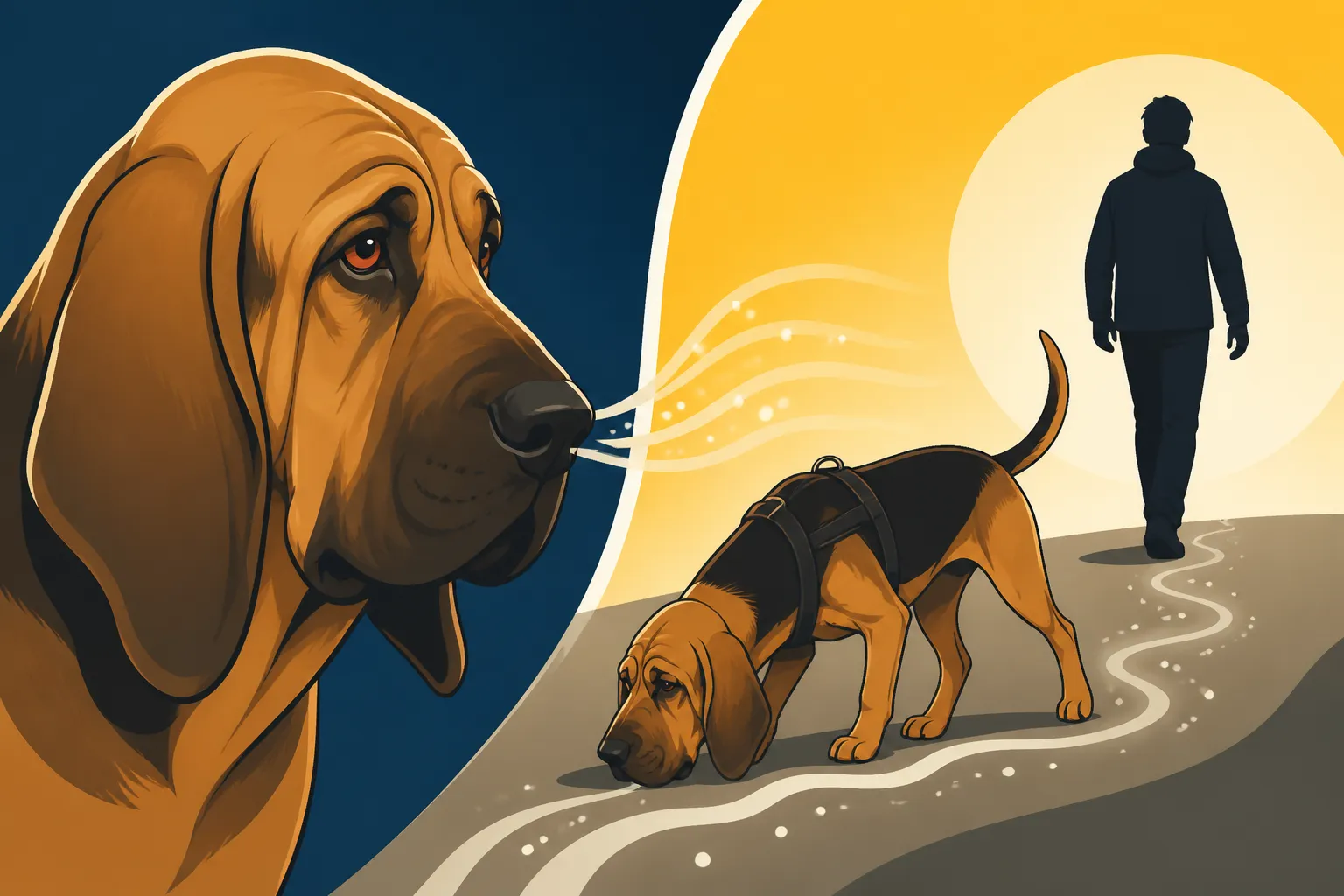
Consider a person walking through a park. With every stride, they are depositing a fresh layer of their personal scent. This scent accumulates on vegetation, on the pavement, and mixes with the ambient air. Even if the ground is hard and leaves no visible footprint, the chemical signature of that person is still there. Bloodhounds are masters at detecting these microscopic deposits, understanding that a denser concentration of these specific human markers indicates a more recent or prolonged presence, rather than just a general path of travel. They're tuned into the biological residue of an individual, not simply the physical disruption of the environment.
Environmental Factors Affecting Scent Trails
While a Bloodhound focuses on human scent, environmental factors absolutely play a huge role in how long and how well that scent persists. Wind can disperse scent quickly, scattering it in unpredictable ways and making a "ground trail" appear in the air. Rain can wash away lighter scent particles, but paradoxically, can also help "fix" heavier scent components to the ground or create ideal humidity for scent to travel. Ground cover, like tall grass, can trap scent longer, while hot asphalt might evaporate it faster.
For instance, a person walking through a dewy field at dawn will leave a much more "intact" and easily detectable scent trail than someone traversing a dry, windy parking lot at high noon. The moisture in the air and on the ground in the field helps to hold and transfer those microscopic scent particles. Conversely, in harsh conditions, a Bloodhound's job becomes incredibly challenging, requiring them to utilize both ground and air scenting techniques, constantly triangulating the direction of the most concentrated human odor. They're not just following a line; they're interpreting a complex, three-dimensional scent landscape that's constantly being shaped and reshaped by the weather and terrain.
A Nose Like No Other: The Bloodhound's Biological Advantage
It's one thing to understand that human scent exists; it's another entirely to possess the biological machinery to detect and interpret it with such unparalleled precision. The Bloodhound's nose isn't just a powerful tool; it's an evolutionary masterpiece, finely tuned for one purpose: to follow a specific scent, often a human one, over long distances and varied terrain.
The Anatomy of a Superior Sniffer
Let's talk about the nose itself. A Bloodhound's nasal cavity is incredibly large, containing up to 300 million olfactory receptors, compared to our mere 5-6 million. But it's not just the number; it's the structure. Their long, pendulous ears, known as leathers, actually help sweep scent particles from the ground up towards their nose, creating a localized scent vortex. Their loose facial skin, with its deep wrinkles and dewlaps, also serves a purpose, trapping scent molecules around their muzzle and extending the area over which they can detect.
Imagine trying to catch a whisper in a crowded room. You cup your ear, lean in, and focus. A Bloodhound's nose and facial features are essentially doing this, but for scent. They are designed to collect, concentrate, and analyze scent from their environment in a way no other breed can quite match. This anatomical advantage means they don't just detect a smell; they detect a symphony of smells, and they can pull out the specific instrument they're looking for. How Many Scent Receptors a Bloodhound Has really highlights just how impressive this sensory equipment is.
Dedicated Brain Power for Scent Processing
Having a super nose is one thing, but a Bloodhound's brain is equally specialized. A significant portion of their brain is dedicated to processing olfactory information – far more than in other breeds, let alone humans. They don't just smell; they analyze and remember scents. This allows them to create a detailed "scent memory" of their target, continuously comparing new scent information to that initial sample.
When a Bloodhound is given a scent article – a piece of clothing, for example – they're not just sniffing a shirt. They are creating a mental file of the unique human scent contained within it. As they trail, their brain is constantly working, sifting through millions of environmental odors to find matches to that specific file. This isn't just about detecting a smell; it's about matching a complex chemical signature against a known reference, filtering out all the "noise," and staying locked onto their target, even hours or days after the scent was laid.
How a Bloodhound Separates One Person's Scent From a Crowd
This is where the magic truly happens. Imagine a bustling city street, full of thousands of different human scents, vehicle exhaust, street food, and general urban funk. A Bloodhound, given a single scent article from one individual in that crowd, can often follow that specific person's trail through the chaos. They can do this because their olfactory system is capable of incredibly fine discrimination.
It's like a master sommelier distinguishing between two wines made from the same grape, grown in adjacent vineyards, with only subtle differences in terroir. The Bloodhound identifies the unique chemical fingerprint of the target individual and can essentially "tune out" other competing human scents. They're not just following "a human," they are following the human whose scent they were given. This ability to isolate and track a single, specific human signature is the cornerstone of their utility in search and rescue and law enforcement. How a Bloodhound Separates One Person's Scent From a Crowd dives deeper into this amazing capability.
The Art of the Trail: How Bloodhounds Work
Trailing is far more than just putting nose to ground and following a line. For a Bloodhound, it's a dynamic, intricate process of sensory input, interpretation, and problem-solving. They are constantly evaluating the strength, freshness, and direction of the target scent, adapting their strategy to the environment.
Following the Gradient of Scent Concentration
A Bloodhound doesn't necessarily follow a perfectly linear path. Instead, they are following the gradient of scent concentration. Think of it like walking up a hill in the dark, feeling for the incline. They move towards areas where the target scent is strongest, knowing this leads them closer to the source or the most recent point of passage. If the scent weakens, they might circle, working to find where the concentration increases again.
This means they might take detours, crossing back and forth over a perceived line of travel, not because they're "lost," but because they are systematically working the edges of the scent cone to find the strongest path forward. This intricate dance of tracking the scent gradient helps them to navigate even when the trail is old, faint, or disturbed. It's an active, investigative process, not a passive following.
Air Scenting vs. Ground Scenting: A Nuanced Approach
While Bloodhounds are often depicted with their noses glued to the ground, they are highly adaptable. They engage in both ground scenting and air scenting, often simultaneously or switching between them as conditions dictate. Ground scenting involves picking up those microscopic skin cells and other biological debris directly from the surface. Air scenting, on the other hand, involves detecting airborne scent particles, which can be carried by wind or rise from the ground.
In an ideal, calm environment with a fresh trail, they might appear to be almost exclusively ground scenting. However, if the wind picks up, or the trail crosses a paved surface where ground scent is less persistent, they will lift their heads, using their incredible sense of smell to pick up airborne scent. This dual capability makes them incredibly effective, allowing them to follow a trail even when physical contact with the ground scent is inconsistent. This versatility is crucial, as What a Bloodhound Is Actually Smelling on a Trail points out, they're not just looking for one type of scent.
Understanding Scent Pools and Disturbance Scents
When a person stands still for a period, like waiting at a bus stop or stopping to talk, they create a "scent pool" – a concentrated area of their unique odor. Bloodhounds learn to interpret these pools, often lingering there to gather more information before continuing. Similarly, a "disturbance scent" is created when ground is physically disrupted (e.g., footfalls crushing vegetation). While many tracking dogs might key into disturbance scent, a Bloodhound's primary focus remains the specific human odor.
They recognize that disturbance scent is a secondary indicator, but it’s the human essence that holds their unwavering attention. This means they won't be fooled by someone else walking over the same disturbed ground if that person's scent doesn't match the target. Their singular focus on the target's unique biochemical signature allows them to differentiate between multiple individuals who might have traversed the same physical path.
Training and Instinct: Guiding the Bloodhound's Nose
While Bloodhounds are born with an extraordinary gift, their proficiency in trailing a specific person is also shaped and refined through dedicated training. This training leverages their natural instincts and channels them towards a specific goal, reinforcing their inherent drive to follow human scent.
Building on Natural Drive from Puppyhood
The Bloodhound's natural instinct to follow a scent is present from a very young age. Responsible breeders and dedicated owners start fostering this drive early, often with simple "runaway" games where a familiar person walks a short distance and hides, and the puppy is encouraged to find them using their nose. These early experiences build confidence and establish the idea that following a scent leads to a reward – finding the person. Starting a Bloodhound Puppy on a Trail emphasizes the importance of these foundational exercises.
This isn't about teaching them how to smell; it's about teaching them what to smell for and what the expected outcome is. Positive reinforcement is crucial here, building a strong, joyful association between working their nose and success. Online resources like BAXTER & Bella can offer guidance on positive reinforcement methods for puppy training, which can then be applied to specific scent work foundations. It's about nurturing their innate abilities in a structured, rewarding way, turning a natural inclination into a focused skill.
The Role of Specific Scent Articles
A critical part of formal trailing is presenting the Bloodhound with a "scent article" – something that has been in direct contact with the missing person, like a piece of clothing, a comb, or a car key. This article provides the Bloodhound with a pure, concentrated sample of the target's unique scent signature, essentially giving them a "chemical photograph" to hold in their mind as they work.
Without a specific scent article, a Bloodhound would simply follow any human scent, or even game trails, which isn't useful for a specific search. The scent article narrows their focus dramatically, instructing their incredibly sensitive nose to ignore all other human scents and lock onto that one, distinct individual. This initial "imprint" is vital for the dog to perform its specialized task effectively. What Scent Article a Bloodhound Puppy Starts On details how to properly introduce and use these crucial tools.
Maintaining Focus on the Target Scent
Maintaining focus is perhaps the greatest challenge for both the Bloodhound and its handler. The world is a cacophony of smells, and it's easy for a highly scent-driven dog to be distracted by a rabbit that just darted across the path, or the remnants of someone's lunch. Training involves teaching the Bloodhound to "stay on the line" – not necessarily a physical line, but the invisible line of the target scent.
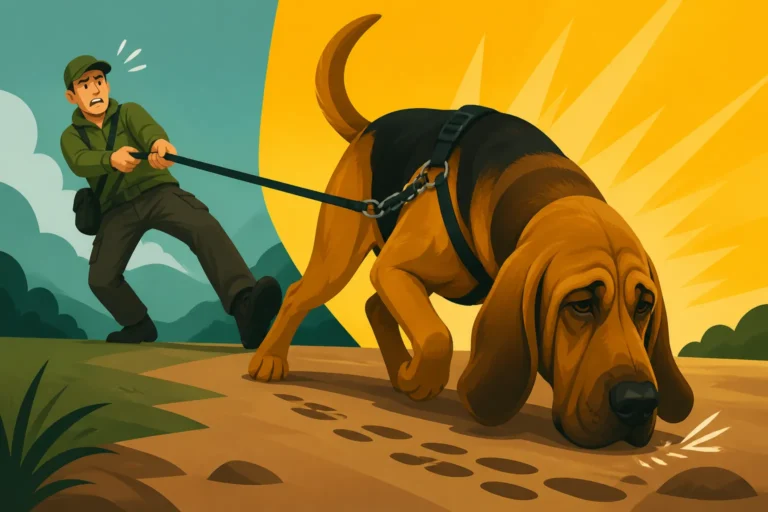
Handlers learn to "read" their Bloodhound, recognizing subtle changes in body language that indicate a shift in scent, a momentary loss of the trail, or a distraction. The handler's job is to encourage, guide, and trust the dog, even when the human eye sees no logical path. Proper equipment, such as a well-fitting tracking harness and a long line (which you can often find on Amazon), helps the handler maintain a connection without interfering with the dog's work. Why a Bloodhound Works on a Long Line, Not a Collar is a must-read for understanding this dynamic. This partnership, built on trust and understanding of the Bloodhound's unique way of working, is what ultimately leads to successful finds.
Why "Path" Trailing Isn't Their Forte
Understanding why Bloodhounds excel at person-specific trailing also means understanding why a general "path" or "track" isn't their primary focus, nor their area of greatest efficiency. They are not built to simply follow disturbances; they are biological detectives honing in on a specific quarry.
The Dynamic Nature of Human Movement
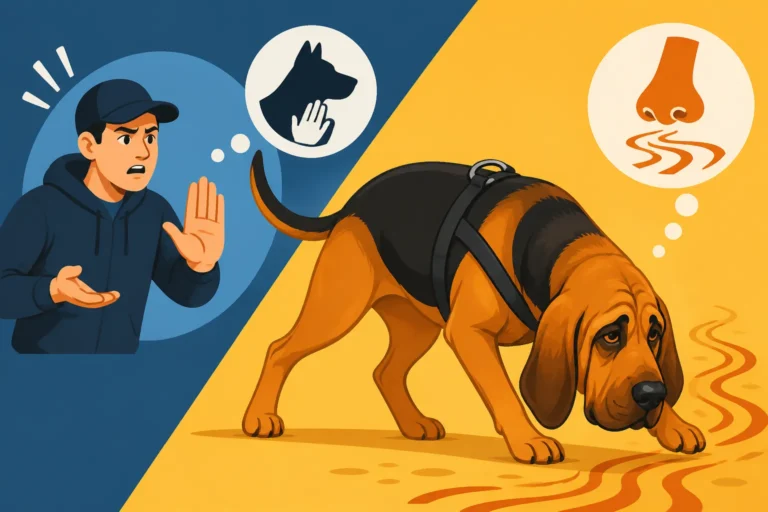
A human's movement is inherently dynamic and often erratic. We don't always walk in straight lines. We pause, we double back, we step off the beaten path, we might even get into a car. If a Bloodhound were solely focused on a "path" – the physical disturbance of the ground – these changes would be incredibly confusing. The scent of a person, however, persists regardless of whether they walked straight or zig-zagged, whether they stepped on grass or concrete.
Imagine a person walking a dog on a leash. The person's scent is consistent, but the path they take might be influenced by the dog's meanderings. A Bloodhound focuses on the human's signature, filtering out the dog's scent and the random foot placement. Their ability to disregard the linearity of a path and instead follow the displaced scent of a specific individual is what makes them so invaluable in real-world scenarios, where missing persons rarely follow neatly defined routes.
The Difference Between Foot-Scent and Person-Scent
It’s crucial to distinguish between what we might call "foot-scent" and "person-scent." Foot-scent would be the general odor left by a foot or shoe, perhaps mixed with dirt or pavement particles. Person-scent, as we've discussed, is the highly complex, unique biological signature of an individual. While footprints might leave some foot-scent, it's the person-scent embedded within those footprints, and carried in the air, that the Bloodhound truly follows.
If a Bloodhound was just following foot-scent, they would struggle immensely in areas where multiple people have walked, or where the ground offers no clear impression. Their goal isn't just to see where a foot was placed; it's to determine whose foot it was and where that person went. This distinction is vital for their accuracy and for their legal standing, as The Bloodhound Is the Only Dog Whose Evidence Stands in Court explains, their ability to identify a specific person is key.
Disinterest in General Environmental Scent
Unlike some other types of working dogs that might track general animal scents or even environmental changes, a Bloodhound, once tasked, generally shows disinterest in generic environmental odors. If they are on a human trail, a deer crossing their path might register, but it won't typically derail them from their mission to find the specific human scent they've been given.
This single-minded focus is what makes them so good at what they do. They are not easily swayed by the myriad of fascinating smells the world offers. Their drive is to find their person. While this intense focus can make them seem stubborn to an owner trying to get them to do something else, it's precisely this unwavering dedication to human scent that makes them unparalleled trackers. It's a testament to their purpose-bred nature.
Summary of Bloodhound Scent Focus
Here's a quick look at the distinctions in what a Bloodhound is tracking:
| Feature | Focus on "Path" (General) | Focus on "Person" (Bloodhound's Strength) |
|---|---|---|
| Scent Source | Disturbed earth, crushed vegetation | Unique human VOCs, shed skin cells, bacteria |
| Specificity | Low, any disruption | High, specific to an individual |
| Persistence | Varies; depends on physical disruption | Varies; influenced by environment & biology |
| Environmental | Can be masked by similar disturbances | Can distinguish target from other human scents |
| Goal | Where something moved | Where this specific individual moved |
This table helps illustrate that while "path" might contain some information, it’s the rich, specific, and persistent "person-scent" that truly captivates and guides a Bloodhound.
Disclaimer
This article is for general informational purposes only and does not constitute professional advice. Laws, prices and regulations vary by location and change over time. Consult a qualified professional for guidance on your specific situation.