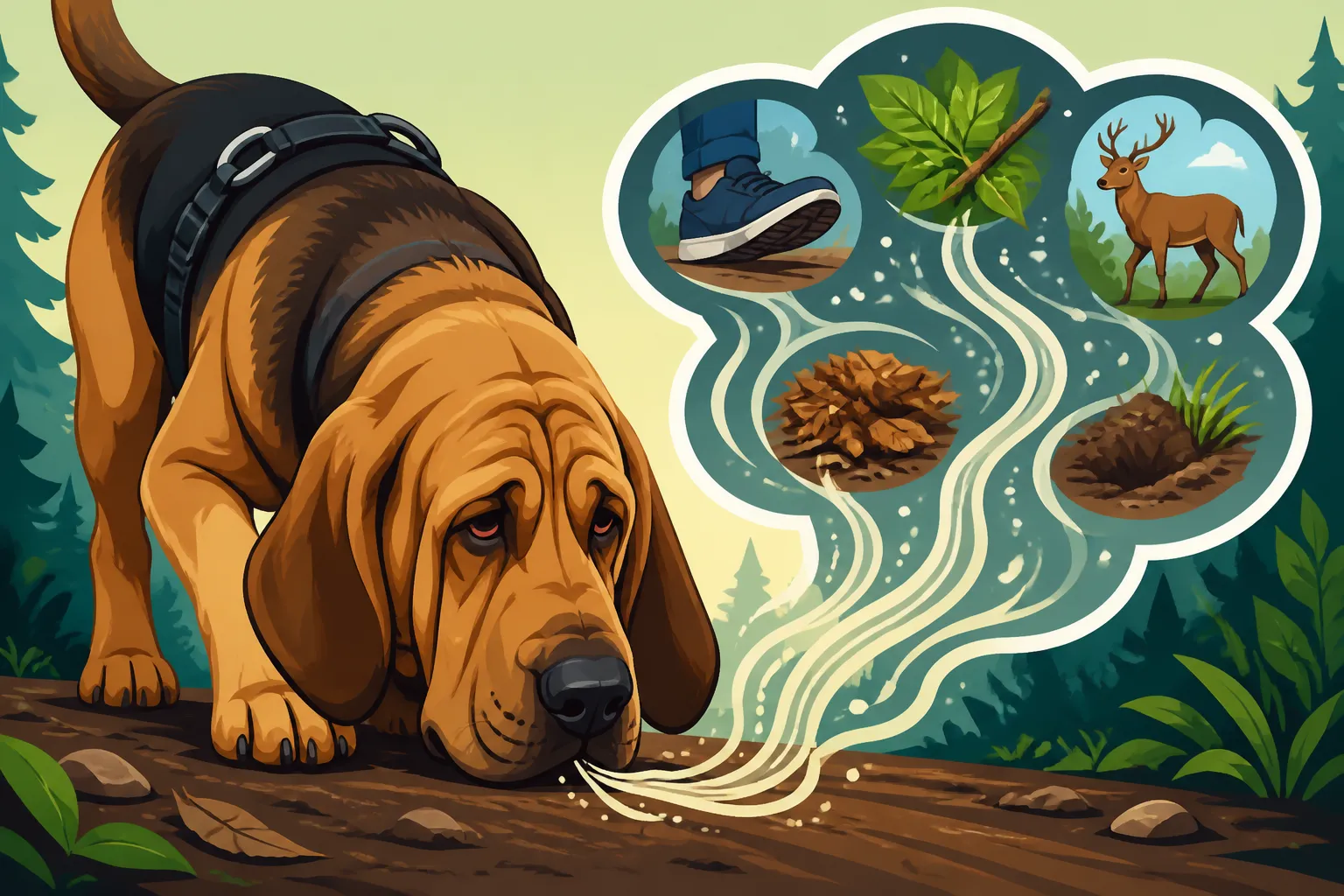
What a Bloodhound Is Actually Smelling on a Trail
When most people think about a Bloodhound on a trail, they imagine it simply following a "smell," perhaps like a cartoon character sniffing a pie. The reality, though, is far more intricate and astounding than just a single odor. This often leads to a misunderstanding of their incredible abilities and the challenges involved in working with these magnificent dogs. This guide will take a deep dive into the complex world of canine olfaction, revealing precisely what a Bloodhound's nose is truly discerning when it’s "on the scent."
Beyond "Smell" – The Olfactory Universe of a Bloodhound
To say a Bloodhound simply "smells" something is like saying a concert pianist just "hits keys." It's an understatement of epic proportions. Their perception of odor is a multi-dimensional experience, a symphony of chemical information that most humans can barely comprehend. They aren't just picking up a general "human" odor; they are dissecting an incredibly complex chemical signature that is as unique as a fingerprint.
The Chemical Symphony of Scent
What we perceive as "human body odor" or "scent" is not one singular, monolithic entity. Instead, it's a dynamic and incredibly complex mixture of volatile organic compounds (VOCs). Think of it this way: when a person moves, they are constantly shedding microscopic skin cells, much like tiny dandruff flakes. These cells carry with them a unique cocktail of bacteria, oils, sweat, hormones, and metabolic byproducts that are specific to that individual.
For us, if we smell a person's worn t-shirt, we get a general impression. A Bloodhound, however, is capable of breaking that impression down into its constituent parts, discerning the specific bacterial populations, the unique fatty acids from the skin, and even subtle hormonal cues. It's like listening to an orchestra and being able to identify every single instrument, every single note, and every individual musician playing them, all at once. This ability to differentiate and analyze such a vast array of chemical signals is what gives the Bloodhound its unparalleled tracking prowess.
How a Bloodhound's Nose is Built for Detection
The Bloodhound's head and face are masterpieces of evolutionary design, purpose-built for scent detection. Take a close look at their long, pendulous ears, known as ear leathers. These aren't just for show; they actually sweep the ground as the dog moves, funneling scent particles directly towards their large, moist nostrils. This action concentrates the scent, effectively enhancing the signal. Coupled with the extensive dewlaps – those loose folds of skin around their neck and muzzle – these features also help to trap and hold scent close to the nose, preventing it from dissipating too quickly.
But the real magic happens inside. A Bloodhound possesses an astonishing number of olfactory receptors – the specialized cells that detect scent molecules – estimated to be around 230 million, compared to our mere 5 million. More than that, the portion of their brain dedicated to processing these scent signals is disproportionately large, accounting for a significant percentage of their total brain mass. This means they not only collect a vast amount of scent data but also have the neurological capacity to interpret and organize it into a coherent picture. It's truly mind-boggling when you consider the sheer biological horsepower dedicated to their nose. To learn more about this incredible sensory organ, check out our article on How Many Scent Receptors a Bloodhound Has.
Distinguishing the Individual – The Personal Scent Signature
Every single one of us carries a unique scent signature, a complex biological fingerprint that a Bloodhound can identify and follow. It's not about tracking a generic "human" smell; it's about discerning your specific essence from everyone else's. This is why they can work amidst crowds or differentiate a suspect's trail from that of hundreds of bystanders.
Shed Skin Cells and Epithelial Debris
At the heart of a Bloodhound's trailing ability is the detection of epithelial debris – tiny, microscopic skin cells that we shed continuously, literally by the millions every hour. These cells, along with the sebum (skin oils) and sweat that cling to them, are the primary components of a person's scent trail. They fall onto surfaces, get carried by air currents, and essentially lay down a breadcrumb trail that is invisible to the human eye but a clear path to a Bloodhound's nose.
Imagine walking through a room; you're not just leaving footprints, but a constant, invisible shower of these unique cells. Each cell carries the unique chemical profile of your body. When a Bloodhound puts its nose to the ground, it's not simply smelling "you," but a distinct combination of these shed cells, each carrying its own micro-signature. This continuous shedding ensures that a trail is always present, even if it's incredibly faint, and the Bloodhound’s sensitive nose is designed to detect these minute quantities.
The Role of Bacteria and Microorganisms
Here's where it gets truly fascinating and a little gross, in the best possible way! A significant portion of what a Bloodhound tracks isn't just your direct cells, but the unique community of bacteria and other microorganisms that live on your skin. These tiny residents break down your sweat, oils, and dead skin cells, producing their own volatile organic compounds. The specific mix of these bacteria and their metabolic byproducts is highly individualized, creating a unique "microbial fingerprint" that changes slightly over time but remains distinctive enough for a Bloodhound.
This bacterial contribution is a huge part of why a Bloodhound can differentiate one person from another, even identical twins sometimes! It's not just about genetics; it's about the unique ecosystem living on your skin, influenced by diet, environment, lifestyle, and even hormones. This helps explain How a Bloodhound Separates One Person's Scent From a Crowd amidst a bustling urban environment or a busy crime scene.
Other Human Effluvia in the Trail
While skin cells and their associated microbial friends are the main event, other human effluvia also contribute to the complex scent picture. Sweat, with its unique chemical composition, leaves behind traces. Hair follicles, bits of clothing fibers, and even respiratory droplets from breathing, coughing, or sneezing all settle on the ground and surfaces, adding to the overall scent profile.
The Bloodhound integrates all these individual components into a cohesive scent picture. They're not just looking for one specific chemical; they're analyzing a constantly shifting kaleidoscope of odors and focusing on the consistent, unique signature of the person they are tasked to find. This comprehensive understanding of the scent makes their work incredibly robust, even when faced with environmental challenges.
Environmental Factors Affecting Scent Retention
The environment plays a huge role in how long a scent trail persists and how challenging it is for a Bloodhound to follow. It's not just about the person's scent, but how that scent interacts with the air, ground, and weather conditions. A Bloodhound handler is constantly assessing these variables to understand what their dog is up against.
Temperature and Humidity – The Scent Lifespan
Think about how a strong perfume dissipates faster in a warm, dry room compared to a cooler, more humid one. The same principles apply to a human scent trail. Higher temperatures cause volatile organic compounds (VOCs) to evaporate and disperse more rapidly. This means that a trail laid on a hot, sunny day will "age" and degrade much faster than one laid in cooler conditions. The scent molecules are simply lifted off the surface and scattered into the atmosphere.
Humidity, on the other hand, can be a Bloodhound's friend. Moisture in the air tends to "anchor" scent particles, keeping them closer to the ground and preserving their integrity for longer periods. A damp morning after a rain shower, even if the ground is drying, can present ideal scenting conditions because the humidity holds the molecules in place. Conversely, a very dry, windy day can be the absolute worst for scent retention, as particles are quickly dried out and blown away. If you're wondering how conditions impact a Bloodhound's work, consider Whether Heat Shortens What a Bloodhound Can Do.
Wind and Air Currents – Scent Dispersion
Wind is a double-edged sword for a Bloodhound. While a gentle breeze might help carry scent particles, a strong, gusting wind can be incredibly disruptive. It can scatter scent over a wide area, making a clear linear trail disappear, or push it in directions entirely contrary to the person's actual path. Imagine trying to follow a straight line on a map while someone is constantly spinning the map around and blowing away your markers. That's what a strong wind can do to a scent trail.
Bloodhounds are incredibly intelligent about this. They often don't just put their nose to the ground in a straight line; they learn to "air scent," picking up molecules that have been lifted and carried by the wind. They might work in wide sweeps, moving back and forth across a broad area, or even work upwind from the actual path, knowing the scent is being blown toward them. They also understand that scent can rise with thermal currents, especially over paved surfaces that absorb heat. This flexibility is key to their success in varied environments. To understand more about this, check out Whether Wind Moves the Scent a Bloodhound Follows.
Ground Cover and Surfaces – Scent Anchoring
The type of surface the missing person has traveled over dramatically affects how well the scent is retained. Porous surfaces like soil, grass, and decaying leaves are excellent "anchors" for scent. The uneven texture and absorbent nature of these materials trap skin cells and other effluvia, protecting them from rapid dispersion. Think of a thick carpet holding dust particles versus a smooth tile floor. The carpet holds onto things much better.
Non-porous surfaces such as asphalt, concrete, pavement, and metal present a greater challenge. Scent particles sit on top of these smooth surfaces, making them more vulnerable to wind and heat. While scent can be detected on these surfaces, it typically doesn't last as long or remain as concentrated. Hard surfaces also tend to absorb and radiate heat, which, as we discussed, causes scent to dissipate faster. This is why trailing in an urban environment with lots of pavement can be incredibly difficult for a Bloodhound. Delve deeper into this topic with Whether Asphalt Holds Scent for a Bloodhound.
Here's a quick comparison of how different surfaces affect scent:
| Surface Type | Scent Retention | Notes |
|---|---|---|
| Soil | High | Excellent for trapping and preserving scent. |
| Grass | High | Blades of grass hold scent; protected from wind. |
| Leaves/Brush | High | Organic matter traps scent; provides cover. |
| Asphalt | Low-Medium | Scent sits on surface, prone to heat and wind dissipation. |
| Concrete | Low-Medium | Similar to asphalt; less porous, scent disperses quicker. |
| Metal | Low | Very poor retention; scent quickly removed by wind/evaporation. |
| Water | Very Low | Scent dissolves or disperses; extremely challenging to follow. |
The Art of Interpretation – How Bloodhounds Follow the Trail
A Bloodhound's work isn't just about detecting scent; it's about interpreting that scent within its environmental context. They are masters of deduction, piecing together fragments of information to reconstruct a person's path, even hours or days later. It's a complex, dynamic puzzle that they solve with incredible focus and precision.
The "Scent Cone" and Air Scenting
Often, when you see a Bloodhound working, its nose isn't glued to the ground every single step. While they are ground trailers, they often work within what's known as a "scent cone." This means they're detecting the cloud of scent particles that have lifted off the ground and are lingering in the air just above it. The highest concentration might be at ground level, but a detectable amount is often suspended a few inches or even a foot or two up.
This ability to air-scent allows them to cover ground more efficiently and account for minor disruptions or changes in the terrain that might briefly obscure the direct ground trail. They are essentially navigating through a three-dimensional cloud of the target's unique odor, following the strongest concentration within that cloud. This doesn't mean they are air scenters in the sense of a search and rescue dog that casts for general human odor; they are still focused on the individual scent, just not exclusively by sniffing directly at the ground.
Aging the Trail – Scent Degradation Over Time
One of the most remarkable aspects of a Bloodhound's ability is its capacity to follow "aged" trails. It’s a common misconception that they can only follow a fresh scent. In reality, they can detect and follow trails that are hours, days, or even in some documented cases, weeks old. This isn't because the scent somehow remains perfectly preserved; rather, it's because the Bloodhound is incredibly adept at picking up the residual components of the scent as it degrades.
As a scent trail ages, the most volatile components dissipate first. However, less volatile components, particularly those associated with the oils and bacterial byproducts, persist longer. A Bloodhound doesn't necessarily know how old a trail is in human terms, but they interpret the degradation pattern and recognize the specific signature of the target person amongst these lingering, fainter elements. This is why their work can be so crucial in missing person cases, where time is often of the essence, but sometimes many hours have passed. To understand the limits, take a look at How Old a Trail a Bloodhound Can Follow.
The "Last Known Scent" and Trailing Strategy
When a Bloodhound is given a scent article – a piece of clothing, a personal item – from a missing person, they are not being told where the person went. Instead, they are being given a "scent picture" or a chemical profile of who they need to find. Their job is then to locate and follow the path where that specific scent signature is present.
Their trailing strategy is purely driven by the scent. They will follow the strongest, clearest, most consistent trail of that individual's odor. If the person meandered, the Bloodhound will meander. If the person doubled back, the Bloodhound will double back. They are not trying to predict human behavior; they are simply following the scent. If they lose the trail (a "loss of track" or "L.O.T."), they will typically cast in increasingly wider circles, trying to pick up that unique scent signature again. This single-minded focus is what makes them so effective, but it also means handlers must trust their dog's nose, even when the path seems illogical to a human.
Practical Implications for Handlers
Understanding what a Bloodhound is truly smelling has significant practical implications for handlers, from preparing for a search to everyday care and training. This knowledge helps maximize their effectiveness and ensures their incredible talent is utilized to its fullest potential.
Scent Articles and Their Importance
A good scent article is paramount. It needs to be something that has had direct, prolonged contact with the missing person and minimal contact with anyone else. An unwashed t-shirt worn recently, a toothbrush, a pillowcase, or even a baseball cap are far better than something handled by multiple people. The goal is to provide the purest, most concentrated sample of the target's unique scent signature.
When preparing for potential emergencies, many families create "scent kits" for loved ones, especially children or those with cognitive impairments. This involves taking a clean gauze pad, having the person hold it in their hand or rub it on their neck/armpit for a few minutes, then sealing it in an airtight container (like a glass jar or a new, heavy-duty Ziploc bag) and storing it in a cool, dark place. This ensures a fresh, uncontaminated scent article is always available. The idea is to minimize foreign scents and maximize the specific human effluvia.
Understanding Limits and Contamination
Even with their phenomenal noses, Bloodhounds have limits. Contamination is their biggest enemy. If multiple people have walked over a trail, or if a strong, overriding odor (like gasoline or bleach) is present, it can significantly interfere with the Bloodhound's ability to isolate the target scent. Handlers are trained to assess potential contamination and adjust their expectations and strategies accordingly. This is why police and search teams often try to secure a scene immediately, preventing unnecessary foot traffic that could destroy a precious trail.
Training a Bloodhound, even for a pet owner, benefits immensely from understanding these sensitivities. For example, BAXTER & Bella offers comprehensive online puppy training programs that, while not specific to trailing, can help establish a strong foundation of communication and control. This general obedience and clear communication with your dog can be invaluable in preventing them from contaminating a potential scent article or distracting them from the task at hand during an actual search.
Equipment That Aids Scent Work
Specialized equipment is essential for effective Bloodhound trailing, ensuring the dog can work comfortably and safely while giving the handler appropriate control without interference.
- Harnesses: Bloodhounds typically wear a specialized tracking harness rather than a collar. A harness distributes pressure across their chest and shoulders, allowing them to pull steadily without restricting their breathing or neck movement. This is crucial for a dog that often works with its head down, applying consistent pressure on the line. Different designs suit different dogs, but the principle is the same: comfort and function. For more details on this, you can read Which Harness a Bloodhound Trails In.
- Long Lines: Forget your standard six-foot leash. Bloodhounds work on long lines, often 15 to 30 feet or even longer, depending on the terrain and the handler's preference. This allows the dog the freedom to follow the scent wherever it leads, covering wider areas when air-scenting, without the handler constantly hovering directly over them and potentially contaminating the trail. These can be easily found on platforms like Amazon.
- Snoods: These fabric tubes are worn over a Bloodhound's long ears, especially when working in brush or while eating. They prevent the ears from getting tangled, torn, or from sweeping through mud, water, or even the dog's own food bowl, which would contaminate them and potentially interfere with their ability to pick up pure human scent. Keeping those ears clean and protected is a constant battle for Bloodhound owners. Check out What a Snood Does for a Bloodhound for more information.
Understanding the depth and complexity of what a Bloodhound's nose actually perceives on a trail is not just fascinating; it's vital for anyone who shares their life with these incredible animals, whether they're a pet owner or a dedicated search handler. It highlights the immense responsibility we have to respect their innate abilities and provide them with the best environment and tools to do what they do best: follow that invisible, chemical thread back to where it began.
Disclaimer
This article is for general informational purposes only and does not constitute professional advice. Laws, prices and regulations vary by location and change over time. Consult a qualified professional for guidance on your specific situation.