Whether Asphalt Holds Scent for a Bloodhound
One of the most common questions and genuine worries for Bloodhound owners and handlers, especially those new to scent work, is how well these incredible noses perform on different surfaces. We all picture a Bloodhound working a grassy field or a forest floor, but what happens when the trail leads onto hot, hard asphalt? It's a valid concern, often leading to frustration when a dog seems to struggle where you expect them to excel. This guide will meticulously unpack the realities of scent retention on asphalt, equipping you with the knowledge to understand your Bloodhound's capabilities and challenges in urban tracking.
The Science of Scent on Asphalt: What Actually Stays Behind?
It’s easy to imagine scent as something invisible and ethereal, but for a Bloodhound, it’s a tangible map, a collection of physical particles and chemical signals left behind by a person. When a Bloodhound puts its nose to the ground, it’s not just smelling an abstract "human smell"; it's processing a complex mixture of biological debris. The nature of asphalt, however, presents some unique hurdles for these delicate scent components.
Understanding Scent Particles and Evaporation
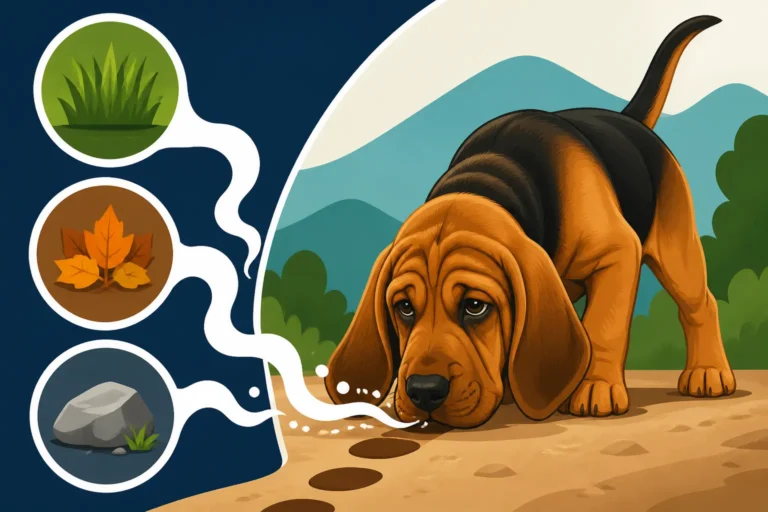
Every step a human takes, they shed a veritable cloud of microscopic biological material. This "human scent" isn't a single odor but a unique cocktail made up of shed skin cells, often called "rafts," along with sweat, oils, bacteria, and volatile organic compounds (VOCs) that are constantly evaporating from our skin. Think of it like a tiny, invisible confetti parade accompanying every person. These particles settle on surfaces, creating the trail your Bloodhound is designed to follow.
However, scent isn't static. It's constantly interacting with the environment. Evaporation is a key player here. The VOCs dissipate into the air, while bacteria continue to metabolize, releasing their own signature byproducts. Skin rafts, though microscopic, are actual physical objects, but even these can be moved by air currents or degraded by environmental factors. The freshness and intensity of a trail depend heavily on how quickly these elements are dispersed or destroyed.
Asphalt's Unique Challenges for Scent Retention
Now, imagine that invisible confetti parade trying to stick to asphalt. Asphalt, whether it's a parking lot, a city street, or a paved walking path, presents several distinct challenges compared to natural surfaces like soil or grass. Firstly, it’s a hard, non-porous surface. Unlike soil, which has countless tiny nooks and crannies, or grass, which offers textured blades and layers, asphalt is relatively smooth. This means fewer places for those precious skin rafts and oily residues to physically lodge and be protected from the elements. They simply lie on top, exposed.
Secondly, and perhaps most significantly, asphalt is a dark material that absorbs and retains heat. On a sunny day, asphalt can become incredibly hot – often reaching temperatures far exceeding the ambient air temperature. This intense heat acts like a turbocharger for evaporation, rapidly accelerating the breakdown and dispersal of volatile scent compounds. What might linger for hours on cool earth could vanish in minutes on scorching pavement. This heat can be a major frustration for handlers and dogs alike, as a seemingly fresh trail can quickly become "cold" due to surface temperature.
Thirdly, the lack of texture and the open nature of many paved areas make scent much more vulnerable to air currents. A gentle breeze that might just stir scent on a leaf-covered forest floor can easily sweep microscopic scent particles off a smooth asphalt surface, scattering them widely and making the original trail much harder to discern.
How Scent Does Cling to Asphalt
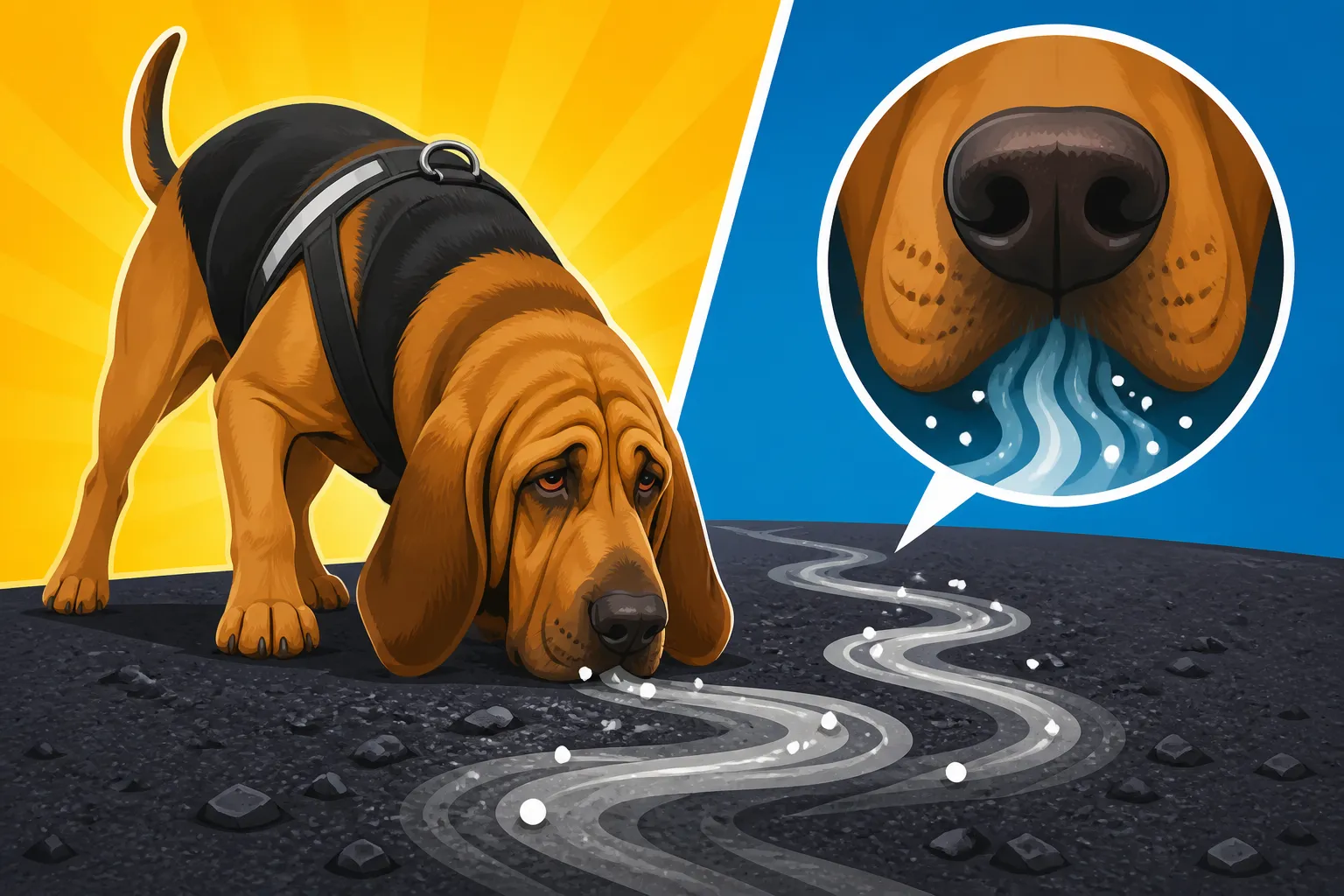
Despite these formidable challenges, Bloodhounds can and do trail on asphalt. It's not a myth. The reason lies in the sheer volume of scent shed and the Bloodhound's incredible sensitivity. Even on smooth, hot asphalt, skin rafts do fall and settle. Oils from skin and sweat leave a greasy residue, even if barely perceptible to the human eye or touch. These residues, though thin, can adhere to the surface.
Furthermore, no asphalt surface is perfectly smooth. Zoom in close enough, and you'll find microscopic imperfections, tiny cracks, and pores that can act as miniature traps for scent particles. These infinitesimal shelters offer just enough protection from wind and evaporation for a Bloodhound's nose to pick up. Think of it like a whisper in a very loud room; while difficult, a Bloodhound is built to hear those whispers. They're not just relying on a strong, continuous line of scent; they're piecing together a "scent mosaic" from faint, dispersed particles. This ability to detect incredibly minute amounts of scent is why they remain the gold standard for tracking. What a Bloodhound Is Actually Smelling on a Trail
Bloodhounds and Hard Surfaces: Adapting to the Urban Trail
The Bloodhound's anatomy and physiology are exquisitely tuned for detecting scent. While often associated with rural, natural settings, their innate abilities, combined with specific training, allow them to adapt to the concrete jungles and paved pathways of our world. It's a different game, but one they can still play, albeit with more effort.
The Bloodhound's Unparalleled Olfactory Prowess
Let's start with what makes a Bloodhound a Bloodhound: its nose. These dogs possess up to 300 million olfactory receptors, a staggering number compared to a human's mere 5-6 million. Their olfactory lobe, the part of the brain responsible for processing smells, is disproportionately large. This isn't just about having "more" smell; it's about having a fundamentally different way of perceiving the world through scent. Their long, pendulous ears, often a point of conversation, are believed to help sweep and concentrate scent particles towards their nose as they move. Similarly, the deep wrinkles and folds around their face may trap scent molecules, acting like an external scent funnel. It’s like they have built-in sensory enhancers. For a deeper dive into these unique features, consider reading about Why a Bloodhound's Ears Sweep Scent Toward Its Nose and Whether a Bloodhound's Loose Skin Helps It Trail.
This superior equipment means that even when scent is sparse and dispersed on asphalt, a Bloodhound has a fighting chance of detecting and following it. They are processing information that is completely invisible and undetectable to any other animal, let alone a human.
Reading the Scent Picture on Concrete vs. Soil
When a Bloodhound works a trail, they're not merely following a straight line like tracing a dot-to-dot puzzle. They are building a complex "scent picture" – interpreting variations in scent concentration, direction, and age. On natural surfaces like soil or grass, scent tends to be more concentrated and linearly distributed, often protected within the substrate. This allows for a more fluid, direct trailing style.
On asphalt, however, the scent picture changes dramatically. Because scent particles are more prone to dispersal and evaporation, the Bloodhound might work more slowly, methodically, and broadly. They may use a wider "casting" motion with their head, sweeping back and forth to gather enough particles to confirm the direction of travel. This might look like hesitation to an untrained eye, but it's actually the dog intensely processing a more challenging, diffuse trail. They are essentially collecting individual pixels of scent to reconstruct the overall image, rather than seeing a continuous line. When a Bloodhound looks like it’s lost the trail on a difficult surface, it’s often actually working harder to gather enough information. What a Bloodhound Does When It Loses the Trail
Training for Urban Environments
Successfully trailing on asphalt isn't just about having a great nose; it's about training that nose to discriminate and persevere in challenging environments. A Bloodhound needs to be specifically conditioned to work hard surfaces, and this training should ideally begin early. "Proofing" is the key – exposing the dog to scent work in a wide variety of environments, including urban settings with asphalt, concrete, and varied distractions.
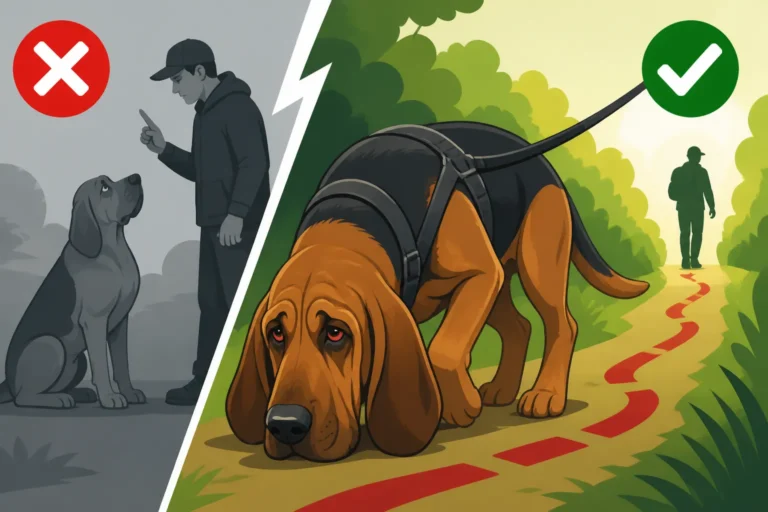
Training should focus on reinforcing the dog for finding and following the scent, regardless of the surface. This means consistent, positive reinforcement when they work through difficult sections. Tools are also crucial for urban trailing. A well-fitting, comfortable harness designed for scent work is essential to prevent injury and allow the dog to move freely. You can find excellent, durable options for harnesses and long lines on platforms like Amazon, where many handlers source their gear. Brands like Ruffwear or sturdy hunting harnesses are often good choices. For more on this, check out Which Harness a Bloodhound Trails In. Similarly, a long line, typically 15-30 feet, provides the necessary control in open, potentially dangerous urban spaces without restricting the dog’s ability to work the scent. Online training programs, such as those offered by BAXTER & Bella, can also provide structured guidance for owners looking to get started with scent work, even if they later progress to in-person mantrailing instruction.
Factors Influencing Scent Durability on Asphalt
While a Bloodhound's nose is truly remarkable, even their abilities are not immune to the laws of physics and environmental impact. Understanding the factors that influence how long scent persists on asphalt is crucial for setting realistic expectations and effectively supporting your dog.
Environmental Conditions
The world around us constantly shapes the longevity and quality of a scent trail, especially on surfaces as exposed as asphalt.
- Temperature: This is arguably the most critical factor. As mentioned earlier, hot asphalt acts like a giant, scent-destroying oven. High surface temperatures accelerate the evaporation of volatile organic compounds and speed up the degradation of biological material. A trail that might be detectable for many hours on a cool, overcast day could be gone within minutes or an hour on asphalt radiating summer heat. This is why handlers often prefer to work urban trails in the early morning or late evening during warmer months.
- Humidity: Humidity can be a double-edged sword. While very high humidity might eventually cause scent particles to become saturated and disperse, moderate humidity can actually help scent "stick" longer. Water molecules in the air can briefly bond with scent particles, preventing them from evaporating as quickly and settling them onto the surface. Conversely, very dry conditions can lead to rapid desiccation and dispersal.
- Wind: Wind is a scent killer on open, hard surfaces. Unlike in a forest where scent might be swirled and trapped by foliage, scent on smooth asphalt has little to hold onto. Strong winds will quickly blow away microscopic skin rafts and disperse VOCs, making the trail diffuse and challenging for the Bloodhound to follow. Even a light breeze can significantly degrade a trail's integrity.
- Rain: Rain presents a clear challenge. Fresh, heavy rain can effectively wash away a scent trail from asphalt, literally rinsing the particles down gutters and drains. However, there's a nuance: light rain or a damp surface before the scent is laid, or immediately after, might temporarily trap scent particles in the moisture, holding them on the surface for a brief period before the water completely dilutes and carries them away. But generally, when we talk about rain, we're talking about scent destruction. If you're wondering about the effects of precipitation, you might find it useful to read Whether Rain Destroys a Bloodhound's Trail.
Age and Quality of the Trail
The older a trail gets, the more challenging it becomes, regardless of the surface. On asphalt, this degradation is often accelerated. Where a trail on ideal soil might persist for 24-48 hours, a comparable trail on asphalt might be practically undetectable after only a few hours, especially under adverse weather conditions. The continuous action of evaporation, wind, and ambient temperature steadily breaks down the scent picture. How Old a Trail a Bloodhound Can Follow
The "quality" of the trail also matters. A person who walks slowly, sheds more skin cells, and has a heavier footfall will likely leave a stronger, more concentrated trail than someone who runs quickly or wears very smooth-soled shoes. A trail laid by multiple people will also generally be stronger than one laid by a single individual. The richer the initial deposit of scent, the longer it will persist, even on challenging surfaces.
Contamination and Distractions
Urban environments are inherently complex scentscapes. Asphalt surfaces in cities or towns are magnets for myriad competing odors. Vehicle exhaust, spilled food, industrial odors, chemicals, and the trails of countless other humans and animals all contribute to a cacophony of smells. For a Bloodhound, this isn't just noise; it's a constant stream of information that must be filtered. They need to discriminate the specific human scent they're looking for from an overwhelming backdrop of other smells.
This requires immense focus and dedication from the dog. Handlers must learn to manage these distractions, sometimes by working during quieter hours or by employing specific handling techniques to help the dog stay on task. It's a testament to their concentration that they can achieve this at all.
| Surface Type | Scent Retention | Primary Challenges | Handler/Dog Adaptation |
|---|---|---|---|
| Asphalt | Low to Moderate | Heat, Wind, Smoothness | Slower, broader search; specific urban training. |
| Concrete | Low to Moderate | Heat, Wind, Smoothness | Similar to asphalt; careful observation. |
| Grass/Soil | High | Moisture, Degradation over time | Faster, more direct trailing; natural scent traps. |
| Leaf Litter | High | Wind (can move leaves), Degradation | Slower on heavy litter; scent trapped underneath. |
| Water | Very Low | Dissolution, Currents | Not a direct trail; relies on scent "cone." Whether a Bloodhound Can Trail Through Water |
Practical Implications for Bloodhound Owners and Handlers
Understanding the science and the challenges is one thing, but translating that into practical action is where the real work begins for Bloodhound owners and handlers. It’s about being prepared, being patient, and being realistic with your incredible canine partner.
Setting Realistic Expectations
The first, and perhaps most important, implication is to set realistic expectations. While your Bloodhound possesses an unrivaled nose, asking them to flawlessly trail a six-hour-old track across hot, sunny asphalt is a monumental task, bordering on unfair. Acknowledge that asphalt is a hard surface to work. It demands more from your dog – more concentration, more energy, and more nuanced interpretation of faint scent.
Don't get discouraged if your Bloodhound's trailing style on asphalt looks different than it does on a perfect grass field. They might be slower, cast more widely, or even lift their head more often to gather airborne scent before returning to the ground. This isn't a failure; it's an adaptation. Celebrate their effort and small successes on these challenging surfaces. The ability to work any scent on asphalt is a testament to their skill.
Gear and Safety Considerations
Working on asphalt, especially in urban areas, introduces specific safety concerns that require appropriate gear.
- Paw Protection: Hot asphalt can burn sensitive paw pads. In warmer weather, consider investing in dog boots to protect your Bloodhound's feet. These are readily available from retailers like Amazon and are a small investment for your dog's comfort and safety.
- Visibility Gear: When trailing near roads or in busy areas, reflective vests or lighted collars are crucial, especially if you're working early morning or late evening. Your dog's focus will be on scent, not traffic, so you need to ensure they are visible to others.
- Secure Harnesses and Long Lines: As discussed, a sturdy, well-fitting harness is non-negotiable. It should distribute pressure evenly and not restrict your dog's movement or breathing. Paired with a long line – often 15-30 feet, depending on the environment – it allows your Bloodhound to work a broad scent picture while keeping them safely tethered. A quality long line is an essential piece of equipment for any Bloodhound handler, and you'll find a wide variety on Amazon, catering to different materials and lengths. To learn more about selecting the right length, check out How Long a Line a Bloodhound Handler Buys. These tools are not just for training; they are fundamental for safe and effective scent work on hard surfaces.
When to Seek Professional Guidance
If you're finding it difficult to train your Bloodhound to work asphalt, or if you're unsure how to interpret their behavior on these challenging surfaces, don't hesitate to seek professional guidance. Certified mantrailing instructors specializing in Bloodhounds or general scent work can provide invaluable insight. They can help you understand your dog's communication, troubleshoot issues, and teach you advanced handling techniques for urban environments.
There are many fantastic online communities and organizations, such as the American Bloodhound Club, that offer resources and sometimes even connect you with local trainers. Structured online programs, like BAXTER & Bella, can also serve as an excellent starting point for basic obedience and scent introduction, building a solid foundation before tackling more advanced trailing scenarios. Learning from experienced handlers can make all the difference, transforming frustration into successful, rewarding experiences for both you and your Bloodhound.
Disclaimer
This article is for general informational purposes only and does not constitute professional advice. Laws, prices and regulations vary by location and change over time. Consult a qualified professional for guidance on your specific situation.