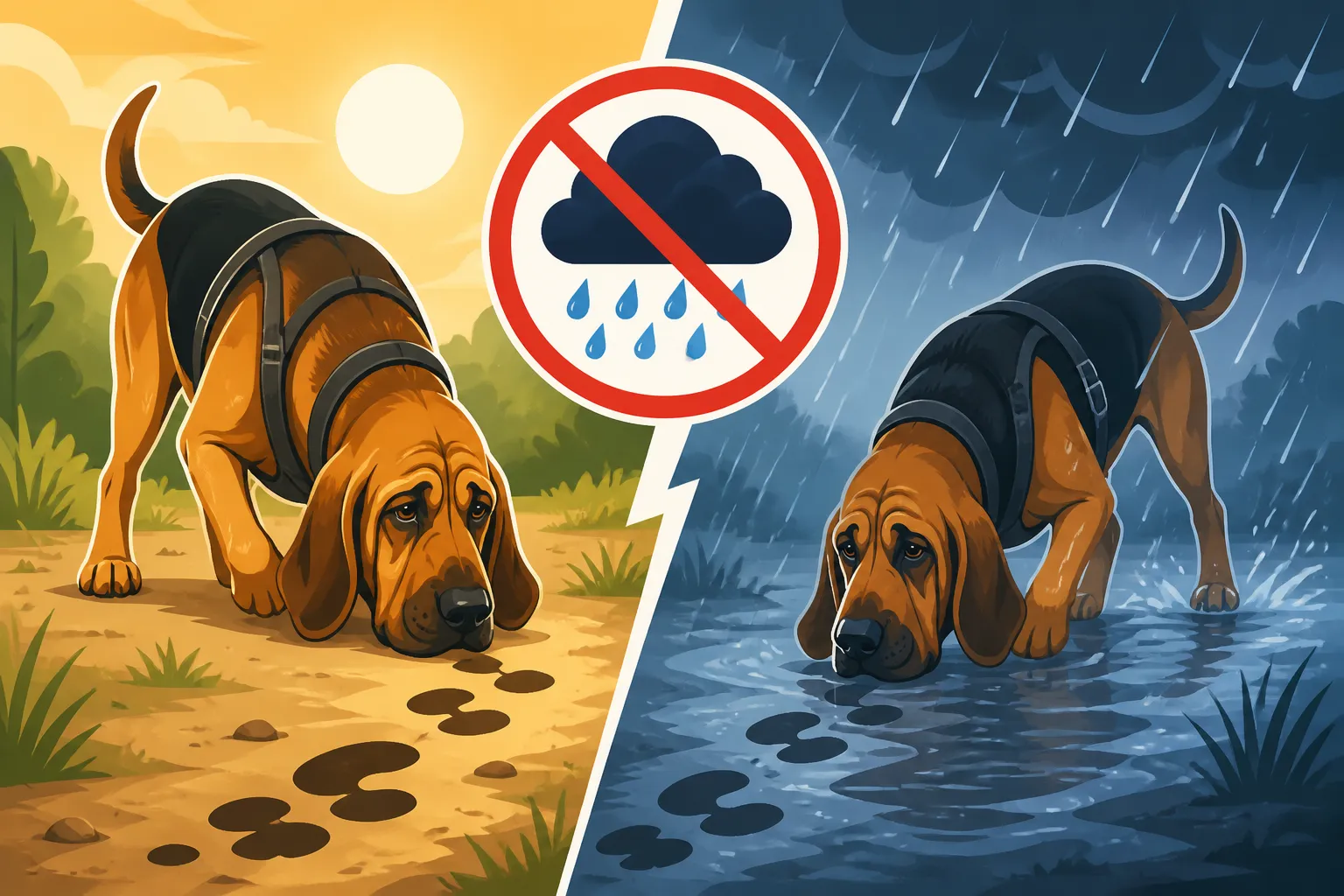
Whether Rain Destroys a Bloodhound’s Trail
One of the biggest worries for Bloodhound owners, especially those interested in scent work or just enjoying an outing with their amazing sniffers, is how the weather impacts their dog's incredible abilities. You might find yourself standing at the window, watching the rain come down, and feeling a pang of disappointment, wondering if all that drizzle is completely washing away any chance of a good trail. The truth is, rain doesn't necessarily "destroy" a Bloodhound's trail, but it certainly changes the game, making the scent picture a whole lot more dynamic and, frankly, fascinating for both dog and handler. This guide will delve into how rain truly affects scent and how your Bloodhound, with its unparalleled nose, navigates these damp challenges.
The Intricacies of Scent and Rain's Influence
It’s easy to imagine scent as a solid line, like a string dropped on the ground, that a Bloodhound simply follows from point A to point B. If only it were that simple! The reality of scent is far more complex, and understanding it helps us appreciate just how much work our Bloodhounds put in, especially when the weather isn't cooperating.
Understanding the Scent Picture
A human trail isn't a single, continuous line. Instead, it's more like a "scent cone" or a plume, a collection of microscopic skin cells, sweat, breath, and natural bacteria that constantly shed from a person's body. These particles, often called "skin rafts," fall to the ground and are carried by air currents, forming a unique olfactory signature. This signature isn't confined to the exact footsteps but spreads out, creating a broader area of scent that dissipates over time and is influenced heavily by environmental factors.
Think of it like glitter. When you walk, you're constantly shedding tiny specks of glitter. On a still, dry day, that glitter might settle relatively close to where you walked. But introduce a breeze or, as we'll discuss, rain, and that glitter gets tossed around, spread out, or pushed into new patterns. This ever-changing "scent picture" is what your Bloodhound is constantly analyzing, processing millions of data points to differentiate the target scent from everything else. This incredible ability is why a Bloodhound can separate one individual's scent from a whole crowd, even hours later. How a Bloodhound Separates One Person's Scent From a Crowd
How Rain Physically Alters Scent Particles
Now, let's talk about the rain. When those droplets start falling, they don't just magically make scent disappear. Instead, they interact with the scent particles in several distinct ways:
-
Dispersion and Dilution: Light rain or drizzle tends to disperse scent particles. Imagine those glitter specks we talked about earlier being hit by raindrops; they spread out. This means the scent becomes less concentrated in any one spot, covering a wider area but with less intensity. Your Bloodhound will still find it, but it might have to work a larger grid, casting about more widely to gather enough scent to confirm the trail. It's like trying to find a specific spice in a very large, gently seasoned stew instead of a concentrated spoonful.
-
Saturation and Adhesion: Moderate rain can saturate the ground, driving scent particles deeper into porous surfaces like soil, grass, or even cracks in pavement. This might make the scent less accessible from the surface, but it also helps preserve it from evaporation by wind or sun. The scent particles adhere to water molecules and soil, essentially "sticking" them in place. This can be a mixed blessing: it protects the scent, but also makes it harder to lift.
-
Washing Away and Runoff: Heavy, torrential rain is where the concept of "washing away" comes closer to reality, but even then, it's not a complete obliteration. On hard, non-porous surfaces like asphalt or concrete, heavy rain can certainly cause scent particles to be carried away by runoff. If the trail crosses a street during a downpour, a significant portion of the scent might literally flow down the drain or into puddles. However, on softer ground, while some surface scent might be carried off, a good portion can still be driven into the ground rather than away from it. The ground acts as a giant sponge, trapping some of those scent molecules.
-
Creating New Odors: Rain also creates its own unique scent profile – the fresh, earthy smell of petrichor, the dampness of vegetation, and the stirring of stagnant water. These additional odors can complicate the Bloodhound's task, adding more "noise" to the scent environment. It means their brain has to work even harder to filter out the irrelevant background smells and focus on the specific human scent they're searching for.
The "Washing Away" Myth vs. Reality
The idea that rain completely "washes away" a trail is largely a myth, born from a human understanding of scent that vastly underestimates a Bloodhound's capabilities. For us, a wet surface might smell "cleaner," but for a Bloodhound, it's a different story entirely. While heavy rain can indeed dilute and disperse scent, making it more challenging to follow, it rarely eradicates it entirely.
Instead, rain often changes the presentation of the scent. What was once a clear, concentrated line on a dry path becomes a broader, more diffused "scent pool" on a damp surface. The dog might not be able to follow a precise stride-for-stride path, but they can still identify the overall area where the target has been and work to reconstruct the trajectory. Imagine trying to find a single drop of dye in a puddle versus a dry spot. It's harder, but not impossible, especially if you have an incredibly sensitive instrument. This resilience in varying conditions is why Bloodhounds are so valued in real-world search scenarios, where waiting for perfect weather simply isn't an option.
How Bloodhounds Navigate Wet Environments
It's one thing to understand how rain affects scent; it's another to witness a Bloodhound's almost magical ability to overcome these challenges. Their unique physiology and unwavering drive combine to make them formidable trackers, rain or shine.
The Bloodhound's Superior Olfactory System at Work
A Bloodhound's nose isn't just "good"; it's a marvel of evolution. With an estimated 300 million olfactory receptors (compared to about 5 million in humans), and a brain region dedicated to scent analysis that is forty times larger than ours, their capacity to detect and interpret smells is unparalleled. This means that even when scent particles are diluted or dispersed by rain, there are still enough molecules for the Bloodhound to detect and process.
Furthermore, their long, pendulous ears, often referred to as "sweepers," actually help in wet conditions. As the dog moves, these ears sweep the ground, stirring up scent particles and directing them towards the nose. When the ground is damp, this action can be even more effective, lifting moist scent molecules that might otherwise be less volatile in dry air. Why a Bloodhound's Ears Sweep Scent Toward Its Nose The loose skin around their face also helps trap scent, creating a "scent cowl" that further enhances their ability to concentrate on the trail.
Working a Saturated or Dispersed Trail
When faced with a trail impacted by rain, a Bloodhound doesn't give up. Instead, their strategy subtly shifts. On a dry, clear trail, they might follow a more linear path, nose to the ground, almost stepping in the exact footsteps. In rain, however, they might adopt a wider search pattern, often referred to as "casting." This means they'll move side to side, covering a broader area, diligently working to find the edges of the dispersed scent pool.
They're not just looking for a strong scent hit; they're piecing together a complex olfactory puzzle. They notice minute differences in scent concentration, subtle shifts in direction, and even residual scent that has adhered to vegetation or low-lying objects. It's an incredible display of cognitive processing, as they continuously adjust their search strategy based on the information their nose is feeding them. They trust their nose implicitly, and this trust allows them to systematically break down even the most challenging, rain-affected trails. What a Bloodhound Does When It Loses the Trail
The Handler's Crucial Role in Rainy Conditions
While the Bloodhound's nose is doing the heavy lifting, the handler's role becomes even more critical in adverse weather. Reading your dog's subtle cues is paramount when the scent is dispersed. A slight increase in tail wag, a change in breathing, a subtle head lift, or a hesitant cast to one side – these are all signals that the experienced handler learns to interpret.
In the rain, the trail might be slower, and the dog's pace might change. It’s vital for the handler to be patient, allowing the Bloodhound to work through the scent picture without rushing or interfering. This means being acutely aware of your dog’s body language and trusting their instincts, even if the trail seems to go cold for a moment. Just because you don't perceive the scent doesn't mean your Bloodhound isn't working diligently to find it. This mutual trust and understanding are built over countless training sessions, often in varying weather conditions. The First Year With a Bloodhound That Already Wants to Trail
Practical Considerations for Trailing in the Rain
Taking your Bloodhound out in the rain requires a bit more planning and preparation, but it's an essential part of their training and mental enrichment. Ignoring rainy days means missing valuable opportunities to hone their skills and strengthen your bond.
The Impact of Ground Cover and Surface Types
The type of surface your Bloodhound is tracking on plays a significant role in how rain affects scent.
-
Grassy or Vegetated Areas: Grass and vegetation can act like natural scent traps. Raindrops hitting leaves and blades of grass can drive scent particles down, but the vegetation also holds onto moisture and scent surprisingly well, protecting it from being completely washed away. The challenge here is the increased "noise" from damp foliage and the scent of the vegetation itself.
-
Dirt and Soil: Porous surfaces like dirt and soil absorb moisture, and with it, scent particles. This can help preserve a trail, especially in light to moderate rain, as the scent is less exposed to wind and evaporation. However, heavy rain can turn dirt into mud, making it physically harder for the dog to navigate and potentially making the scent less accessible.
-
Asphalt and Concrete: These hard, non-porous surfaces are perhaps the most challenging in heavy rain. Scent particles, primarily skin rafts, tend to sit on the surface, making them highly susceptible to being carried away by runoff. While some scent might adhere to micro-crevices or be protected by standing water, a trail on asphalt in a downpour will be significantly degraded compared to other surfaces. Whether Asphalt Holds Scent for a Bloodhound Nonetheless, a skilled Bloodhound can still pick up residual scent where it pools or adheres to adjacent structures.
-
Water and Puddles: While a Bloodhound can certainly follow a trail around or even through puddles, deep or moving water will effectively wash away scent. However, their ability to "air scent" or pick up scent from the banks or where the target exited the water is still remarkable. They understand that the scent won't be in the middle of a flowing stream and will work to find where the trail resumes on solid ground.
Preparing Your Bloodhound for Wet Trails
Preparation is key to a successful and comfortable rainy trail.
-
Gear Check: Ensure your Bloodhound's harness is well-fitting and comfortable, even when wet. A good quality, durable harness won't chafe when damp. Consider materials that dry quickly. A long line is absolutely essential, as off-leash work in areas with distractions and varied terrain is generally not safe for a Bloodhound, especially when their nose is glued to a trail. You can find excellent harnesses and long lines on platforms like Amazon, offering a wide range of options suitable for a working Bloodhound. What a Mantrailing Harness and Long Line Cost
-
Protecting Those Precious Ears: Bloodhounds have notoriously long, heavy ears that are prone to infection, especially when they get wet and stay damp. Before heading out, consider a snood to keep their ears out of puddles and mud, and to prevent them from getting soaked. After the trail, thorough ear care is non-negotiable. Cleaning a Bloodhound's Ears Every Week for Life You need to dry their ears completely and possibly use a vet-approved ear cleaning solution to prevent yeast and bacterial growth. Why a Bloodhound's Ear Canal Stays Damp This daily vigilance can prevent painful and costly ear infections. Whether a Bloodhound's Ears Get Sore at the Tips
-
Visibility: In rainy, overcast conditions, visibility can be reduced. Consider reflective gear for yourself and your Bloodhound, especially if you're working near roads or in areas with other people.
-
Paw Protection: Prolonged exposure to wet conditions can soften paw pads, making them more susceptible to cuts or abrasions from rough terrain. While not always necessary, paw balm applied before and after a trail can help.
Managing Expectations and Safety
It's important to adjust your expectations when trailing in the rain.
-
Slower Pace: The trail will likely be slower than on a dry day. Your Bloodhound will need more time to process the dispersed scent, and you should allow them that time without frustration. Patience is a virtue in all scent work, but especially in challenging conditions.
-
Shorter Sessions: Even the most dedicated Bloodhound can tire faster in the rain, battling slippery surfaces, reduced visibility, and the mental effort of a diffused trail. Keep sessions shorter to prevent exhaustion and maintain enthusiasm. Remember that How Long a Bloodhound Can Work Before It Tires can vary greatly depending on conditions and the individual dog.
-
Post-Trail Care: Beyond ear care, thoroughly dry your Bloodhound after a rainy session. Their loose skin and folds can trap moisture, leading to skin irritation or "hot spots." A good towel rub and even a dog-specific drying coat can make a big difference. This also prevents that distinct "wet dog" smell from permeating your home.
-
Handler Comfort: Don't forget yourself! Dress in waterproof layers, wear appropriate footwear, and ensure you're comfortable. A miserable handler can't effectively support their dog.
The Indispensable Value of Training in All Weather
While it might be tempting to only train on sunny, pleasant days, embracing all types of weather, including rain, is crucial for developing a well-rounded and resilient Bloodhound.
Building Resilience and Skill in Your Bloodhound
Training in diverse weather conditions, including rain, is one of the best ways to build your Bloodhound's confidence and refine their trailing skills. It teaches them to:
- Problem Solve: They learn to adapt their search strategy to different scent presentations. This is an invaluable skill for real-world scenarios where conditions are rarely perfect.
- Trust Their Nose: By successfully completing trails in challenging conditions, they gain confidence in their own olfactory abilities, reinforcing their natural instincts.
- Focus Despite Distractions: The additional environmental "noise" of rain, puddles, and new scents forces them to heighten their focus on the target odor, sharpening their concentration.
This kind of exposure ensures that your Bloodhound isn't just a "fair weather tracker" but a capable partner ready for anything. It’s part of truly understanding Whether a Working Bloodhound Costs More to Keep Than a Pet One – the investment isn't just financial, but in time and commitment to diverse training.
Enhancing the Handler-Dog Bond
Working through challenges like a rainy trail strengthens the bond between you and your Bloodhound like almost nothing else. It fosters:
- Mutual Trust: Your dog learns that you will support them, even when the trail is tough, and you learn to trust their incredible nose, even when you can't perceive anything.
- Communication: You become more attuned to your dog's subtle signals, and they learn that you understand their needs and adjustments.
- Shared Accomplishment: Successfully completing a difficult trail together is incredibly rewarding for both of you, deepening your partnership.
Real-World Readiness
The simple truth is that real-world searches, whether for a lost pet or a missing person, don't wait for ideal weather conditions. They happen when they happen, often in the pouring rain, snow, or extreme heat. Training in varied weather ensures that if your Bloodhound is ever needed for a critical task, they are prepared and experienced.
For those looking to deepen their understanding of dog training and communication, resources like BAXTER & Bella offer excellent online programs that can help you navigate these training nuances, including working in different environments. They emphasize positive reinforcement and building a strong partnership, which is vital for any Bloodhound owner. Whether your Bloodhound is a dedicated working dog or a beloved family companion, giving them the opportunity to use their nose in all conditions is one of the greatest gifts you can offer, enriching their lives and your own. Moreover, studies show that Whether Nose Work Tires a Bloodhound More Than Walking is often true – mental exercise through scent work can be just as, if not more, fatiguing and satisfying than purely physical exercise.
| Rain Intensity | Impact on Scent Concentration | Bloodhound Trailing Speed (Relative) | Handler Guidance Needed (Relative) | Post-Trail Care Considerations |
|---|---|---|---|---|
| Light Drizzle | Mildly dispersed, slightly driven down | Slightly slower | Moderate | Standard ear drying, general wipe down |
| Moderate Rain | Dispersed, saturated into ground | Slower, more casting | High | Thorough ear cleaning/drying, full wipe down |
| Heavy Downpour | Heavily dispersed, washed on hard surfaces | Significantly slower, very broad casting | Very High | Immediate, thorough ear care, full drying, paw check |
Disclaimer
This article is for general informational purposes only and does not constitute professional advice. Laws, prices and regulations vary by location and change over time. Consult a qualified professional for guidance on your specific situation.