Whether Wind Moves the Scent a Bloodhound Follows
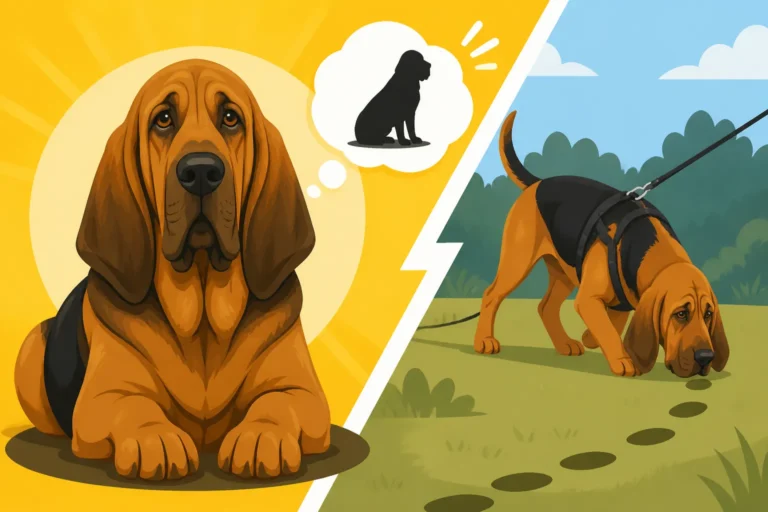
One of the most common worries I hear from new Bloodhound owners, and even experienced handlers, is about the weather. Specifically, they wonder how elements like wind affect their dog's incredible nose. It's a valid concern, because if you've ever seen a Bloodhound at work, you know their focus is absolute, but wind feels like it could just blow all that hard-won scent away. This guide is going to deep dive into the fascinating, complex relationship between wind and a Bloodhound's ability to follow a scent trail, dispelling myths and offering practical advice for working with, rather than against, nature's invisible currents.
The Invisible Dance: How Wind Interacts with Scent Particles
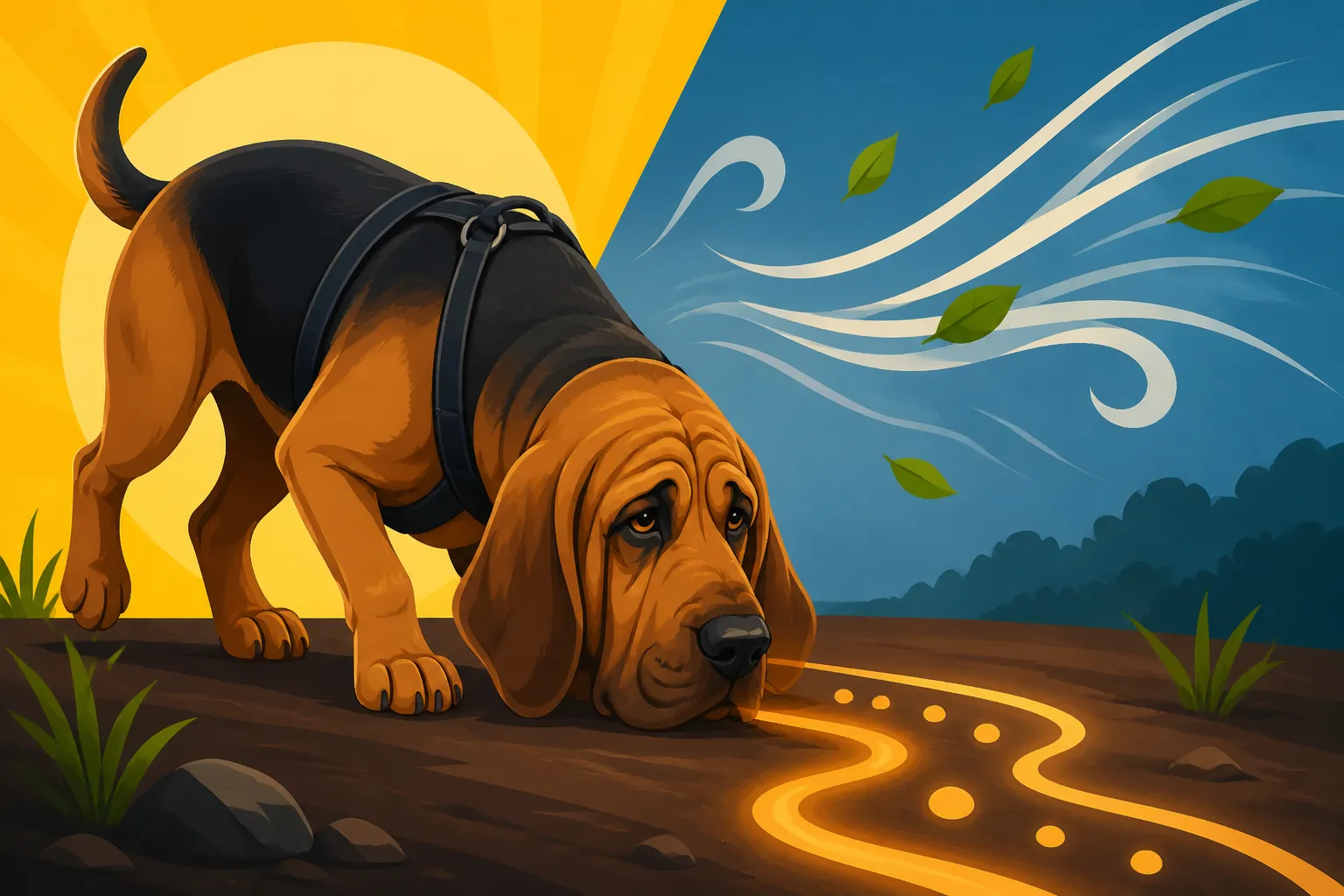
It’s easy to imagine a scent trail as a solid, visible line, like chalk drawn on the ground, especially when you think about how unerringly a Bloodhound can follow it. But the reality is far more ephemeral, a dynamic and ever-changing "scent picture" made up of microscopic skin rafts, oils, sweat, and breath particles shed by the person. When you introduce wind to this picture, it's like adding a powerful, invisible brush that constantly swirls and shifts those particles. The wind doesn't erase the scent; rather, it moves it, spreads it, and dilutes it. Understanding this basic principle is crucial to appreciating the Bloodhound's genius.
Understanding the Scent Cone and Plume
Imagine a person walking, leaving a trail of scent particles behind them. In still air, these particles might settle relatively close to the ground, forming a somewhat concentrated "scent cone" that slowly dissipates over time. But add wind, and this cone transforms into a "scent plume" – a cloud of scent that is picked up and carried by the air currents. Think of it like smoke from a chimney; it doesn't just hang there, it billows and drifts, sometimes creating a long, narrow ribbon, other times a broad, dispersed cloud.
The shape and direction of this plume are entirely dependent on the wind. A steady breeze will carry the scent particles downwind, often creating a trail adjacent to the actual ground path the person took. This is where things get tricky for the human handler, but it's where the Bloodhound truly shines. They aren't necessarily following the exact footsteps; they are following the odor plume that originated from those footsteps, which can be several yards off to one side. This understanding is fundamental to appreciating What a Bloodhound Is Actually Smelling on a Trail.
How Air Currents Disperse and Dilute Odor
Wind is a double-edged sword for scent work. On one hand, it can carry scent particles further, potentially spreading the "detectable" area for the Bloodhound. On the other hand, it can also dilute the concentration of these particles. Imagine a single drop of dye in a still glass of water versus a drop in a fast-flowing river. The river carries the dye far, but it quickly disperses and becomes less concentrated.
Similarly, a strong, gusty wind can tear scent particles from the ground or vegetation, lift them high, and scatter them over a wide area, reducing their concentration near the original path. This dilution means the Bloodhound has to work harder to pick up enough particles to maintain a continuous trail. It's not that the scent is gone, but it's spread thin, making it a more challenging puzzle for even the most gifted nose. This is particularly relevant when considering Whether Rain Destroys a Bloodhound's Trail, as moisture and wind combined create a very different scent environment.
The Ground Scent vs. Air Scent Debate
In the world of scent detection, there's often talk about "ground scenters" and "air scenters." While Bloodhounds are primarily known as ground scenters, meaning they work with their noses close to the ground, diligently following the physical trail, the reality in windy conditions blurs this line significantly. When the wind is active, much of the human odor is lifted from the ground and becomes airborne.
A Bloodhound's ability to work a trail effectively is its remarkable capacity to utilize both ground and air scent, often switching between the two seamlessly depending on the conditions. Their long, pendulous ears are thought to play a role here, sweeping scent particles up towards their nose, especially when working a ground trail. You can learn more about this incredible adaptation in Why a Bloodhound's Ears Sweep Scent Toward Its Nose. In windy situations, they might lift their heads more, "air scenting" to pick up the broader plume, then drop back to the ground when the scent becomes more concentrated or when they're trying to pinpoint the exact direction. It's a dynamic ballet of olfactory processing that constantly adjusts to environmental inputs.
A Bloodhound's Superpower: Adapting to Wind-Shifted Scent
The notion that wind somehow "ruins" a trail for a Bloodhound couldn't be further from the truth. While it certainly adds a layer of complexity, a well-trained Bloodhound views wind not as an impediment, but as another piece of information to be factored into the scent puzzle. Their noses are literally built for this kind of work, capable of distinguishing incredibly faint odors and processing a kaleidoscope of scent information.
Reading the Air: Why a Bloodhound Works Upwind or Downwind
A Bloodhound handler quickly learns that their dog isn't always going to follow the most direct line, especially on a windy day. If the wind is blowing consistently from the west, carrying the target's scent to the east, the Bloodhound might initially run east of the actual path to get into the heart of that scent plume. This is called working the "scent cone" or "scent funnel." They are essentially finding the edges of the dispersed scent and then using their incredible ability to discern stronger concentrations to move towards the source.
They might work a zigzag pattern, or loop widely, especially at turns or when the scent becomes faint. This isn't your Bloodhound being stubborn or lost; it's them actively working the wind, trying to find the strongest possible concentration of the target scent. Sometimes they'll work upwind, allowing the scent to hit them directly; other times, they might work downwind, chasing the expanding plume. It all depends on the specific conditions, the age of the trail, and the density of the scent. Understanding this helps you, the handler, trust your dog when it seems to deviate from where you think the trail should be.
The Bloodhound's Nasal Anatomy in Windy Conditions
The Bloodhound's legendary nose isn't just about the sheer number of scent receptors, which is impressive enough. It's also about the intricate structure of their nasal passages and their physical characteristics. Their long, pendulous ears, as we discussed, act like scent scoops. Their loose skin, particularly around their faces and dewlaps, also plays a role, creating folds that can trap scent particles.
In windy conditions, these features become even more vital. The large surface area of their floppy ears, when lowered, might help create a micro-environment of calmer air near the ground, allowing more subtle ground scent to be detected even as stronger air currents blow overhead. Their deep, moist nostrils are perfectly adapted to sample vast quantities of air, and their ability to sniff in continuously (as opposed to sniffing in, then exhaling fully like humans) means they are constantly processing new scent information, making them remarkably efficient at tracking even dispersed, wind-blown plumes. This detailed sensory input allows them to understand How a Bloodhound Separates One Person's Scent From a Crowd, even with wind trying to mix everything up.
When Wind Creates a "Ghost" Trail
One of the more challenging aspects of wind for a handler is when it creates what some call a "ghost" or "phantom" trail. This happens when scent particles are lifted, carried by the wind, and then deposited somewhere else, completely separate from the actual physical path of the person. Imagine a strong gust picking up scent from a person walking near a fence, carrying it over the fence, and dropping it on the other side. A less experienced dog might become confused.
However, a skilled Bloodhound, through training and natural inclination, is generally able to differentiate this. They learn that while scent might land in a new spot, the concentration of the true "trail" will always be strongest nearer to the original source and will follow a logical progression. This is where their incredible memory and ability to reconstruct the scent picture over time really come into play. It's a testament to their intelligence and natural working drive that they can solve these complex environmental puzzles.
Practical Strategies for Trailing in Windy Weather
Working your Bloodhound on a windy day can be exhilarating, but it also requires a shift in your mindset and handling techniques. You can't fight the wind, but you can certainly learn to work with it. Preparation and specific training can make all the difference, transforming a potentially frustrating experience into a successful one.
Training Your Bloodhound for Variable Wind Conditions
Starting early and exposing your Bloodhound puppy to a variety of environmental conditions, including wind, is key. Don't always train on calm days! Purposefully set trails on windy days, in open fields where the wind has a clear path, or even in urban areas where buildings can create swirling gusts. This helps your dog build experience and confidence in interpreting the complex scent information the wind provides.
You might notice your Bloodhound's head position changing, or their pace altering. Encourage them to trust their nose. Reward persistence, especially when they are working wide of the visible path to pick up a wind-blown scent. A great foundation in basic scent work, perhaps through an online program like those offered by BAXTER & Bella, can give your pup the confidence to tackle these more complex scenarios when they're older. The goal is to build a dog that can problem-solve, not just blindly follow. Consider topics like How Long a Bloodhound Takes to Learn Something New and integrate variable conditions into your training early.
Adjusting Your Handling Techniques
As the handler, your role becomes even more critical in windy conditions. Here are a few adjustments you might need to make:
- Trust Your Dog's Nose, Not Your Eyes: This is paramount. If your Bloodhound is pulling away from where you think the trail should be, especially downwind, let them work. They are likely following the scent plume.
- Maintain a Loose Line: Your Bloodhound needs freedom to move and follow the scent, which might mean wide arcs or zigzags. A tight leash will only frustrate them and prevent them from working effectively. Ensure you have a long line appropriate for scent work. How Long a Line a Bloodhound Handler Buys is an important consideration here.
- Observe Your Dog's Body Language: Learn to read the subtle cues your Bloodhound gives. A sudden head lift, a pause, or a change in tail carriage might indicate they've hit a strong scent cone, or are re-evaluating due to a wind shift.
- Be Patient: Wind can slow down the trailing process. Scent is more dispersed, and your dog has to work harder. Don't rush them.
- Consider the Terrain: Open fields will have different wind patterns than wooded areas or urban canyons. Anticipate how the wind will interact with obstacles and adjust your expectations accordingly.
Essential Gear for Windy Trailing
Having the right gear isn't just for your Bloodhound's comfort; it's for effective trailing.
- Proper Harness: A well-fitting tracking harness is essential. It distributes pressure evenly across your dog's chest, allowing them to pull comfortably without restricting their breathing or movement. You can find excellent options on platforms like Amazon. Check out Which Harness a Bloodhound Trails In for more details.
- Long Line: A 15 to 30-foot long line (or even longer, depending on your environment) gives your Bloodhound the freedom to work the scent plume without you constantly being right on top of them. Again, Amazon is a good resource for these.
- Weather-Appropriate Clothing: For you, the handler! You'll be standing and walking slowly, potentially in exposed areas. Layers, waterproofs, and good gloves are your friends.
- Hydration: Both for you and your dog. Wind can be dehydrating, even on cooler days, especially if you're out for How Long a Bloodhound Can Work Before It Tires.
| Wind Condition | Scent Behavior | Bloodhound Strategy | Handler Focus |
|---|---|---|---|
| Still Air | Scent particles settle closer to the ground, forming a concentrated "cone." | Stays low, follows ground scent closely. May work a very tight, direct line. | Observe for nose-to-ground work; trust the dog's direct path. |
| Light Breeze | Scent plume drifts downwind, slightly away from the direct path, but remains relatively concentrated. | Works wider of the physical path, often slightly downwind, utilizing the air currents. | Allow wider arcs and deviations; be ready for dog to work off the "visible" trail. |
| Gusty Wind | Scent is picked up, dispersed, and diluted rapidly; may create "ghost" trails. Highly variable. | Frequent head lifts (air scenting), wider sweeps, and potential backtracking to re-acquire. | Patience is key; watch body language for confusion or re-acquisition; allow more time. |
| Consistent Wind | Scent is carried far downwind, creating a distinct, elongated plume. | Often works parallel to the physical path, 5-20 feet (or more) downwind of it. | Maintain a loose long line; trust the dog to work parallel or wide. |
| Swirling Wind | Scent becomes unpredictable, creating eddy currents and localized concentrations. Often in urban canyons. | Erratic patterns, frequent re-checking, may appear to lose and regain scent quickly. | Stay calm; give maximum leash freedom; be aware of how structures affect wind flow. |
Common Misconceptions About Wind and Bloodhound Work
It's natural to have preconceived notions about how wind affects scent, especially when we, as humans, can barely smell anything our dogs are working so intently on. However, some of these ideas can actually hinder your effectiveness as a handler. Let's clear up a couple of common misunderstandings.
Wind Doesn't Erase, It Redistributes
The biggest misconception is that strong wind simply blows away the scent, effectively erasing the trail. While it's true that wind disperses and dilutes scent, it almost never completely removes it, especially from a fresh trail. Think about it: a person is constantly shedding microscopic particles. Even if the top layer of scent is swept away, there are often still particles lodged in the ground, vegetation, or even in the very air currents that are creating the challenge.
Instead of thinking of wind as an eraser, visualize it as a massive, invisible fan that reorganizes the scent. The Bloodhound's job isn't to find the original, undisturbed trail (which might not exist on a windy day), but to interpret this reorganized scent information. They are experts at finding the faint whispers of scent, even if they're stretched thin across a wide area. This ability is why How Old a Trail a Bloodhound Can Follow is so impressive, even in less-than-ideal conditions.
Why a Bloodhound Doesn't Always Follow the Straightest Line
Sometimes, especially on trails with a clear visual path, handlers get frustrated when their Bloodhound veers off course, seemingly ignoring the obvious route. On a windy day, this behavior is almost always your Bloodhound intelligently working the scent plume. If the wind is carrying the scent several feet to the left of the person's actual footsteps, the Bloodhound, being the efficient scent-detecting machine it is, will go where the scent is strongest and easiest to follow.
This means their path might look meandering, wide, or even illogical to your human eyes. But to their nose, it's the most direct and efficient way to process the available scent. A good handler learns to shed the expectation of a straight line and instead trusts their Bloodhound's expertise in navigating the complex world of wind-blown odor. Encouraging your Bloodhound to trust its instincts and rewarding them for their problem-solving when they find the target, regardless of the path taken, will build a stronger, more confident trailing team.
Disclaimer
This article is for general informational purposes only and does not constitute professional advice. Laws, prices and regulations vary by location and change over time. Consult a qualified professional for guidance on your specific situation.