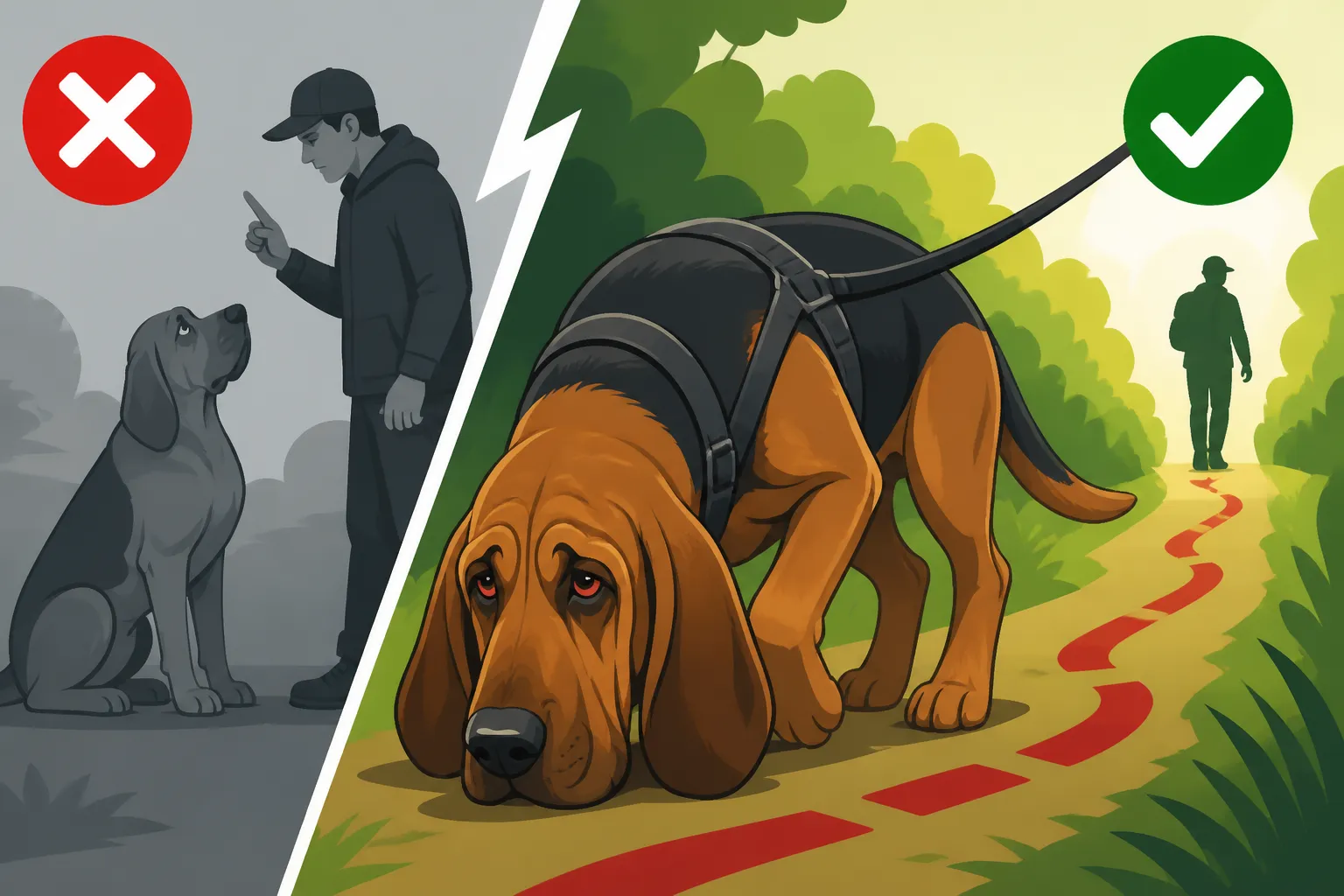
Mantrailing Is the Answer to a Bloodhound, Not Obedience
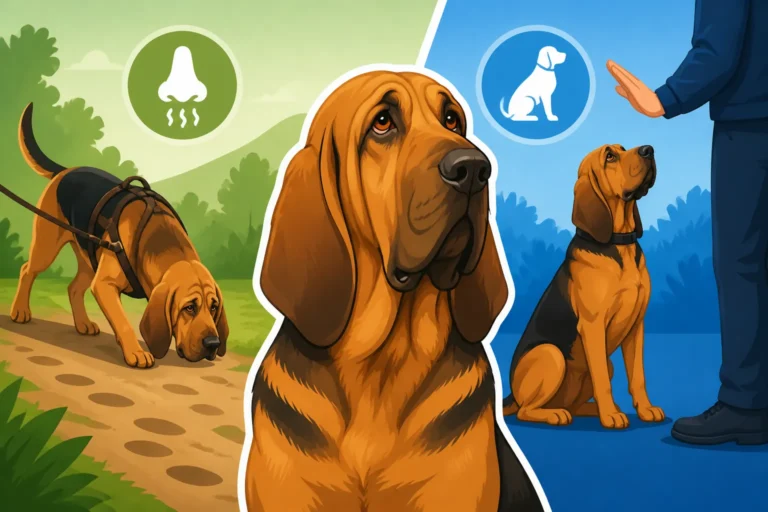
Many Bloodhound owners quickly discover that trying to fit their deeply scent-driven companion into a traditional obedience mold can feel like trying to teach a fish to climb a tree. It's not that your Bloodhound can't learn to sit or stay; it's that their entire being is wired for something far more complex and rewarding, and when you try to suppress that, both you and your dog end up feeling frustrated. This guide is here to tell you that there's a different, more natural path to a harmonious relationship with your Bloodhound: mantrailing.
Understanding the Bloodhound's Innate Drive: Why Obedience Can Feel Like a Mismatch
Let's be honest, trying to get a Bloodhound to perform rote obedience drills on cue, especially when there's even a whisper of an interesting smell nearby, can be infuriating. You might find yourself repeating commands, feeling like your dog is deliberately ignoring you, or worse, just not "getting it." But the truth is, it's not about them being unintelligent or defiant; it's about a profound difference in priorities. Their brain is simply hardwired to engage with the world through its nose, and that overrides almost everything else.
The Unyielding Power of Their Nose
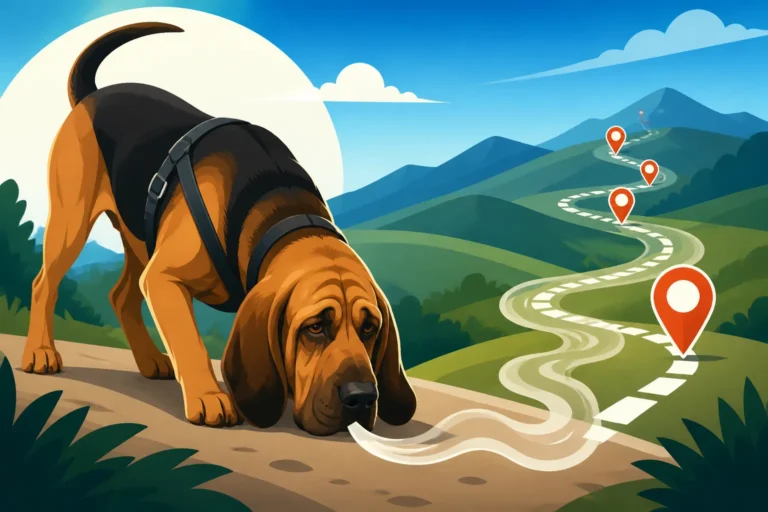
Imagine having a superpower so strong it shapes your entire perception of reality. For a Bloodhound, that superpower is their nose. They possess an astounding number of scent receptors – estimated to be hundreds of millions more than humans. This isn't just a slightly better sense of smell; it's an entirely different sensory experience. Where we might smell a freshly baked pie, a Bloodhound smells every individual ingredient, the heat of the oven, the person who baked it, and the path they took from the kitchen. This olfactory world is vibrant, detailed, and utterly captivating to them.
Their nose is not just for smelling; it's for working. Every wrinkle on their face, every long, pendulous ear, even the folds of skin on their neck are designed to enhance their ability to trap and concentrate scent molecules. Their low-slung head keeps their nose close to the ground, where residual scent particles linger. When a Bloodhound drops its head to a trail, it’s not just sniffing; it's processing an immense amount of data, building a picture of who was there, when, and where they went. To expect them to abruptly disengage from this rich sensory tapestry for a verbal command that, to them, seems utterly trivial in comparison, is simply asking them to defy their very nature. It’s why a sharp "come!" can fall on deaf ears when they've picked up the faintest hint of a squirrel that passed by hours ago.
"Stubborn" or Simply Scent-Driven?
The label "stubborn" gets thrown around a lot when describing Bloodhounds, and it’s a narrative that does this incredible breed a disservice. What we often perceive as stubbornness is, in reality, intense focus and an independent spirit, both traits that were deliberately bred into them for their historical role. Unlike many retriever or herding breeds that thrive on constant human interaction and live to please their handlers, Bloodhounds were developed to follow a scent trail independently, often for long distances, without needing constant direction. Their job was to stick to the scent, regardless of distractions or the handler's desire for them to do something else.
This means their default mode isn't necessarily "what does my human want?" but rather "what does this scent tell me?" They are problem-solvers, driven by the puzzle of the trail, and that drive can make them seem aloof or unwilling to comply. It's not personal; it's simply their genetic blueprint at work. They aren't trying to be difficult; they are being exactly who they were born to be. If you've ever felt like your Bloodhound has a mind of its own, you're not wrong – they do, and it's a magnificent mind geared towards scent.
The Limitations of Traditional Obedience
When we talk about "traditional obedience," we often picture a dog sitting on command, heeling perfectly on a loose leash, or coming instantly when called. While these behaviors have their place in any dog's life for safety and polite living, relying solely on them for a Bloodhound's mental and physical fulfillment can be a recipe for disaster. For many breeds, these drills offer structure and engagement, but for a Bloodhound, they often fall flat.
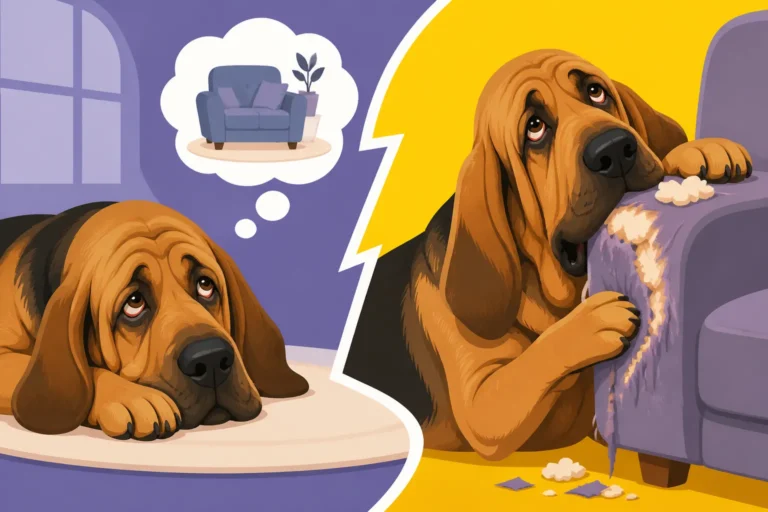
Imagine being asked to do arithmetic problems all day when you're a world-renowned astrophysicist. It might be easy, but it's not challenging or satisfying. Similarly, repeated "sits" and "stays" can quickly become boring for a Bloodhound whose brain craves complex olfactory challenges. They might comply for a moment, especially for a high-value treat, but the intrinsic motivation just isn't there for long. This lack of deep engagement can lead to a dog that's physically tired from walks but mentally frustrated, potentially manifesting in destructive behaviors at home, excessive baying, or general restlessness. It's not that obedience is bad; it's just insufficient for the unique needs of this remarkable breed.
What Exactly Is Mantrailing and Why Is It Perfect for a Bloodhound?
If traditional obedience feels like a forced fit, then mantrailing is like finding the missing piece of the puzzle for your Bloodhound. It's not just a sport or a hobby; it's a profound way to connect with your dog, tap into their deepest instincts, and provide the mental and physical stimulation they crave. It's allowing them to be a Bloodhound, pure and simple.
Defining the Art of Trailing
Mantrailing, sometimes referred to as human scent trailing or simply "trailing," is the specialized discipline of training a dog to follow the unique scent signature of a specific person. Unlike "tracking," where a dog follows disturbed vegetation or ground scent, or "air-scenting," where a dog casts to find any human scent in the air, mantrailing focuses intently on the individual human odor. It's about finding one needle in a haystack of smells.
The process usually begins with a "scent article" – an item handled by the missing person that contains their unique scent. The Bloodhound is presented with this article and then follows the trail that person left behind, often across varied terrain, through crowds, and even over obstacles. The goal isn't just to find a person, but the person whose scent was provided. This requires an incredible level of discrimination and focus, precisely what the Bloodhound's nose is built for. What a Bloodhound Is Actually Smelling on a Trail delves deeper into the complexity of their olfactory process. It's an active, engaging partnership between dog and handler, where the dog leads the way, and the handler learns to interpret their subtle signals.
Tapping into the Bloodhound's Superpower
The Bloodhound's entire physiology is a testament to its trailing prowess. Their long, drooping ears act like scent gatherers, sweeping odors toward their massive noses as they move. Their loose skin, particularly on their face and neck, creates additional surface area to trap scent particles, essentially making them a walking, sniffing sponge for airborne molecules. This is why you'll often see them with their heads low, their jowls nearly dragging the ground – they are literally creating a micro-environment to optimize scent detection. Why a Bloodhound's Ears Sweep Scent Toward Its Nose explains this fascinating adaptation in more detail.
Mantrailing provides a legitimate, constructive outlet for this unparalleled gift. When a Bloodhound is on a trail, they are in their element. Their focus is absolute, their drive unwavering. This isn't just about sniffing; it's about solving a complex environmental puzzle using their most powerful sense. The joy and satisfaction they derive from successfully completing a trail and finding their "missing person" (the runner) is palpable. It's a deep, innate fulfillment that few other activities can provide for them, reinforcing their purpose and allowing them to truly shine.
Mental and Physical Fulfillment
One of the greatest benefits of mantrailing is its ability to thoroughly exhaust a Bloodhound, both mentally and physically. A long walk around the neighborhood might tire their legs, but it rarely engages their incredible minds. Mantrailing, however, demands intense concentration, problem-solving, and sustained effort. Following a complex scent trail requires continuous analysis, discrimination against competing odors, and memory of the scent picture. This mental workout is often far more tiring than hours of physical exercise alone.
A Bloodhound that has spent an hour or two engaged in dedicated trailing will typically return home a much calmer, more contented dog. The mental stimulation helps to prevent boredom, which is a common trigger for destructive behaviors, excessive barking, or anxiety in undersimulated dogs. Furthermore, successfully completing trails builds immense confidence, especially in more timid or insecure Bloodhounds. They learn to trust their nose, and that confidence often spills over into other aspects of their life. It's a holistic approach that nurtures their natural abilities and promotes overall well-being.
Getting Started: The First Steps into the World of Scent Work
So, you're ready to ditch the endless "sit-stays" and embrace your Bloodhound's inner detective? Fantastic! Getting started with mantrailing doesn't require complex equipment or specialized training academies right off the bat, but there are a few essentials to ensure both you and your dog have a safe and positive experience.
Essential Gear for Your Trailing Journey
Before you hit the "trail," you'll need a few key pieces of equipment. The right gear not only ensures your Bloodhound's comfort and safety but also helps you communicate that it's "work time."
- Harness: This is non-negotiable. Your Bloodhound should always work in a well-fitting harness, never a collar. A harness distributes pressure evenly across their chest and shoulders, preventing strain on their neck and throat, especially important for a large, powerful dog that pulls with purpose. A Y-front or H-back harness is ideal, allowing full range of motion. Avoid harnesses that restrict shoulder movement or put pressure directly on the throat. You can find excellent options on platforms like Amazon, but always prioritize fit over brand.
- Long Line: This is your lifeline and connection to your trailing Bloodhound. A standard leash simply won't cut it. You'll need a long line, typically 15 to 30 feet in length, made of durable material like Biothane or nylon webbing. This allows your Bloodhound to range ahead and follow the scent without you constantly breathing down their neck, while still keeping them safely connected to you. It's crucial for safety, especially in urban environments or near roads.
- Scent Article: This is the piece of magic that tells your Bloodhound exactly who they're looking for. A good scent article is something that the "missing person" (also called the "runner" or "quarry") has handled recently and exclusively. A worn t-shirt, a sock, a glove, or even a car key can work. Store it in a clean, airtight bag or container to preserve the scent until you're ready to start the trail.
- High-Value Treats/Rewards: While the act of trailing itself is incredibly rewarding for a Bloodhound, a jackpot reward at the end helps solidify the "find" and keeps their motivation sky-high. Think soft, stinky treats like cheese, hot dogs, or cooked chicken. Some Bloodhounds also love a favorite squeaky toy or a vigorous game of tug as their reward. Experiment to find what truly motivates your individual dog.
Introducing the Puppy or New Bloodhound to Scent
Starting your Bloodhound puppy or a newly adopted adult on scent work should be all about fun, positive reinforcement, and building confidence. There's no pressure to be perfect; the goal is to make it the most exciting game ever.
Begin with very short, simple "runaway" trails in a low-distraction environment like your backyard. Have a helper (the "runner") engage with your dog briefly, perhaps by playing a quick game or giving them a treat, then show them the scent article and have them walk just 20-30 feet away, out of sight, and hide. Give your Bloodhound the scent article, enthusiastic praise, and then let them follow their nose to the hidden runner. When they find the person, it's party time! Lots of praise, treats, and maybe a quick game with the runner. Keep these initial trails short, successful, and incredibly positive. How to Introduce a Bloodhound Puppy to a Scent Article provides excellent guidance on these crucial first steps. The idea is to build a strong association: harness and scent article mean an amazing game where you get to use your nose and find a human, followed by huge rewards!
Finding a Mentor or Class
While you can certainly start with basic scent games at home, finding experienced guidance is invaluable for progressing safely and effectively in mantrailing. A good instructor will teach you how to read your Bloodhound's subtle body language on the trail, how to lay trails that build skills progressively, and how to troubleshoot common challenges. They can also ensure you're practicing safely, especially when moving to more complex environments.
Look for local mantrailing clubs, K9 search and rescue groups that offer public training, or certified professional trainers specializing in scent work. These groups often have a wealth of knowledge and provide a supportive community. While not specifically focused on mantrailing, resources like BAXTER & Bella offer excellent foundational positive reinforcement training principles that can absolutely enhance your communication and partnership with your Bloodhound, setting a strong groundwork for any specialized activity. Remember, the right instruction can prevent frustration for both you and your dog, making the learning process smoother and more enjoyable. The First Year With a Bloodhound That Already Wants to Trail highlights the importance of early, correct guidance.
Beyond the Basics: Developing Your Bloodhound's Trailing Skills
Once your Bloodhound has grasped the fundamental concept of following a specific human scent, the real adventure begins! Developing their skills involves gradually increasing complexity, exposing them to diverse environments, and, most importantly, learning to trust their incredible nose.
Increasing Difficulty and Distance
Progressing in mantrailing is all about taking small, incremental steps to challenge your Bloodhound without overwhelming them. After mastering short, straight trails in familiar areas, you can start introducing more variables:
- Turns: Instead of straight lines, have your runner make turns. Start with gentle 90-degree turns and gradually move to sharper angles, even U-turns. Your Bloodhound will learn to adjust their path as the scent signature changes direction.
- Longer Distances: Slowly increase the length of the trail. What started as 20 feet can become 50 feet, then 100 feet, and so on. This builds endurance and sustained focus.
- Older Trails: The real challenge! Introduce "aged" trails, where the runner has left the scent article and then walked away a certain amount of time before your Bloodhound starts. Begin with just 5-10 minutes, then increase to 30 minutes, an hour, or even several hours. How Old a Trail a Bloodhound Can Follow can provide more insights here. This teaches your dog to work with fainter scent concentrations.
- Varying Environments: This is crucial. Start moving beyond your quiet backyard. Introduce trails in parks, on sidewalks, near busy streets, through light woods, or even inside buildings. Each environment presents unique challenges with different surfaces and ambient odors. A Bloodhound needs to learn that scent exists everywhere, not just on grass.
Understanding Environmental Factors
Scent doesn't behave the same way in all conditions, and learning about environmental factors is a key part of becoming a good handler. Things like wind, temperature, humidity, and terrain all affect how scent disperses and lingers.
- Wind: Wind can scatter scent particles or push them in unexpected directions. Training on windy days teaches your Bloodhound to work cross-wind or downwind, searching for the "cone" of scent. Whether Wind Moves the Scent a Bloodhound Follows explores this in depth.
- Temperature: Heat causes scent to rise and dissipate faster, while cooler temperatures can help scent settle and last longer. Training in various temperatures helps your dog understand these dynamics.
- Humidity: Higher humidity can hold scent particles closer to the ground, making them easier to detect, whereas dry air can make trails more challenging.
- Terrain and Surfaces: Scent behaves differently on grass, concrete, asphalt, dirt, or even through water. Concrete, for example, can absorb and then "off-gas" scent as it warms, creating a different trailing experience. Whether Rain Destroys a Bloodhound's Trail also discusses how precipitation affects scent. Regularly exposing your Bloodhound to different surfaces builds their versatility and confidence.
Reading Your Bloodhound on a Trail
This is arguably the most fascinating and rewarding part of mantrailing: learning to "read" your dog. Your Bloodhound communicates constantly through their body language, and understanding these subtle cues is essential for effective handling.
Look for:
- Head Position: Is their nose firmly on the ground, or are they lifting their head to air-scent? A low head typically indicates they are actively working a ground scent.
- Tail Action: A steady, slow tail wag might indicate confidence on the trail. A frantic or tucked tail could signal confusion or uncertainty.
- Pace Changes: They might speed up when on a hot scent, or slow down, casting side to side, when scent is weak or lost.
- Momentary "Lost" Behaviors: When a Bloodhound temporarily loses the trail, they might stop, lift their head, cast in circles, or even look back at you for guidance. This is normal! Give them time and space to work it out. Trust their nose to re-acquire the scent. What a Bloodhound Does When It Loses the Trail offers valuable insights into these moments. Your job as a handler is to observe, support, and only intervene if truly necessary, building a deep, non-verbal communication based on trust. What a Bloodhound Does at the End of a Trail describes the triumphant moment when they succeed.
The Unique Bond: How Mantrailing Transforms Your Relationship
Many dog owners want a deep connection with their companion, but often struggle to find an activity that truly resonates with their dog's intrinsic nature. For Bloodhound owners, mantrailing offers a unique pathway to forge an unparalleled bond, shifting the dynamic from handler-as-commander to handler-as-partner.
Building Trust and Partnership
In traditional obedience, the handler is usually the one giving directions, and the dog is expected to comply. Mantrailing flips this script. Here, the Bloodhound is the expert. They possess the sensory information; they know where the scent leads. As a handler, your role becomes one of support, observation, and facilitation. You provide the opportunity, manage the line, navigate obstacles, and trust your dog's nose, even when every fiber of your being wants to second-guess them.
This dynamic builds incredible mutual trust. Your Bloodhound learns that you will listen to them, that you will provide the space and freedom for them to do their job, and that you will celebrate their successes. You, in turn, learn to believe in their extraordinary abilities, seeing past the "stubborn" label to the true genius within. This shared experience creates a deeper understanding and appreciation for each other, transforming your relationship into a true partnership.
The Joy of Shared Success
There's a special kind of exhilaration that comes from a successful trail. The moment your Bloodhound reaches the "runner," often with a triumphant bay or an enthusiastic tail wag, and you see the pure joy on their face – it's an unmatched feeling. This isn't just your success as a trainer; it's their success as a working dog, and your shared accomplishment as a team.
The celebration at the "find" is crucial. It’s a moment of pure, unadulterated positive reinforcement for the Bloodhound. This celebration isn't just about the treats or the praise; it's about the confirmation that they used their incredible gifts to complete a task, fulfilling a deep-seated instinct. For the handler, it's the reward of witnessing their dog thrive, seeing them completely engaged and happy in their most natural state. This mutual satisfaction strengthens the emotional bond, creating powerful positive memories that cement your partnership.
Problem-Solving Together
Mantrailing is rarely a straight line. Trails can be complex, crossing roads, navigating busy areas, or winding through dense vegetation. There will be moments where the scent is faint, conditions are challenging, or distractions are high. These are the moments where you and your Bloodhound truly become a team.
As your Bloodhound works through a difficult section, you're not just passively holding the line. You're observing, anticipating, and subtly supporting. You might adjust your pace, manage the line to give them more slack, or quietly encourage them without interfering with their thought process. You learn to read their slight pauses, their changes in gait, the way they lift their head to catch a cross-breeze. This shared act of problem-solving, overcoming challenges together, deepens your understanding of each other’s capabilities and limitations. It's a dance of instinct and intuition, a silent conversation between two beings working towards a common goal, building communication that transcends verbal cues.
Addressing Common Misconceptions and Challenges
It's natural to have questions or concerns when considering a new activity, especially one as specialized as mantrailing. Let's tackle some common misconceptions and challenges head-on, ensuring you feel confident in this journey with your Bloodhound.
"My Bloodhound is too old/unruly to start!"
This is a very common thought, and it’s completely understandable. You might have an older Bloodhound who's settled into certain habits, or a younger one whose exuberance makes traditional training a nightmare. But here's the wonderful truth: any Bloodhound, regardless of age or previous training history, can benefit from mantrailing.
For older Bloodhounds, scent work is fantastic because it's low-impact physically but incredibly stimulating mentally. While they might not be chasing runners for miles, they can still enjoy shorter, more deliberate trails, using their seasoned noses to solve puzzles. It keeps their minds sharp and provides a sense of purpose. For the "unruly" or highly energetic young Bloodhound, mantrailing is a fantastic outlet for that boundless energy and focus. Instead of trying to suppress their natural drive, you're channeling it constructively. That intense focus on scent can help them learn self-control and patience in a way that rote obedience often fails to. Whether an Older Bloodhound Can Still Learn to Trail affirms that age is truly just a number when it comes to a Bloodhound's nose. The key is to adapt the trails to their individual capabilities and ensure it remains a positive, confidence-building experience.
The Role of Basic Obedience in a Trailing Dog's Life
It's important to clarify: mantrailing isn't about replacing all basic obedience. It's about prioritizing the type of engagement that truly fulfills your Bloodhound. Basic manners and safety cues are still essential for daily life. A reliable "come" (even if it's only reliable in a low-distraction environment), a polite "sit," and loose-leash walking skills are important for trips to the vet, walks in the park, and general household harmony.
However, the pressure to achieve perfect, competition-level obedience with a Bloodhound can be counterproductive and frustrating. Instead, view these basic obedience skills as tools that support your mantrailing activities and ensure your dog is a polite member of society. For example, a "wait" command can be useful before starting a trail, and a calm demeanor is always a plus. Mantrailing becomes the primary outlet for their intellectual and physical energy, and often, a well-stimulated Bloodhound who is regularly working their nose becomes calmer and more receptive to general household rules anyway. Whether a Bloodhound Can Trail and Do Obedience suggests a balanced approach is possible and beneficial.
Managing the "Bay" and Other Bloodhound Quirks
Ah, the Bloodhound bay! It’s legendary, distinctive, and often, quite loud. Many owners worry about this characteristic vocalization, especially if they have close neighbors. Why a Bloodhound Bays explains that this deep, resonant sound is a natural part of their communication and their working style – it’s not something you can, or should, train out of them entirely.
The good news is that by channeling your Bloodhound's energy into mantrailing, you might find that indiscriminate baying or nuisance barking decreases. A dog that is regularly fulfilled by intense scent work is less likely to be bored, anxious, or have pent-up energy that manifests as excessive vocalization. When they do bay on a trail, it's often a signal of excitement or a clear indication that they are on a hot scent, which is precisely what you want! Other Bloodhound "quirks," like drooling, shedding, or dragging their ears through their food bowl, are simply part of the package. Embrace them! A good snood, like those found easily on Amazon, and plenty of towels will become your best friends. These aren't problems to be fixed, but characteristics to be managed and loved as part of owning this unique breed.
Is Mantrailing Right for Every Bloodhound Owner?
Mantrailing offers an incredible path to understanding and fulfilling your Bloodhound, but it's important to consider if it aligns with your lifestyle and expectations. It's a commitment, but one that many owners find profoundly rewarding.
Time Commitment and Dedication
Mantrailing isn't a "set it and forget it" activity. To truly see your Bloodhound thrive and progress, it requires a consistent time commitment. Ideally, you'd want to dedicate at least one or two sessions a week to formal trailing, plus shorter fun scent games at home. Each trailing session can last anywhere from 30 minutes to a few hours, depending on the trail's length and complexity, plus travel time to different training locations.
This means finding time in your schedule, potentially connecting with a training group, and being prepared to train in various weather conditions. It's a hobby, not a quick fix, and like any hobby, the more you put into it, the more you and your Bloodhound will get out of it. For many Bloodhound owners, this dedication quickly becomes a joyful routine, a highlight of their week. The rewards of a truly engaged and happy Bloodhound far outweigh the effort involved.
Understanding the "Working Dog" Mindset
If you're considering a Bloodhound, it's crucial to understand that you are bringing a working dog into your home. This isn't a breed designed for purely ornamental companionship. They were bred for a specific, demanding job, and they possess an inherent drive to do that job. Trying to turn a Bloodhound into a couch potato without any outlet for their scenting abilities is like trying to keep a Border Collie happy without anything to herd – it simply won't work in the long term.
Embracing the "working dog" mindset means understanding that their nose isn't just a cute feature; it's their life's purpose. It means being willing to provide opportunities for them to use that nose in a constructive way. Mantrailing provides that perfect avenue, allowing them to engage their powerful instincts, solve complex problems, and experience the deep satisfaction of a job well done. It's about respecting their heritage and providing them with a life that truly fulfills them.
The Uniqueness of the Bloodhound Partnership
Owning a Bloodhound is a unique experience. They are not like many other breeds who are always looking to their handler for direction. Instead, they require a handler who is patient, observant, and willing to trust their dog's incredible abilities. It's a partnership where you often take a backseat, guiding and supporting, rather than commanding every move.
This breed thrives when given the opportunity to lead with their nose. If you're someone who enjoys watching your dog work, who appreciates intelligence and independence, and who is fascinated by the hidden world of scent, then mantrailing with a Bloodhound will likely be an incredibly rewarding journey. It might not be for everyone, particularly those who prefer a dog that adheres strictly to human-centric commands above all else. But for those who embrace the Bloodhound's true nature, mantrailing is the key to unlocking a profound and beautiful connection with these magnificent, scent-driven companions.
| Feature | Traditional Obedience for a Bloodhound | Mantrailing for a Bloodhound |
|---|---|---|
| Primary Focus | Human commands, precise execution, handler control. | Dog's nose, following a specific scent, dog-led problem-solving. |
| Dog's Motivation | Treats, praise, avoiding correction; often seen as a chore. | Innate drive to use their nose, intrinsic reward of finding the "quarry," deep fulfillment. |
| Mental Engagement | Can be limited for a Bloodhound; often feels repetitive and unchallenging. | High; requires continuous analysis, discrimination, memory, and sustained focus. |
| Physical Effort | Walks, drills; may not fully exhaust the breed's energy. | Significant; requires sustained movement, navigating varied terrain, often for extended periods. |
| Relationship Dynamic | Handler-directed, dog-complies model. | Collaborative partnership, handler supports dog's natural expertise, mutual trust. |
| Common Frustration | "Stubbornness," lack of focus, ignoring commands when scent is present. | Learning to read subtle dog cues, managing long line, environmental factors. |
| Outcome | Basic manners, safe coexistence; potential for under-stimulated dog if solely relied upon. | Highly fulfilled, confident dog; reduced nuisance behaviors; deep, unique bond with owner. |
| Best Application | Foundational safety commands, polite household behavior. | Primary outlet for mental/physical energy, building confidence and partnership. |
Disclaimer
This article is for general informational purposes only and does not constitute professional advice. Laws, prices and regulations vary by location and change over time. Consult a qualified professional for guidance on your specific situation.