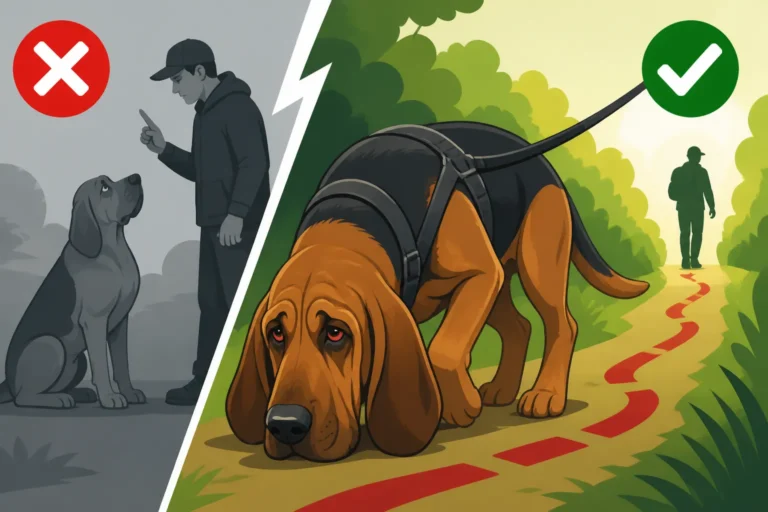
Whether a Bloodhound Trails Better in Morning Air
Anyone who has spent time with a Bloodhound, whether for serious trailing or just trying to navigate a walk in the park, knows that their nose is a force of nature. But have you ever wondered if there are certain times of day when that incredible nose performs even better? It's a question many handlers ponder, especially when faced with a challenging trail, and the answer often lies in the subtle dance between scent, weather, and the environment. This guide is here to shed some light on why morning air frequently offers the most advantageous conditions for your Bloodhound to truly shine on a trail.
Understanding How Scent Behaves in Different Atmospheric Conditions
Before we can appreciate why mornings are often prime trailing time, we need to understand a little about scent itself. It’s not just an invisible cloud; it’s a complex tapestry of microscopic particles, each subject to the whims of the environment.
The Basics of Scent Dispersion and Evaporation
When a person walks, they shed countless 'scent rafts' – a mix of skin cells, sweat, natural oils, and microscopic debris. These particles, unique to each individual, are the treasure trove your Bloodhound is seeking. Once shed, they don't just sit there static; they interact with the air, the ground, and everything around them. Think of it like a delicate perfume evaporating into the air. The rate at which these scent particles become airborne and disperse is heavily influenced by their surroundings.
If the air is warm and dry, these scent particles will evaporate and lift off the ground much more quickly. They'll scatter, dilute, and become harder for even the most potent nose to detect as a concentrated trail. Conversely, if the air is cool and moist, the evaporation process slows down dramatically. The scent particles tend to cling closer to the ground, remaining more concentrated and distinct. This is a critical factor for your Bloodhound, whose olfactory system is designed to pick up even the most minute traces. We often hear about how a Bloodhound can supposedly smell forty times better than a human, but it's not just about the number of receptors; it's also about how well that scent is preserved for them to find. Whether a Bloodhound Really Smells Forty Times Better Than a Person
The Role of Temperature and Humidity in Scent Longevity
Temperature and humidity are arguably the two most significant environmental factors dictating how long a scent trail remains viable. Imagine trying to follow a trail of footprints in fresh snow versus on hot, dry asphalt. The principle is similar for scent.
When the air is cool, scent molecules are less energetic, meaning they don't spread out as quickly. This keeps the trail more cohesive, like a solid line rather than a broken, dotted one. Humidity, or the moisture content in the air, acts as a sort of scent-preserver. Moisture in the air can actually bind to scent particles, weighing them down and preventing them from rising too high into the atmosphere or dispersing too widely. Think of a slightly damp sponge holding onto liquid versus a completely dry one letting it run off. High humidity can even help 'rehydrate' older scent particles, making them more detectable.
This combination of cool temperatures and higher humidity creates an ideal environment where the scent trail doesn't just hang around longer, but it stays structured. For a Bloodhound, this means a clearer, more defined path to follow, reducing confusion and increasing their efficiency. It's why a scent laid an hour ago on a humid morning might be easier to follow than a trail laid just fifteen minutes ago on a blazing hot, dry afternoon.
Why Morning Air Often Offers Optimal Trailing Conditions
Many experienced handlers will tell you that the early morning hours, just as the sun is starting to peek over the horizon, are often the sweet spot for scent work. There’s a scientific basis for this widespread observation among those who regularly Work a Downtown Sidewalk with their hounds.
The "Cool and Calm" Advantage of Early Mornings
As we transition from night to day, especially in temperate climates, we often experience what's called a temperature inversion. During the night, the ground cools, and the air immediately above it becomes cooler than the air higher up. This layer of cool, dense air acts like a lid, trapping scent particles close to the ground. When the sun first rises, it slowly begins to warm the ground, but for a period, that cool, stable air remains. This "cool and calm" period is a gift to your Bloodhound.
With less thermal activity (rising warm air currents) and often minimal wind, the scent remains undisturbed. There are no strong updrafts to carry scent away or turbulent gusts to scatter it. This means the scent cone—the area where a Bloodhound can pick up the scent—is wider and more consistent. The hound can move with more confidence, less prone to overshooting or losing the trail due to environmental interference. It’s like a fresh canvas for their nose, before the day’s activities complicate things.
Dew and Ground Moisture: A Bloodhound's Best Friend
Alongside cool temperatures and still air, morning often brings another significant advantage: dew. That glistening layer of moisture on grass, leaves, and even pavement isn't just pretty; it's a phenomenal scent anchor.
Dew forms when the air cools to its dew point overnight, causing water vapor to condense on surfaces. This moisture literally grabs and holds onto scent particles, preventing them from evaporating or blowing away. For your Bloodhound, this means the scent is not only closer to the ground where their powerful nose can access it best, but it's also rehydrated. Think of it: a dry scent particle is like a tiny, shriveled raisin, while a rehydrated one is plump and full of detectable compounds. The moisture also helps create a better 'transfer' of scent to the Bloodhound's nose. As they move, their long, pendulous ears, which are specifically designed to help funnel scent towards their nostrils, sweep through this damp, scent-laden air and over the ground, further enhancing their ability to pick up the trail. Why a Bloodhound's Ears Sweep Scent Toward Its Nose It's truly a marvel of natural engineering working in perfect harmony with nature's morning conditions.
Challenges and Considerations for Midday and Evening Trails
While mornings might be ideal, the reality is that trails need to be followed at all times of day. Understanding the challenges presented by midday and evening conditions is crucial for any Bloodhound handler to manage expectations and strategize effectively.
The Impact of Rising Temperatures and Thermal Lift
As the sun climbs higher in the sky and temperatures rise, the game changes dramatically for scent work. Warm air rises, creating what's known as thermal lift. This isn't just a gentle breeze; it's an invisible elevator for scent particles, pulling them off the ground and carrying them upwards and outwards.
Imagine a plume of smoke from a chimney. On a cold, still morning, it might hang low. On a hot afternoon, it shoots straight up and disperses rapidly. Scent behaves similarly. As the ground heats up, it releases stored warmth, creating these thermal currents. What was once a clear, ground-level trail can become a frustrating puzzle as scent is lifted metres into the air or dissipated entirely. This phenomenon explains Whether Heat Shortens What a Bloodhound Can Do. A Bloodhound relying on ground scent will struggle immensely when the very air currents are working against them, pulling their quarry's signature away from their level. This is where patience, observation, and an understanding of wind currents become paramount for the handler.
Wind, Activity, and Scent Contamination
Beyond temperature, midday and evening often bring increased wind and human activity, both of which are major antagonists to a clean scent trail.
Wind is an obvious disruptor. Even a gentle breeze can scatter scent particles, breaking up the continuous line your Bloodhound needs. A stronger wind can completely disperse a fresh trail in minutes, making it incredibly difficult to follow. Whether Wind Moves the Scent a Bloodhound Follows The direction of the wind also plays a huge role; a hound might find themselves 'air scenting' downwind of the trail rather than working directly on it, which can be confusing and less efficient.
Increased activity—people walking, cars driving, other animals—adds layers of complexity. Each person leaves their own scent, creating a cacophony of odors that can overwhelm or distract a Bloodhound trying to focus on a single, specific trail. This is particularly true in urban or busy areas. What was a clear path in the quiet morning hours becomes a blurred mess of conflicting information by midday. Imagine trying to hear a whispered secret in a bustling market versus a quiet library; that's the difference for your Bloodhound's nose. While they are phenomenal at How a Bloodhound Separates One Person's Scent From a Crowd, an overwhelming amount of new, irrelevant scent can still add significant challenge.
| Condition Feature | Morning Air (Early) | Midday/Afternoon | Evening/Night |
|---|---|---|---|
| Temperature | Cool, stable | Warm, rising | Cooling, stable |
| Humidity | Higher (dew present) | Lower, drying | Higher (dew forming) |
| Wind | Often calm | Often breezy/windy | Variable, often calmer later |
| Scent Dispersion | Slow, ground-level | Fast, lifted | Slow, ground-level |
| Scent Longevity | High, well-preserved | Low, dissipates quickly | Moderate to High |
| Ground Moisture | High (dew, damp) | Low (dry) | Moderate (dew forming) |
| Human Activity | Low | High | Moderate to Low |
| Optimal Trailing | Excellent | Challenging | Good (improving after heat) |
Practical Tips for Bloodhound Handlers in Varying Conditions
Knowing when conditions are optimal is one thing, but knowing how to adapt when they're not is the mark of a truly effective Bloodhound handler. Our hounds don't get to choose when a trail needs to be worked, so we have to equip ourselves and them for every scenario.
Adapting Training and Search Strategies
One of the biggest mistakes a Bloodhound owner can make is only training in ideal conditions. While it's great for building confidence in a young hound, real-world scenarios don't always offer that luxury. You need to train your Bloodhound in all sorts of weather, at all times of day. Practice on hot, dry asphalt; in windy fields; and even after a light rain, keeping in mind that Whether Rain Destroys a Bloodhound's Trail can depend on many factors. This helps your hound learn to discriminate scent even when it's faint or broken, and teaches you to read their subtle cues in less-than-perfect situations.
When you're out there, observation is your most powerful tool. Look for visual cues: where is the sun hitting? Is there dew? How strong is the wind, and in what direction? If the conditions are challenging, consider laying shorter, more frequent trails during training. Use a reliable, comfortable tracking harness and a long line—you can find many durable options on Amazon, which makes it easy to experiment with different lengths and materials for various terrains. What a Mantrailing Harness and Long Line Cost A good quality long line is essential for giving your dog enough freedom to work the scent cone without allowing them to wander off into potential danger.
Utilizing Weather Patterns to Your Advantage
Becoming a bit of an amateur meteorologist can greatly benefit your Bloodhound work. Always check the weather forecast before heading out for a training session or, even more critically, before starting a real search. Pay attention to predicted temperature changes, humidity levels, and wind speed and direction.
If you know the afternoon will be hot and windy, try to get your training done in the cool, calm morning. If you're faced with a midday trail, mentally prepare for your Bloodhound to work slower, possibly lifting their head more to air-scent, and be ready to provide more encouragement and guidance. Remember, these are highly intelligent dogs, and they're always trying to figure things out. Providing clear expectations and consistent reinforcement, perhaps using structured exercises from platforms like BAXTER & Bella, can help them navigate complex scent puzzles. Even if the trail is difficult, a positive attitude from you makes a huge difference.
Understanding Your Bloodhound's Individual Strengths
Every Bloodhound is an individual, and while the breed as a whole possesses an incredible nose, there can be variations in how each dog handles different conditions. Some Bloodhounds might be more sensitive to wind, while others might power through heat with less struggle. Observe your specific dog closely during various training sessions.
Does your Bloodhound get frustrated more easily on hot, dispersed trails? Do they become more methodical and confident in damp, cool air? Learning your dog's personal tendencies will allow you to tailor your approach. For example, if your Bloodhound struggles with high heat, don't push them for extended periods on a scorching day. Keep sessions short, focus on fundamental skills, and save the long, complex trails for when the weather is more cooperative, or for those precious morning hours. Ultimately, building a strong working relationship with your Bloodhound, understanding their physical and mental limits, and respecting the power of environmental factors will lead to the most successful and rewarding trailing experiences. It's about working with your hound and the elements, not against them.
Disclaimer
This article is for general informational purposes only and does not constitute professional advice. Laws, prices and regulations vary by location and change over time. Consult a qualified professional for guidance on your specific situation.