Whether a Bloodhound Really Smells Forty Times Better Than a Person
If you're a Bloodhound owner, or even just an admirer of these incredible dogs, you've probably heard the almost mythical claim that their sense of smell is forty times better than a human's. It's a staggering figure that makes you wonder if it's true, or just a widespread exaggeration. The truth is, quantifying something as complex as scent perception isn't as simple as assigning a single number, but the sheer power of a Bloodhound's nose is indeed almost beyond human comprehension, making them true masters of scent. This guide will delve into what makes their noses so extraordinary, what those comparisons actually mean, and how this unique ability shapes their world and interaction with ours.
Decoding the "Forty Times Better" Claim
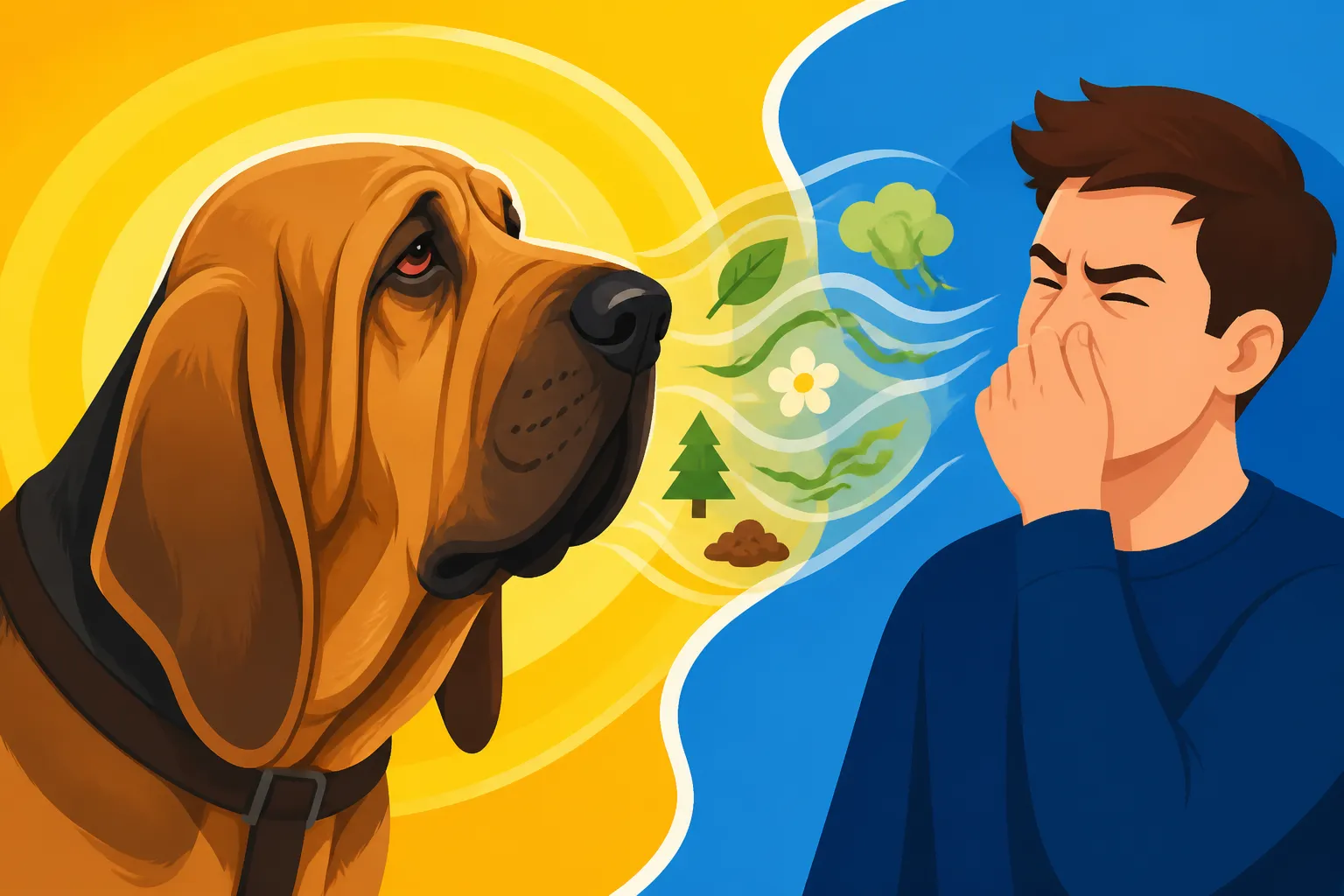
When we talk about a Bloodhound's nose being "forty times better" than a human's, it's not a precise, universally agreed-upon scientific measurement. It's more of a powerful analogy to convey the sheer magnitude of the difference. Imagine trying to describe the difference between a pinprick and a supernova – both are light, but on vastly different scales. Our human brains are primarily visual, processing the world through our eyes. For a Bloodhound, their world is painted in scent, an intricate tapestry of odors we can barely fathom.
Why Such Numbers Are Hard to Pin Down
The challenge with a definitive number like "forty times" is that scent perception isn't just about the number of olfactory receptors, though Bloodhounds certainly have us beat there. It's also about the brain's capacity to process, categorize, and remember those scents. What one dog perceives, another might ignore, and what a scientist attempts to measure in a lab doesn't always translate perfectly to a dog tracking a lost person through a bustling city park or a dense forest. There are so many variables: the type of scent, its concentration, environmental factors like wind and temperature, and even the individual dog's health and focus.
Think about it this way: could you accurately say how many times better a chef's palate is than an average person's, or how many times more acutely a musician hears notes than a non-musician? It's not just about the raw data entering the senses, but the sophisticated interpretation of that data. For a Bloodhound, their entire biological system is a finely tuned instrument dedicated to scent, something no other creature comes close to replicating in its specialized form for trailing.
Practical Realities of a Bloodhound's Nose
Instead of getting hung up on an exact multiple, it's more useful to understand the implications of this superior scenting ability. A Bloodhound doesn't just smell a strong scent more intensely; it can detect incredibly faint traces, discriminate between similar odors with astounding accuracy, and follow a specific scent trail even when it's hours or days old and layered over countless other smells. Where we smell a "dog park," a Bloodhound smells every dog that has passed through, which direction they went, if they were male or female, and probably what they had for breakfast.
Their ability to identify and stick to a particular human's individual scent signature, even amidst a sea of other human odors, is what gives them their unique and valuable role in search and rescue. This is the heart of why The Bloodhound Is the Only Dog Whose Evidence Stands in Court. It's not just about strength of smell, but the incredible precision and persistence with which they can differentiate and follow a specific scent.
The Marvel of Bloodhound Olfactory Anatomy
A Bloodhound's nose isn't just a powerful sniffer; it's a masterpiece of biological engineering, honed over centuries for the sole purpose of tracking. Every wrinkle, every flap, every internal structure plays a crucial role in making them the undisputed kings and queens of scent work. It's truly a marvel to observe.
More Receptors, More Information
One of the most significant factors in a Bloodhound's superior scenting ability is the sheer number of olfactory receptors in their nasal passages. While a human might have around 5-6 million scent receptors, a Bloodhound boasts an astounding 200-300 million. Imagine having 50 times more pixels in your camera sensor; that's the kind of raw data advantage they have. This massive increase in receptors allows them to detect odors at concentrations far below what we can perceive. It's like listening to a conversation through a thick wall versus having your ear pressed to the door – the subtle nuances, the faint whispers, become clear.
Beyond the number, the structure of their nasal cavity is also key. Their long, deep muzzles house intricate turbinates – bony scrolls lined with scent-detecting tissue. These turbinates increase the surface area available for scent absorption and create complex airflow patterns that help trap odor molecules. When a Bloodhound inhales, a portion of the air goes directly to their lungs, but another significant portion is diverted to these olfactory turbinates for scent analysis, allowing them to breathe and smell simultaneously without compromising either function.
Physical Adaptations for Scent Collection
It's not just what's inside the nose; it's the whole package. The Bloodhound's distinctive long, drooping ears and abundant loose skin (the "wrinkles" and "flews") are not just aesthetic features; they are functional tools designed to enhance their scenting prowess.
| Feature | Human Olfactory System | Bloodhound Olfactory System | Contribution to Scenting |
|---|---|---|---|
| Olfactory Receptors | ~5-6 million | ~200-300 million | Dramatically increased detection sensitivity |
| Nasal Passages | Relatively simple | Long, deep, complex turbinates | Increased surface area for scent, optimized airflow |
| Brain Size (Olfactory Bulb) | Small (0.01% of brain) | Large (at least 3% of brain) | Extensive processing and analysis of scent data |
| External Ears | Small, fixed | Long, heavy, drooping | Sweeps ground scent towards nose, blocks environmental noise |
| Loose Skin (Flews/Wrinkles) | Minimal | Abundant, pendulous | Traps scent particles, creates scent funnel |
| Scent Tracking Method | Visual dominant | Olfactory dominant | Sustained focus on individual scent signature |
Their heavy, pendulous ears, often trailing on the ground as they work, literally sweep scent particles from the environment towards their nose, creating a funnel effect. This helps concentrate the scent in their immediate vicinity. You can see this in action when a Bloodhound is working, its head low, ears almost plowing the ground. Why a Bloodhound's Ears Sweep Scent Toward Its Nose is more than just an interesting anatomical fact; it's a critical part of their functional design.
Similarly, the ample loose skin around their face and neck, known as flews and wrinkles, also helps trap and hold scent molecules. As they move their heads, these folds stir up air currents, pushing scent towards their nostrils. It’s like their whole head is designed as a sophisticated scent-gathering and analysis machine, constantly working to provide the most detailed olfactory picture possible.
How a Bloodhound Processes the World Through Scent
For humans, our primary sense is sight. We navigate the world by seeing. For a Bloodhound, their world is primarily experienced through scent, making it an entirely different reality. This isn't just about smelling more; it's about smelling differently and understanding what they smell in a way we simply cannot.
The Brain's Role: Decoding the Scent Map
Having hundreds of millions of scent receptors is only part of the equation. What truly sets Bloodhounds apart is the incredible amount of brain power dedicated to processing that information. Their olfactory bulb, the part of the brain that interprets scent, is proportionately much larger than ours – sometimes making up over 3% of their brain mass, compared to a tiny fraction in humans. This means their brains are hardwired to not just detect, but to meticulously analyze, differentiate, and remember scents.
When a Bloodhound encounters a scent, it's not a singular impression; it's a complex, multi-layered data stream. They can identify individual components of a scent, even when those components are incredibly diluted or masked by other odors. This is why How a Bloodhound Separates One Person's Scent From a Crowd is so profound. They don't just pick up "human smell"; they pick up that specific human's individual odor signature, which is as unique as a fingerprint, and can follow it for incredible distances and durations, even hours or days after it was laid. Their memory for scent is also exceptional, allowing them to form a vast mental library of smells.
A Scent-Dominated Reality
Imagine experiencing the world like this: every surface, every person, every animal, every gust of wind carries a unique, identifiable scent. This is the Bloodhound's reality. When you walk down a street, you see buildings, cars, people. A Bloodhound smells the rubber from the tires, the exhaust fumes, the food scraps in a bin, the anxiety pheromones of a passing cat, the specific human odor left on the sidewalk by someone who walked there two hours ago.
This profound difference in perception has immense implications for their behavior. They are not being "stubborn" when they put their nose to the ground and ignore your calls; they are simply prioritizing the most compelling information in their world. What seems like a distraction to us is, to them, the most important message they've received all day. This is why many traditional obedience commands often fall flat when a Bloodhound is "on-nose"; their olfactory drive simply overrides all other inputs.
Living with a Scent-Driven Companion: Practical Implications
Understanding the depth of your Bloodhound's olfactory world isn't just fascinating; it's absolutely crucial for being a responsible and empathetic owner. Their incredible noses dictate so much of their behavior, exercise needs, and even safety protocols.
Training and Enrichment: Embracing the Nose
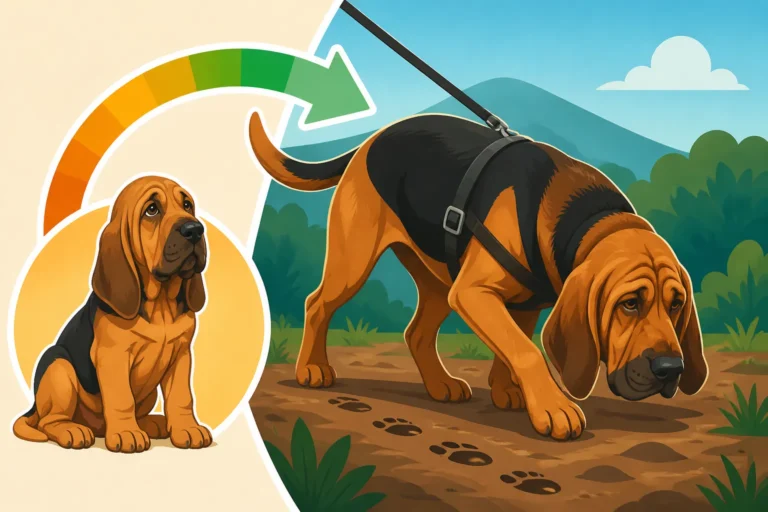
Given their innate drive, traditional obedience training, while important for basic manners, often misses the mark when it comes to truly engaging a Bloodhound's mind. They thrive on activities that let them use their nose. Mantrailing Is the Answer to a Bloodhound, Not Obedience because it channels their natural instincts into a productive and rewarding activity. This isn't just about finding people; it's about giving your Bloodhound a job, fulfilling their deepest purpose.
You can start scent games at home with simple hide-and-seek activities using treats or favorite toys. Many owners invest in specific scent work kits available from retailers like Amazon, which often include scent articles and training aids to help build foundational skills. Even everyday walks can become "nose walks" where you let your Bloodhound dictate the pace and direction, allowing them to thoroughly investigate interesting smells. This kind of mental stimulation can be as tiring, if not more so, than physical exercise. As many of us have found, Whether Nose Work Tires a Bloodhound More Than Walking is often a resounding yes!
For those looking for more structured guidance, online programs like BAXTER & Bella offer virtual puppy and dog training courses that can help you integrate scent work into your routine. These resources can provide valuable insight into how to motivate and engage your scent-driven companion.
Safety First: The Unstoppable Nose
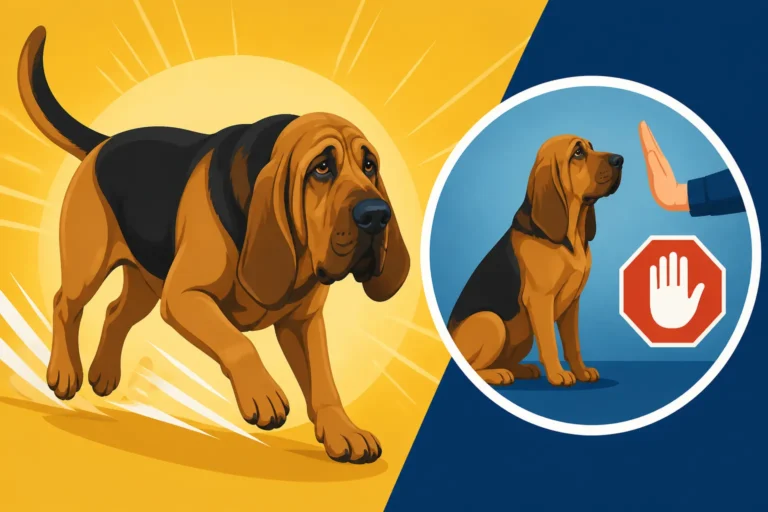
The power of a Bloodhound's nose also comes with a significant responsibility for their safety. Their drive to follow a scent is so strong that it often overrides self-preservation. A Bloodhound on a trail will ignore traffic, dangerous terrain, or your panicked calls. This is precisely Why Off Leash Is Not a Goal With a Bloodhound in most environments. Even the most perfectly trained Bloodhound can be overwhelmed by a compelling scent.
This means a secure, physical fence is non-negotiable for a Bloodhound. An invisible fence is rarely enough, as the drive to follow a trail can easily overcome the deterrent. When out and about, they need to be on a sturdy leash, ideally attached to a well-fitting harness rather than just a collar, to prevent injury if they lunge. Long lines, also easily found on Amazon, are excellent tools for giving them a sense of freedom in safe, open areas while still maintaining control. Always be mindful of their surroundings; a sudden compelling scent could send them off in an instant.
Understanding what your Bloodhound is smelling, and how powerfully it influences them, transforms your relationship. It moves beyond simply owning a dog to appreciating and facilitating the incredible, ancient instinct that makes them who they are.
Disclaimer
This article is for general informational purposes only and does not constitute professional advice. Laws, prices and regulations vary by location and change over time. Consult a qualified professional for guidance on your specific situation.