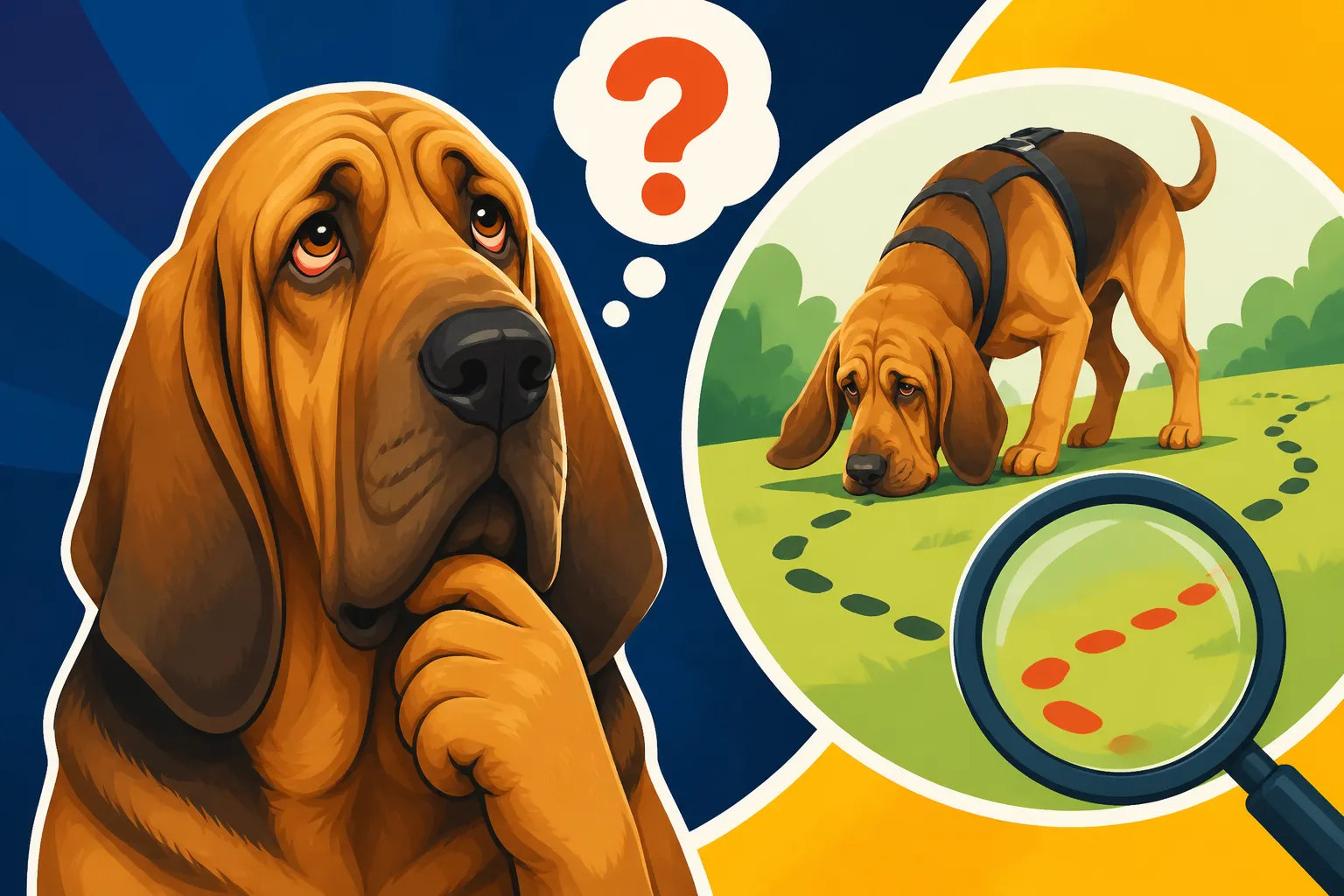
Whether a Bloodhound Can Be Wrong
It’s a natural concern for any Bloodhound owner, or anyone who relies on these incredible scent hounds, to wonder if a Bloodhound can ever truly be "wrong" on a trail. We hear so many amazing stories about their unerring accuracy, their ability to find the needle in the haystack, and their legal standing in court. But the reality is, trailing is a complex art, not a perfect science. This guide will delve into the nuances of what "wrong" truly means in the context of a Bloodhound's work, exploring the factors that can influence their performance and how our human interpretation often shapes our understanding of their success or failure.
The Nuance of "Wrong": What Does It Mean for a Bloodhound?
When we talk about a Bloodhound being "wrong," it's rarely as simple as them pointing a nose at the incorrect person. Their olfactory capabilities are so incredibly refined, and their innate drive to follow a specific scent is so powerful, that true biological "wrongness" on their part is exceptionally rare. Instead, what often gets labeled as a Bloodhound being "wrong" is usually a result of misinterpretation by the handler, complex environmental factors, or issues with the starting scent. It's not that the dog lied; it's that we, as humans, might have misunderstood the incredibly detailed narrative their nose was telling us.
When "Wrong" is Really a Different Trail
One of the biggest misconceptions about Bloodhounds is that they will only follow the scent of the specific person whose item they were introduced to at the start of the trail. While their ability to discriminate individual human scent is truly phenomenal, the world is a chaotic tapestry of odors. A Bloodhound might genuinely be following a human scent, but perhaps it's not the specific human scent you intended for them to track. For instance, the intended subject might have crossed paths with another person, or had an interaction that caused scent to transfer. A dog might then follow that secondary, clearer, or fresher scent, leading to a "wrong" conclusion in the eyes of the handler, even though the dog was meticulously following a human scent. This isn't a failure of the dog; it's a dynamic situation where multiple scent trails exist, and the dog chose one that was most salient and followable.
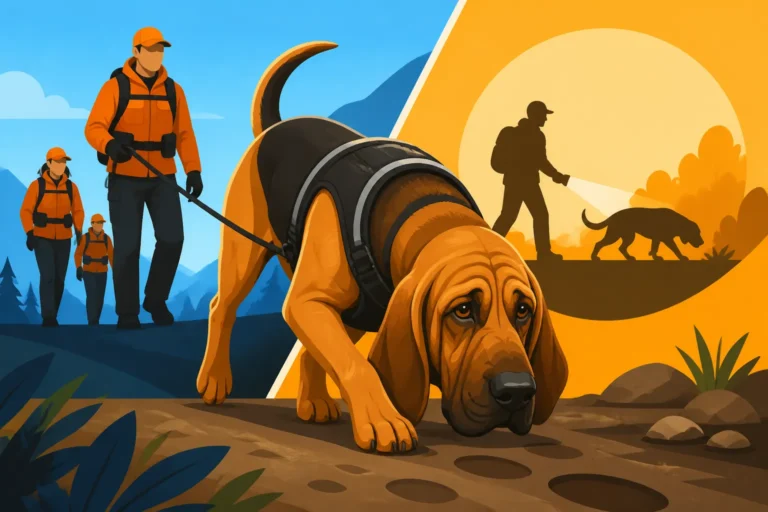
Imagine your Bloodhound, Brutus, on a training trail in a moderately busy suburban park. You give him a scent article from your training partner, Dave, who walked through the park an hour ago. Brutus starts strong, nose to the ground, working diligently. However, after about fifteen minutes, he leads you to a bench where another man, completely unrelated to Dave, is sitting. Did Brutus get it "wrong"? Maybe, but it's more likely that Dave paused at that bench, and shortly after he left, the other man sat down, leaving a very strong, fresh scent. Brutus, ever focused on the clearest human scent trail, might have naturally transitioned to the fresher scent. He was still trailing human scent; it just wasn't the specific human scent you wanted him to. This situation underscores the critical importance of understanding What a Bloodhound Is Actually Smelling on a Trail – it's a constant, detailed assessment of microscopic scent particles.
Environmental Interference and Scent Contamination
The environment plays a massive, often underestimated, role in how a Bloodhound works a trail. Factors like rain, wind, temperature, humidity, and even the type of ground cover can profoundly alter the longevity, strength, and direction of a scent trail. A Bloodhound might encounter a section of a trail where the original scent has been completely washed away by heavy rain, blown far off course by strong winds, or heavily masked by other human or animal odors. In such scenarios, the dog isn't "wrong" for failing to follow what is effectively an invisible or highly diffused trail; it's simply experiencing the limitations imposed by natural conditions. It might then try to "cast" (move in a pattern) to find traces, or indicate to its handler that the scent has ended or is no longer viable.
Consider a hot, dry afternoon following a significant downpour earlier in the day. You're attempting to track someone who walked across an asphalt parking lot. The rain might have initially diluted or washed away much of the scent, and the subsequent high temperatures could have rapidly evaporated any remaining scent particles. Your Bloodhound, renowned for its incredible ability to follow How Old a Trail a Bloodhound Can Follow, might struggle immensely here. It might hesitate, lift its head to air scent, or even circle back, indicating uncertainty or loss of the trail. A handler who doesn't account for these environmental variables might mistakenly perceive this as the dog being "wrong," when in reality, the scent picture has become incredibly challenging, if not impossible, for even the keenest nose to follow with precision. This is where a deep understanding of scent dynamics and your dog's individual working style becomes invaluable.
When Human Factors Cloud the Picture
While Bloodhounds are equipped with an unparalleled olfactory sense, their actual performance on a trail is always inextricably linked to human elements. This includes the handler's skill level, the quality and integrity of the scent article provided, and the overall management of the trailing situation. More often than not, when a Bloodhound's work is questioned or deemed "wrong," the root cause lies in a misstep by the people involved, rather than an inherent error by the canine.
The Critical Role of the Handler and Interpretation
A Bloodhound, for all its instincts, is a partner in a team. Like any skilled artisan relying on a specialized tool, its effectiveness is heavily dependent on the proficiency of the operator. A handler who lacks experience in reading their dog's subtle body language, who inadvertently interferes with the dog's natural trailing process, or who makes assumptions about the dog's intentions can easily lead to a "wrong" outcome or, more accurately, a misinterpretation of a correct one. Bloodhounds are constantly communicating through their posture, changes in tail movement, ear set, and fluctuations in pace. An experienced, intuitive handler understands these myriad signals, knowing precisely when their dog is confident, momentarily confused, taking a strategic cast, or has definitively found the subject.
For instance, your Bloodhound might lower its head slightly, slow its pace, and begin sweeping its nose side-to-side, transitioning from ground-scenting to air-scenting. This often indicates that the ground scent has become weak, and the dog is attempting to pick up the scent cone from the air to re-establish the trail. An inexperienced handler might misinterpret this behavior as the dog losing interest or becoming distracted, perhaps pulling it back onto a ground path where no viable scent now exists, thereby interrupting the dog's legitimate work. Conversely, a Bloodhound might get a strong scent of someone in an area and attempt to indicate a find, only for the handler to rush past, assuming it's not "the right" person. Knowing What a Bloodhound Does When It Loses the Trail is a crucial part of reading your dog accurately. Resources from organizations like BAXTER & Bella can be incredibly helpful for new handlers to develop these essential interpretation skills, fostering a stronger and more effective partnership. You can find many useful training tools, like long lines and appropriate harnesses, on sites like Amazon.
Scent Article Quality and Contamination
The initial step of any trailing endeavor – presenting the scent article – is absolutely paramount. If the scent article itself is of poor quality (e.g., an item handled by multiple individuals, or one that has been exposed to the elements for an extended period, allowing scent degradation), the Bloodhound is starting with a significant disadvantage. Dogs work with the information they are given. If the initial scent is weak, muddled with other odors, or compromised, the trail will naturally be far more challenging to follow, dramatically increasing the likelihood of a "wrong" turn or an unsuccessful find.
Consider a scenario where the only available scent article for a missing person is a shirt that has been worn, then placed in a laundry hamper with other family members' clothes, and subsequently handled by several well-meaning but ungloved search volunteers. The Bloodhound is then being asked to discern one specific scent from an incredibly complex mixture of human odors. This is an incredibly difficult, if not impossible, task. Similarly, if a scent article is handled carelessly – perhaps picked up by multiple people without protective gloves – it introduces multiple new scent profiles that the dog might then follow. In these instances, the perceived "fault" lies not with the Bloodhound's magnificent nose, but with the initial management and integrity of the scent article. This is precisely why strict protocols for handling scent evidence are enforced in professional search and rescue operations.
Legal Standing and Challenging a Bloodhound's Trail
The exceptional legal standing of a Bloodhound's trail – being the only canine evidence often accepted in various courts – comes with a significant amount of scrutiny and responsibility. This means that the concept of a Bloodhound being "wrong" isn't merely a casual concern; it carries profound implications for ongoing investigations and potential legal proceedings. Understanding why this evidence is accepted, and conversely, how it can be challenged, provides critical insight into the practical definition of a Bloodhound's accuracy and reliability.
Why a Bloodhound's Evidence is Unique
Historically, the Bloodhound's trailing evidence has earned acceptance in courts due to its unique and repeatedly demonstrated ability to follow individual human scent, even across considerable distances and over extended periods. It's not just about locating a person; it's about discriminating and steadfastly adhering to one specific person's unique scent signature amidst countless others. This singular, unwavering focus is what sets them apart from other breeds and lends their work significant legal credibility. However, this acceptance is almost invariably tied to rigorous standards of handler training, comprehensive dog certification, and strict adherence to established handling protocols. It's not just the dog's nose that's being evaluated, but the entire, systematic approach surrounding its deployment. Indeed, The Bloodhound Is the Only Dog Whose Evidence Stands in Court precisely because of this unique ability and the historical precedent it has set.
This extraordinary recognition is a testament to their inherent abilities, but it simultaneously places a heavy burden on handlers to ensure their work is impeccable and defensible. In a courtroom, the focus isn't solely on the dog; instead, the entire operation is scrutinized – the handler's qualifications, the dog's training regimen, the environmental conditions at the time of the trail, and the meticulous handling of the scent article. If any link in this chain of protocols is found to be weak or compromised, the entire testimony based on the Bloodhound's trail can be effectively undermined. This is why continuous, documented training and maintaining detailed logs of every trail, including environmental data and dog behavior, are absolutely crucial for any Bloodhound team involved in legal work.
When a Defense Challenges a Trail
In any legal setting where a Bloodhound's trail is introduced as evidence, it is almost a certainty that the defense will challenge its validity and reliability. This is where the concept of a Bloodhound being "wrong" transitions from an informal discussion among enthusiasts to a serious, contested legal argument. The defense's primary objective will be to introduce reasonable doubt, often by highlighting potential handler errors, instances of environmental contamination, issues with the integrity of the scent article, or by suggesting that the dog could have been following a different, unintended trail. Whether a Defense Can Challenge a Bloodhound's Trail is a fundamental right within the legal system, and understanding this mechanism profoundly influences how Bloodhound evidence is prepared and presented.
For example, a defense attorney might aggressively question the temperature, humidity, and wind conditions on the day of the trail, suggesting that environmental factors rendered the scent unlikely to persist reliably. They might inquire about every single person who handled the scent article, meticulously searching for any possibility of contamination. They could probe the handler's specific experience, their certifications, or even the dog's recent training records for any inconsistencies. This line of questioning isn't necessarily claiming that the dog is "wrong" in a biological sense, but rather arguing that the circumstances surrounding the trail were compromised to such an extent that the resulting evidence should be deemed unreliable. This critical distinction highlights that a Bloodhound's "wrongness" in a court of law is often about the perceived reliability and integrity of the entire tracking operation, not merely the dog's innate olfactory capability.
It is therefore imperative for handlers to be able to clearly and articulately describe their dog's behavior throughout the trail, specifically explaining What a Bloodhound Does at the End of a Trail and how that precise indication signifies a definitive find of the subject. Without clear communication from the dog, coupled with an expert understanding and articulation by the handler, even the most biologically accurate trail can be dismissed as unreliable in a judicial setting.
Mitigating "Wrongness": Training and Best Practices
While no system involving living, sentient beings and unpredictable, ever-changing environments can ever be 100% foolproof, there are numerous practical and proven ways to significantly reduce the chances of a Bloodhound's trail being "wrong" or, more precisely, being misinterpreted by human observers. Ultimately, achieving maximum accuracy and reliability boils down to rigorous, consistent training, meticulous preparation before each trail, and a deep, empathetic understanding of the Bloodhound's inherent capabilities and its very real limitations.
Building a Strong Handler-Dog Partnership
The single most pivotal factor in a Bloodhound's consistent success on a trail is the profound bond and mutual understanding forged between the dog and its handler. This goes far beyond mere affection; it involves developing a clear, consistent, and nuanced communication system built through countless hours of dedicated training and shared experiences. A proficient handler must learn to accurately read their dog's often-subtle cues, recognizing precisely when it is actively working, when it is momentarily confused, when it is taking a strategic pause or cast, and when it is providing a definitive indication of a find. This deep, almost telepathic connection allows the handler to provide subtle guidance to the dog without inadvertently interfering with its natural trailing process, thus creating a seamless and highly effective partnership.
Consistent, positive reinforcement training is absolutely essential for cultivating this bond and skill set. Bloodhounds, like all dogs, thrive on clear expectations, consistent feedback, and meaningful rewards. Practical products, easily found on platforms like Amazon, such as high-value, palatable training treats, and durable, appropriate long lines, can be invaluable tools in this ongoing process. Regular training sessions conducted in varied environments, utilizing trails of differing ages, and under diverse weather conditions, simultaneously build both the dog's experience and the handler's crucial ability to accurately interpret the dog's sophisticated communication. The objective isn't merely to make the dog "not wrong," but rather to equip the handler to be "not wrong" in their understanding and interpretation of the dog's inherently correct work. This continuous education is paramount, as is understanding how factors like Whether an Older Bloodhound Can Still Learn to Trail can influence training approaches.
Diligent Preparation and Protocol Adherence
Before any trailing exercise or real-world deployment commences, meticulous preparation is an absolute necessity. This includes the critical steps of securing a clean, uncontaminated scent article, gathering as much intelligence as possible about the subject's last known movements, and thoroughly assessing the prevailing environmental conditions. For professional search and rescue (SAR) teams, strict, internationally recognized protocols are rigorously followed to ensure the utmost integrity of the scent and the trail itself.
These vital protocols typically encompass:
- Scent Article Management: This involves wearing gloves when handling scent items, placing them promptly into sealed, airtight bags, and verifying that the item has ideally only been touched by the subject.
- Contamination Avoidance: Maintaining strict control over the search area, keeping curious onlookers, other animals, and non-essential personnel well away from the starting point and the immediate trail area.
- Environmental Assessment: Meticulously noting prevailing weather conditions, including temperature, humidity, wind direction and speed, and the types of ground surfaces encountered, all of which provide crucial context for interpreting the dog's work.
- Thorough Documentation: Maintaining detailed written records of every trail, including precise start and end times, specific locations, observed dog behavior, and comprehensive environmental data.
These rigorous preparatory steps are designed to minimize external variables that could potentially lead to misinterpretations of the Bloodhound's work. It's fundamentally about setting the dog up for the highest possible chance of success and ensuring that if a perceived "wrong" turn occurs, it can be thoroughly analyzed and understood within its proper context, rather than simply attributing blame to the dog. Always remember that a Bloodhound's accuracy is heavily dependent on the clarity and integrity of the initial scent provided, thus necessitating utmost diligence in handling source materials.
Understanding Limitations and Realistic Expectations
Even the most genetically gifted Bloodhound, partnered with the most highly skilled and experienced handler, possesses inherent limitations. They are not infallible robots; they are living, breathing, complex creatures influenced by physiological factors such as fatigue, environmental distractions, and the inherent, unavoidable challenges of scent degradation over time. Expecting absolute perfection on every single trail, under every conceivable condition, is not only unrealistic but also profoundly unfair to the dog. Understanding and acknowledging these limitations is not an admission of "wrongness" on the dog's part, but rather a realistic recognition of biological and environmental realities.
For instance, a Bloodhound can only physically sustain a concentrated trail for How Far a Bloodhound Will Follow a Trail before becoming physically exhausted and less effective. Similarly, extremely old trails, particularly those laid under adverse or rapidly changing environmental conditions, become exponentially more difficult to follow with precision. A Bloodhound deployed for law enforcement purposes, perhaps to aid in Whether a Bloodhound Finds People With Dementia, might encounter different success rates compared to one tracking a known escapee, simply due to the differing conditions of the scent, the time elapsed, and the urgency of the situation. The ultimate goal isn't to eliminate all possibility of perceived "wrongness," but rather to deeply understand why it might occur and to develop adaptive strategies to work through or around these challenges.
It is far more productive and instructive to view a Bloodhound's perceived "wrong" turn or moment of hesitation as valuable information rather than an outright failure. Such behavior might be communicating that the scent is no longer present in a particular area, that the environmental conditions are currently too challenging, or that the team needs to re-evaluate their current trailing strategy. This kind of adaptive, analytical thinking is precisely what characterizes a truly successful Bloodhound team.
Here's a quick reference on common reasons a Bloodhound's trail might be perceived as "wrong":
| Category | Description | True "Wrongness" by Dog? | Mitigation Strategy |
|---|---|---|---|
| Scent Dynamics | Scent degradation (weather, time), presence of multiple, conflicting scents, environmental contamination. | Rarely | Proper scent article management, thorough environmental assessment, varied training scenarios. |
| Handler Error | Misinterpretation of dog's subtle cues, inadvertent interference, poor leash handling. | No | Rigorous handler training, fostering consistent communication, seeking mentorship. |
| Scent Article Issues | Contaminated, weak, or insufficient starting scent article provided. | No | Strict scent article protocols, utilizing the freshest and cleanest possible source material. |
| Environmental Challenges | Strong winds, heavy rain, extreme heat or cold, complex terrain affecting scent retention or movement. | Rarely | Deep understanding of environmental impacts, adjusting expectations, training in all conditions. |
| External Distractions | Presence of wildlife, other dogs, loud human noises, accessible food on the ground. | Rarely | Early socialization, consistent focus training, maintaining environmental control where possible. |
In conclusion, when a Bloodhound appears to be "wrong" on a trail, it almost invariably points back to a complex interplay of external environmental factors, human handling and interpretation, or the inherent, unavoidable challenges of working within a dynamic and complex scent environment. The Bloodhound's nose, in its pure biological function, is exceedingly rarely at fault. This powerful reality serves as a crucial reminder that while these dogs are undeniably incredible, they operate within a close partnership and a specific set of circumstances that demand profound respect, a deep understanding, and an ongoing commitment to education from their human counterparts.
Disclaimer
This article is for general informational purposes only and does not constitute professional advice. Laws, prices and regulations vary by location and change over time. Consult a qualified professional for guidance on your specific situation.