Whether a Bloodhound Works Alongside a Search Team
Many Bloodhound owners dream of seeing their incredible dogs put their noses to work, perhaps even joining a formal search and rescue (SAR) team. But often, there's a real question about how a highly specialized, scent-focused Bloodhound truly fits into the complex, multi-faceted world of a broader search operation. It’s not just about finding a missing person; it’s about doing it safely and effectively as part of a coordinated effort. This guide will explore exactly how a Bloodhound team works alongside other elements of a search, highlighting the unique contributions and challenges involved in this specialized partnership.
The Bloodhound's Unique Role in Search Operations
It's easy to be captivated by a Bloodhound's legendary nose, but understanding how that nose works and what it's best suited for is crucial for anyone considering formal search work. They aren't generalists; they're masters of a very specific craft.
The Solo Scent Tracker
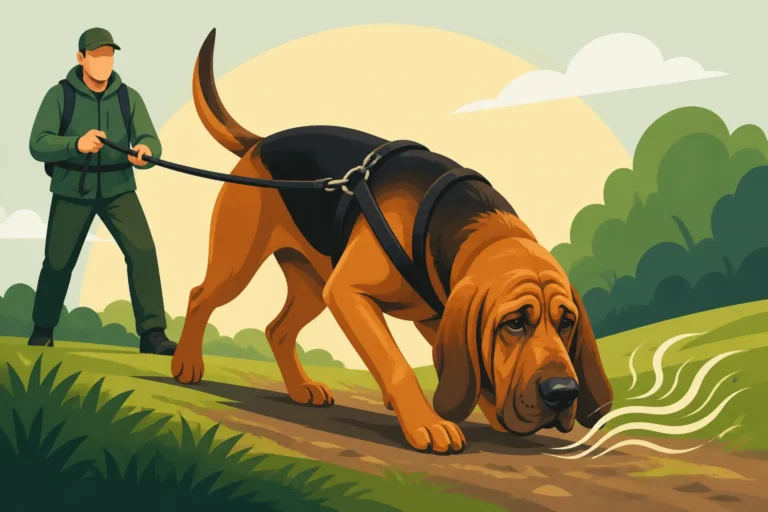
A Bloodhound on a trail is a creature singularly focused. Their world shrinks to the infinitesimal particles of human scent left by the subject they are tracking. This isn't just a strong sense of smell; it's a profound ability to differentiate, isolate, and follow a specific human odor through varying terrain, conditions, and distractions. When a Bloodhound drops its nose and commits to a trail, it's often a deeply personal journey between dog and handler, a silent conversation dictated by scent.
This single-mindedness means that, while they are part of a larger search effort, their actual work on the trail is inherently individual. The handler becomes the dog's protector, shielding the delicate "scent cone" from contamination and interruption. Every step is methodical, every sniff a data point. Trying to rush or divert a Bloodhound from a trail it has committed to can be counterproductive, diminishing the accuracy of its work. The handler learns to read every twitch of the ear, every shift in pace, understanding that the dog is building a complex picture of the subject's movement and behavior. This requires immense trust and a deep bond, cultivated through countless hours of training.
Not a "Jack of All Trades"
It’s vital to distinguish the Bloodhound's role from other incredible canine partners in search and rescue. While all SAR dogs are invaluable, they specialize. An air-scent dog, often a German Shepherd or Labrador Retriever, works with its nose in the air, casting for any human scent within a broad area, typically off-leash, covering vast ground quickly. Cadaver dogs are trained to detect the scent of human remains. Water search dogs locate submerged victims. The Bloodhound, however, is almost exclusively a trailing dog. Its strength lies in following a specific individual's scent on the ground, step by painstaking step. What a Bloodhound Is Actually Smelling on a Trail clarifies this distinction beautifully.
This means a Bloodhound isn't deployed to grid-search a wilderness area or to rapidly scan a collapsed building. Its value lies in establishing a direction of travel, confirming a last-known point, or locating a specific individual who has left a discernible trail. They are often called in when a missing person's last known location is established, or when an air-scent dog has given a "last seen" point but no further direction. Their particular gift is the ability to ignore ambient human scent and focus on that single, specific target. This specialized niche means they complement, rather than duplicate, the efforts of other SAR assets.
Integrating a Bloodhound into a Multi-Disciplinary Search Team
Bringing a Bloodhound into a search environment is rarely a solitary endeavor. While the trailing work itself is often focused, the preparation, deployment, and overall strategy absolutely depend on effective teamwork and communication.
Understanding the Team Structure
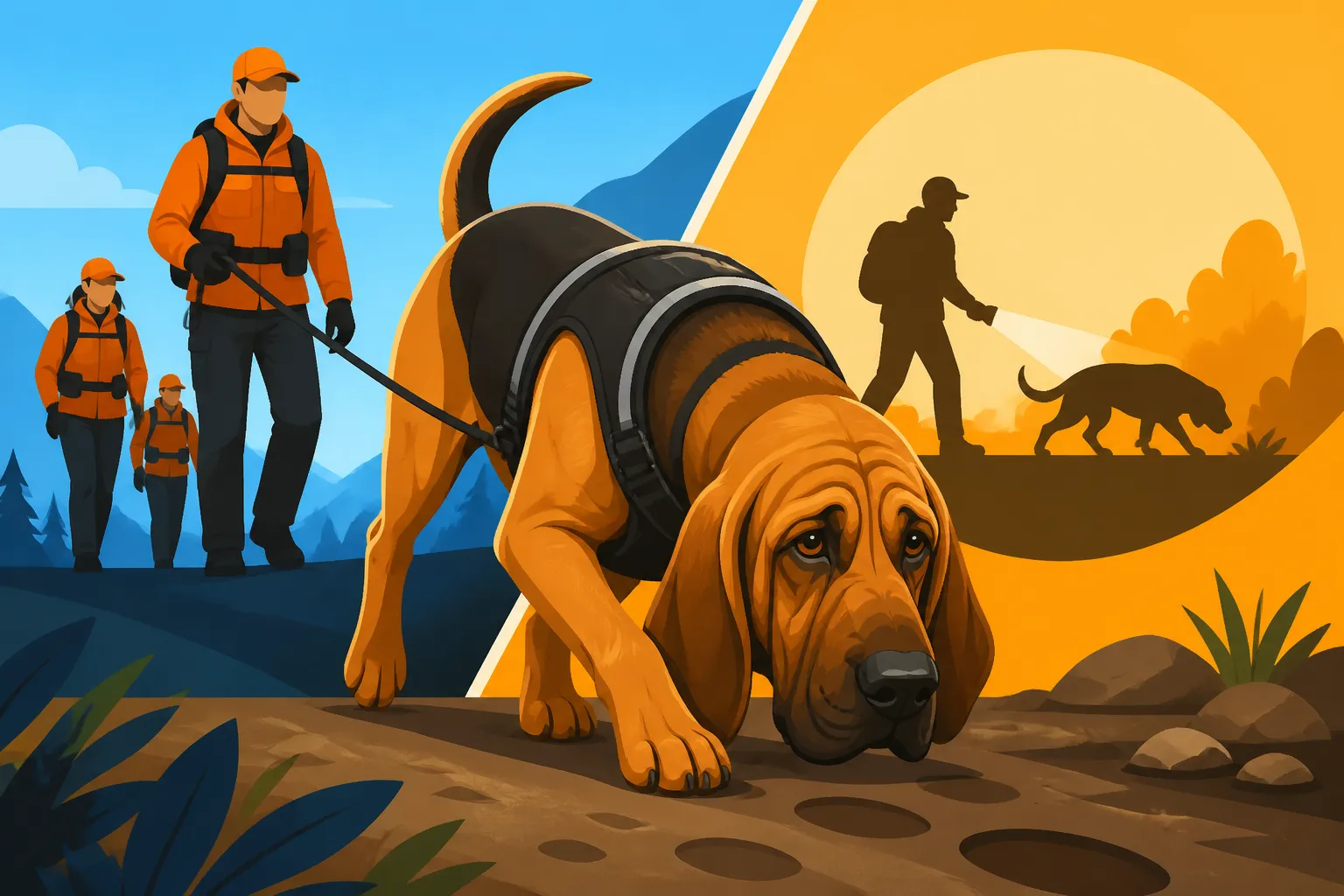
Modern search and rescue teams are typically organized with clear roles and an incident command structure. You'll find ground searchers, medics, communications specialists, logistics personnel, and various canine teams. A Bloodhound handler and their dog function as a highly specialized unit within this larger framework. They are not simply released into the wild to find someone; their deployment is strategic, based on intelligence and the overall search plan.
For instance, a Bloodhound team might be deployed after initial ground teams have cleared certain areas or established perimeters. Their objective might be to confirm if the subject crossed a road, or to follow a scent from a specific point, like a last-seen location at a trailhead or home. The team's overall mission manager needs to understand the Bloodhound's capabilities and limitations – that it needs a "clean" starting point, that it works at its own pace, and that environmental factors can influence the trail. Clear communication channels are paramount. Everyone needs to know where the Bloodhound team is operating, their progress, and potential findings to avoid interference and to guide subsequent search efforts.
The Handler's Crucial Role in Teamwork
The Bloodhound handler is far more than just the person holding the leash. They are the critical bridge between their dog and the broader search team. This isn't just about reading their dog; it's about translating the dog's indications into actionable intelligence for human searchers. When the Bloodhound gives a subtle head turn or a change in tail carriage, the handler interprets this as a shift in scent strength or a change in direction. This information is then relayed to the incident commander.
The handler also acts as the Bloodhound's advocate within the team. They must be able to educate other team members on proper procedures around a working Bloodhound, such as maintaining distance to prevent scent contamination or understanding why the dog might suddenly slow down or loop back. A truly effective Bloodhound handler is as adept at human communication as they are at canine communication. They participate in briefings, provide regular updates, and understand how their piece of the puzzle fits into the whole picture. Learning strong interpersonal skills and understanding incident management systems are as important as pure dog training.
Maintaining the "Scent Cone" and Minimizing Contamination
This is perhaps the most critical aspect of Bloodhound integration. A Bloodhound's ability to follow an individual's unique scent relies on the integrity of that scent. Other searchers, vehicles, or even curious onlookers can inadvertently contaminate or degrade a trail, making the Bloodhound's job significantly harder or even impossible. Imagine a missing child's scent trail, fresh for a Bloodhound, but then a dozen well-meaning volunteers trample through the area, laying down their own scents.
Search teams must implement strict protocols around Bloodhound deployment. This often means securing a "scent article" (an item with the missing person's uncontaminated scent), bringing the Bloodhound team directly to the last known point without crossing the potential trail, and ensuring that other personnel are held back until the Bloodhound has worked the area or a clear path has been established. This can sometimes feel frustrating to other eager searchers, but it's absolutely necessary for the Bloodhound to perform its unique magic. Effective coordination ensures that the Bloodhound is deployed in a way that maximizes its potential, rather than hindering it.
Training and Preparation for Team Environments
Successful integration into a search team doesn't just happen. It's the culmination of dedicated training, not only for the Bloodhound's nose but for its temperament and its handler's skills.
Foundational Training for the Bloodhound
While a Bloodhound's genetic drive to trail is undeniable, it still needs foundational training to be a reliable team member. This goes beyond just teaching it to follow a trail. An effective SAR Bloodhound needs to be well-socialized and have a strong understanding of basic manners. It needs to be comfortable around strangers, other dogs, and strange noises—sirens, helicopter rotors, barking radios, and the general hubbub of a search command post. A dog that is constantly distracted by other people or sounds will struggle to focus on its scent work. The First Year With a Bloodhound That Already Wants to Trail often emphasizes the need for early and consistent exposure to the world.
This means putting in the work on general obedience and exposure training, even if "obedience" looks different for a Bloodhound. Programs like those offered by BAXTER & Bella can be incredibly helpful for building a solid foundation of focus, confidence, and appropriate behavior in various environments. A Bloodhound needs to learn to settle in a crate in a noisy command center, ride calmly in a vehicle with unfamiliar people, and tolerate handlers and medics tending to a subject at the end of a trail. All these "soft skills" are crucial for making the dog a functional asset rather than a liability in a high-stress team environment.
Training the Handler for Teamwork
Just as critical as the dog's training is the handler's preparation. Becoming a Bloodhound SAR handler isn't just about knowing how to read your dog; it's about becoming a skilled team player. This involves understanding incident command systems (ICS), learning radio communication protocols, first aid, land navigation, and wilderness survival. Many teams require handlers to be certified in these areas before their dogs even begin formal SAR training.
Handlers also need to practice working with other team members. This might involve participating in simulated searches where different assets are deployed, understanding how to brief and debrief, and learning to manage resources around their dog. They need to learn when to push their dog and when to give it a break, and how to communicate those needs effectively to a commander who might not understand canine physiology or behavior. Regular drills that simulate real-world conditions, including interactions with various personnel and equipment, are invaluable. How a Bloodhound Is Certified for Search Work goes into detail about the rigorous standards handlers and dogs must meet.
Specific Scenarios for Bloodhound Team Integration
Bloodhounds truly shine in specific scenarios where their unique abilities are maximized within a team context.
Consider a situation where a child has wandered from a backyard. An initial rapid ground search by volunteers might yield nothing. This is where a Bloodhound team can be deployed. Starting from the child's bedroom (for a clean scent article), the Bloodhound can quickly establish a direction of travel, perhaps indicating the child went through a specific gate, into a wooded area, or down a particular street. This information is gold for the search team, narrowing the search radius significantly and directing other resources.
Another scenario might involve an elderly person with dementia who walked away from their home. The Bloodhound can pick up the trail from the front door and follow it through complex suburban environments, indicating turns and resting spots, even if the person has been gone for several hours. This prevents other searchers from fruitlessly scouring areas the person clearly did not enter.
| Bloodhound Strength in Team Settings | Potential Challenge in Team Settings |
|---|---|
| Pinpoint Trailing: Locates exact path. | Slow Pace: Requires patience from team. |
| Scent Discrimination: Ignores other human scent. | Scent Contamination Risk: Requires strict team discipline. |
| Evidence Quality: Trail can be legally admissible. | Specialized Deployment: Not suitable for every search phase. |
| Confirmation: Can verify or disprove other findings. | Communication: Handler must translate dog's cues. |
| Long-Term Scent: Can follow older trails. | Resource Management: Needs clear operating space. |
For this work, specialized gear is also essential. A durable, well-fitting tracking harness is crucial, as is a long line that allows the dog to work comfortably ahead of the handler without being constrained. Many handlers find reliable, high-quality long lines and other essential gear on platforms like Amazon, ensuring they have the right tools for the job. Why a Bloodhound Works on a Long Line, Not a Collar delves deeper into this.
Challenges and Considerations for Bloodhound Teams
While incredibly effective, Bloodhounds do present some unique challenges that a search team must be prepared to manage.
The Pacing Discrepancy
One of the most common frustrations for a multi-disciplinary team unfamiliar with Bloodhounds is their pace. A Bloodhound is not a fast worker. They are deliberate, methodical, and meticulous. They need time to process scent, to work out turns, and to overcome environmental challenges. This can feel agonizingly slow to ground searchers who might be used to covering large areas quickly. The Bloodhound’s pace is dictated by the scent, not by human impatience.
This requires clear education and patience from the incident command. Expecting a Bloodhound to sprint through a field like an air-scent dog or to cover ground as quickly as a human grid search is unrealistic and will compromise the quality of their work. A good handler will communicate their dog's pace and progress accurately, setting realistic expectations for the rest of the team. Whether Nose Work Tires a Bloodhound More Than Walking touches on the mental effort involved, which can contribute to their slower pace.
Managing Other Resources
When a Bloodhound team is actively on a trail, the management of other resources becomes paramount. This often means creating a "sterile" zone around the Bloodhound's intended path, keeping other searchers, vehicles, and even media at a distance. If the Bloodhound indicates a path leading to a difficult or dangerous area, tactical teams or technical rescue specialists may need to be deployed after the Bloodhound has established the route, rather than converging on the area simultaneously.
This coordination requires a deep understanding of each asset's capabilities and limitations. A drone might be used to scout ahead of the Bloodhound team, or ground teams might parallel the Bloodhound's path at a safe distance. It's a dance of different resources, all working towards a common goal, but respecting each other's operational needs.
Post-Find Protocols
The moment a Bloodhound finds the missing person is a culmination of intense effort, but it's not the end of the team's work. Once the subject is located, the Bloodhound handler must be ready to transition the scene to medical personnel, law enforcement, or recovery teams. The dog's role is typically to find and indicate; the human team then takes over with care and documentation.
The handler needs to secure their dog, provide clear information about the find location and circumstances, and then step back to allow other specialists to do their work. This might involve marking the spot, relaying coordinates, and describing the subject's condition. Thorough documentation is essential, not just for the search record, but potentially for legal proceedings later, given the Bloodhound's unique standing in court. A well-trained Bloodhound handler is prepared for this transition, ensuring the safety and well-being of both their dog and the subject found, and facilitating a smooth handover to the next phase of the operation.
Disclaimer
This article is for general informational purposes only and does not constitute professional advice. Laws, prices and regulations vary by location and change over time. Consult a qualified professional for guidance on your specific situation.