Whether a Bloodhound Can Trail Through Water
It's a familiar moment for any Bloodhound owner or handler: your dedicated scent hound has been working a trail with incredible focus, nose to the ground, pulling steadily on the line. Then, suddenly, the trail hits water – a small stream, a wide creek, or even a large puddle. You see your dog's head come up, their intensity waver, and a little bit of panic might set in. Does that mean the trail is gone? Is all that amazing scenting ability rendered useless by a bit of H2O? It's a frustrating situation that often leaves handlers wondering if their furry detective's powers have met their match. This guide is here to shed light on how Bloodhounds navigate water on a trail, what challenges they face, and how you, as their handler, can best support them through these tricky wet spots.
The Basics of Scent and Water for Bloodhounds
Understanding how scent interacts with water is the first step to knowing what your Bloodhound is up against. It's not as simple as scent just "washing away" – the reality is far more complex, and our dogs are dealing with intricate physics we can only guess at.
How Scent Behaves Around Water
Scent, in its essence, is made up of microscopic particles shed by a person – skin cells, bacteria, sweat, even exhaled breath. These particles are incredibly light and are primarily carried by air currents. When these scent particles encounter water, several things can happen, complicating your Bloodhound's job.
First, water can trap scent. Imagine walking through a shallow stream; some scent particles will inevitably cling to the water's surface, or even become embedded in the mud or rocks at the bottom. However, water can also dilute and disperse scent. The movement of water, whether it's a gentle ripple or a strong current, can spread scent out over a wider area, making it less concentrated and harder for your Bloodhound to pinpoint. It's like trying to find a single drop of ink in a swimming pool once it's dispersed. The air density changes around water bodies too, which can affect how scent travels in the air. A cooler, heavier air mass might sit right over the water, influencing how airborne scent is carried or held. Sometimes, scent can even "pool" in depressions or hollows right at the water's edge, creating a confusing hotspot that doesn't necessarily indicate the subject entered the water directly at that point.
A Bloodhound's Nose vs. Water Dynamics
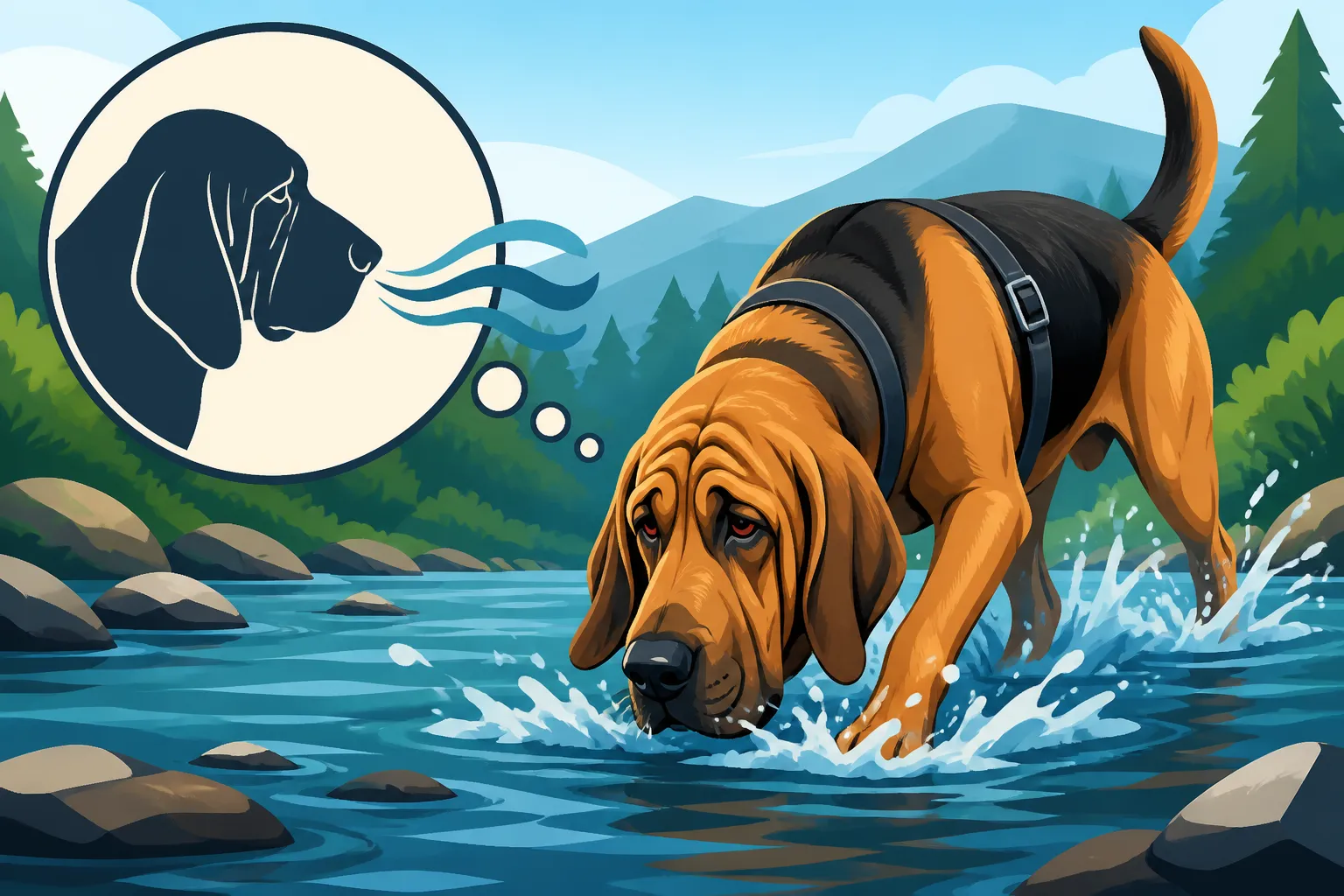
While Bloodhounds are masters of ground scent, picking up those shed skin cells that settle on the earth, they also utilize air scent, especially when the ground trail becomes difficult. Near water, this air scent component becomes even more critical. Your Bloodhound might switch from actively tracking with their nose to the ground to lifting their head, "air scenting" to pick up particles that have been carried by the wind across a river or along its bank.
The "cone" of scent dispersion becomes a real factor over water. If a person wades into a creek and then climbs out, their scent might be like a faint, wide cone emanating from their entry point, trailing across the water, and then narrowing again as they exit. This wider, less defined scent cone over water can be incredibly challenging for even the most talented Bloodhound. Factors like the water's current can pick up and carry scent particles downstream, leading your dog to follow the water's edge rather than attempting a direct crossing. Wind can also play a huge role, pushing scent particles across a narrow stream or blowing them away entirely from a wide lake. Even the depth of the water can matter; very shallow water might retain more scent on the substrate, while deep, fast-moving water offers fewer solid surfaces for scent to cling to. Despite these challenges, a Bloodhound's natural instinct is to follow the scent, which means they will often try to work out the puzzle, sometimes even attempting to enter the water themselves if they believe the trail is truly there. They are incredible problem-solvers, even when faced with the laws of physics.
Scenarios: Trailing Across Different Water Bodies
Not all water obstacles are created equal when it comes to scent trailing. The size, depth, and movement of the water body significantly impact how a Bloodhound will approach and potentially overcome the challenge.
Small Puddles and Shallow Streams
For the most part, small puddles and shallow streams typically don't pose a major threat to a Bloodhound's trail. If the person being trailed has simply stepped through a puddle or splashed through a stream that's only ankle-deep, the scent layer on the ground might remain largely intact, or at least enough for your Bloodhound to quickly pick it up on the other side. Your dog might briefly lift their head, perhaps give a little shake of their own head as they pass through the water, but they usually reconnect with the scent with relative ease once they are back on solid ground.
The key here is momentum and the minimal disturbance of the scent. If the stream is narrow, the scent particles might even "bridge" the gap, carried by gentle air currents, allowing the Bloodhound to effectively track without losing a beat. As a handler, you'll need to observe your dog closely. A brief hesitation or a slight change in head carriage is normal, but if they continue to show drive forward, trust their nose. It's crucial not to interrupt their focus unless they are truly lost. Often, they just need a moment to confirm the scent and then they'll be off again. For a young Bloodhound, getting them comfortable with wading through shallow water during training sessions, perhaps with a fun reward on the other side, can build confidence for these common encounters. Many times, these minor water crossings become almost second nature for a seasoned trailing dog.
Rivers and Lakes: A Greater Challenge
When the water body is larger – a wide river, a deep canal, or the edge of a lake – the challenges for a Bloodhound escalate significantly. Here, the scent isn't just momentarily disturbed; it can be actively washed away, dispersed by strong currents, or simply dissipate over a large open area where wind and sun have greater impact. In these situations, your Bloodhound isn't just looking for a direct path across; they're trying to figure out if the person entered the water, where they might have exited, or if they followed the bank.
This is where the "point last seen" (PLS) concept becomes paramount. Your Bloodhound might be able to tell you exactly where the person reached the water's edge. They'll often work the bank diligently, sniffing every rock, every clump of grass, trying to find an entry or exit point. If the person waded across a river, the Bloodhound might air scent from the bank, trying to catch any faint traces that have been carried by the breeze from the opposite side. However, they are generally not trained to track through a large body of water in the way a water recovery dog might work. Their expertise lies in terrestrial scent. You might find them frantically working one bank, then needing to be cast to the other side to continue the search. The temperature of the water can also play a role; very cold water might preserve some scent, while warmer water can accelerate decomposition of scent particles. The sheer volume of water and its movement typically means the direct scent path through a large body of water is lost. Knowing How Far a Bloodhound Will Follow a Trail is important, but a wide river can effectively act as a hard stop to a direct ground trail.
What Happens When a Person Enters Water and Stays In?
This is arguably the most difficult scenario for a Bloodhound, and it's where their role shifts from active trailing to helping define a search area. If a person enters deep water and remains submerged, the distinct, concentrated scent that a Bloodhound relies on is significantly diminished, diffused, and often impossible to follow. Bloodhounds are not typically specialized water recovery dogs, which often work with different scent profiles (e.g., cadaver scent) and methodologies.
In such cases, the Bloodhound's invaluable contribution becomes locating the precise entry point, or "Point Last Seen" (PLS), as accurately as possible. They can often indicate where a person walked to the edge, even if they can't follow them into the water. They might also indicate exit points along the shoreline if the person got out further away. The focus then shifts to an intensive shoreline search. Water currents can, however, carry scent along the bank. Imagine a river with a strong current; scent might still emanate from the water, but it will be carried downstream. Your Bloodhound might follow this "linear" scent along the bank, indicating the general direction of travel, rather than a specific point within the water. This information is crucial for search teams, even if the Bloodhound isn't actively trailing in the water. It helps narrow down where other resources, such as divers or specialized water cadaver dogs, should concentrate their efforts. It’s important to understand this limitation to avoid frustration and manage expectations during a critical search.
Training and Handling for Water Obstacles
Successfully navigating water obstacles with your Bloodhound isn't just about the dog's inherent ability; it's also about proactive training and smart handling strategies on your part. A confident dog with a knowledgeable handler is always more effective.
Preparing Your Bloodhound for Water Crossings
The journey to a water-confident Bloodhound starts long before you encounter a critical trail that disappears into a creek. Early exposure is key, just like with any other environmental factor. Begin by introducing your Bloodhound puppy to various types of water bodies in a positive and low-pressure way. Start with shallow puddles, then progress to gentle streams, and eventually, if appropriate, larger, calm bodies of water. The goal isn't to make every Bloodhound love swimming – some simply don't, and that's okay! – but rather to ensure they are comfortable and willing to enter or cross water when necessary for their work.
Make these experiences fun. Toss a favorite waterproof toy into shallow water, or use high-value treats to lure them across a small stream. Praise and reward heavily for any willingness to engage with the water. You might find some Bloodhounds are naturally more inclined to water than others. During these training sessions, begin to associate specific commands with water crossings, such as "cross" or "wade." This helps them understand what's expected. A Bloodhound who has been exposed to different terrains, including wet, muddy, and rocky stream beds, will be more confident when faced with similar conditions on an actual trail. Remember, building confidence takes time and patience, but it's an investment that pays off immensely when your dog calmly assesses a water obstacle rather than becoming hesitant or shutting down. You'll also want to prioritize Cleaning a Bloodhound's Ears Every Week for Life, especially if they enjoy splashing around, as dampness can quickly lead to infections.
Handler Strategies at the Water's Edge
When your Bloodhound's trail hits water, your role as the handler becomes absolutely critical. This isn't the time to panic or try to guess. It's time to observe, trust your dog's signals, and apply strategic thinking. First and foremost, allow your Bloodhound to work the banks thoroughly. They will often pace back and forth, sniffing intently, trying to pick up any "spillover" scent that has been carried along the shoreline or blown from across the water. Pay close attention to subtle changes in their tail action, head carriage, and the intensity of their pull on the line – these are all indicators of whether they're still on scent, even if it's faint.
Knowing when to encourage a crossing versus searching for an alternative path is a judgment call that comes with experience. If the water is narrow and the dog shows strong indications that the scent goes straight across, a gentle encouragement to cross might be appropriate. If they hesitate, work both banks for a good distance, both upstream and downstream, before pushing for a crossing. The wind direction is a massive factor here; scent will naturally travel downwind, so if the wind is blowing across the water, your Bloodhound might pick up scent on the far bank even if it's very faint. If the wind is blowing along the water, they might track the bank for a long way before finding a definitive exit. This is where a long line comes into its own. Using a high-quality, durable long line, perhaps one you'd find on Amazon, allows your Bloodhound the freedom to explore the banks or make a cautious crossing while still providing you with control and safety. Never pull them into water unwillingly, but guide them and let their nose lead the way as much as possible. If the trail truly goes cold, marking the "point last seen" accurately is vital for follow-up search efforts.
When the Trail Goes Cold at Water
It's going to happen. You're working a trail, your Bloodhound is focused, and then they reach a body of water and the scent simply… vanishes. They might work the banks diligently, pacing back and forth, sniffing every nook and cranny, but eventually, their cues tell you the trail has gone cold. This is when frustration can set in for even the most experienced handler, but it's crucial to remember that a "cold" trail at water isn't necessarily a failure; it's a piece of vital information.
Your first step is to re-establish the "Point Last Seen" (PLS) as accurately as possible. This means the last point on solid ground where your Bloodhound indicated strong, consistent scent. This spot becomes your new starting point for other strategies. From there, you'll need to expand your search radius, primarily focusing on both banks of the water body. The subject might have followed the bank for a considerable distance before finding a safer crossing point, or perhaps they doubled back. Consider the geography: Is there a bridge upstream or downstream? Are there areas where the water narrows significantly? If you're working with a search team, this is when other resources might be called in. Specialized water recovery K9s, which are trained for cadaver scent in water, or even drones with thermal imaging, could be deployed based on the Bloodhound's information. It's important to remember that sometimes, the most effective strategy is to assume the person exited further down or upstream than initially thought and begin a new cast from an educated guess of their potential exit point. Above all, resist the urge to contaminate the area around the PLS by walking all over it, as this can destroy any lingering scent. Patience, systematic searching, and knowing when to call in specialized assistance are hallmarks of a skilled handler when a trail seems to disappear into the water.
Tools and Considerations for Water Trailing
Being prepared for water encounters on a trail involves more than just training your Bloodhound; it also means having the right gear and understanding the health and safety implications of wet environments.
Essential Gear for Wet Environments
When you're out trailing with your Bloodhound, especially in areas with potential water crossings, having the right gear can make a huge difference in comfort, safety, and effectiveness. First, and perhaps most obviously, waterproof leashes and harnesses are absolutely crucial. A leather leash, while classic, can become heavy, slippery, and eventually rot if repeatedly soaked. Biothane or similar synthetic materials are fantastic for long lines and harnesses, as they don't absorb water, are easy to clean, and remain grippy even when wet. Look for durable, well-stitched options that can withstand powerful pulls, such as those you might find on Amazon.
Don't forget the Bloodhound's magnificent ears! Those long, heavy ears are built to sweep scent, but they're also highly prone to issues when wet. A snood can be a lifesaver, especially if your Bloodhound is drinking from puddles or wading through shallow water, keeping those ears out of the muck and moisture. A Bloodhound's Ears Are a Standing Infection Risk is a very real concern, and a snood helps mitigate it. For yourself, waterproof boots and quick-drying clothing are non-negotiable. There's nothing worse than being cold and wet for hours on a search. And always, always carry a dedicated towel for your dog. A quick rub down after a water crossing can help prevent skin irritation or chills. Consider a dog-specific towel that is super absorbent and can be easily packed. These small gear choices can significantly improve the trailing experience for both you and your Bloodhound.
Health and Safety in and Around Water
Working around water bodies with your Bloodhound introduces a unique set of health and safety considerations that every handler must be aware of. One of the most immediate concerns, especially in cooler weather, is the risk of hypothermia. Even if your Bloodhound isn't fully submerged, prolonged exposure to cold water or damp, chilly air can drop their body temperature dangerously. Always have a plan for warming them up quickly if they get too cold, whether it's a warm blanket in the car or a dry vest.
Waterborne diseases are another serious threat. Leptospirosis, for example, is a bacterial disease often spread through the urine of infected wildlife (like rodents) and thrives in stagnant or slow-moving water. Ensure your Bloodhound is up-to-date on all recommended vaccinations, including lepto, if you'll be working in these environments. Giardia and other intestinal parasites can also be contracted from contaminated water. Always carry fresh water for your dog, even if you're surrounded by streams, and encourage them to drink from their own supply rather than questionable natural sources. Beyond disease, the physical environment itself poses risks. Watch out for sharp rocks, broken glass, or submerged debris that could cut paws or cause injuries. Strong currents in rivers can be deceptively powerful; never put yourself or your dog in a situation where you could be swept away. Familiarize yourself with how A Bloodhound's Ear Canal Stays Damp and the increased risk of infection after water exposure, making diligent post-water ear care a priority. These considerations are not meant to deter you but to empower you to trail safely and responsibly.
Understanding Limitations
Despite their legendary noses, it's vital to have a realistic understanding of a Bloodhound's limitations, especially when it comes to trailing through water. Their nose is not magic; it operates within the laws of physics, and water introduces significant variables that can make scent trailing extremely difficult, if not impossible, in certain situations. While a Bloodhound can often navigate small puddles and indicate entry/exit points from larger bodies of water, expecting them to track a submerged person or follow a direct scent trail across a wide, fast-moving river for miles is simply unrealistic.
The goal in these challenging water scenarios shifts from following a precise "line" to gathering information. Even if your Bloodhound cannot continue a trail directly, their ability to pinpoint where a person entered or exited the water, or to indicate a general direction along a bank, is incredibly valuable. It helps narrow down search areas and directs other resources effectively. There will be times when the scent truly goes cold at the water's edge, and that's okay. It means your Bloodhound has given you all the information they can, ruling out certain paths and confirming the subject's last known terrestrial location. Patience, realistic expectations, and the understanding that your Bloodhound is a partner in discovery – not a perfect robot – are paramount. Embrace the information they provide, even when it points to the end of a physical trail, and appreciate the immense effort and talent that went into getting you that far.
| Water Obstacle | Scent Challenge | Bloodhound Response (Typical) | Handler Action |
|---|---|---|---|
| Puddle/Shallow Stream | Minimal disruption; scent often crosses | May hesitate briefly, then cross; head up slightly | Encourage crossing; observe for re-engagement |
| Narrow Creek | Scent dispersed, carried by current | Works banks, may cross, air scents on far side | Work upstream/downstream, encourage crossing, long line |
| Wide River/Lake | Scent heavily diluted, washed away, wind-blown | Works entry/exit points; struggles with mid-water scent | Focus on shorelines; consider "point last seen" method |
| Standing Water (swamp) | Scent trapped, mixed with other organic scents | Slower, more deliberate search; may air scent | Allow thorough investigation; watch for hazards |
Disclaimer
This article is for general informational purposes only and does not constitute professional advice. Laws, prices and regulations vary by location and change over time. Consult a qualified professional for guidance on your specific situation.