When Bloodhounds Began Trailing People Instead of Game
A Bloodhound’s history did not turn on one dramatic moment when it stopped hunting deer and began following people. The shift was gradual: hounds bred to pursue scent were increasingly valued for tracking people, too. This guide explains what changed, when the evidence becomes clearer, and why “Bloodhound” can mean different things in different historical records.
From game trails to a broader scenting role
The hound came before the modern Bloodhound
The Bloodhound’s ancestry is often linked to the hounds of Saint Hubert, bred by monks at the Abbey of Saint-Hubert in what is now Belgium. Those dogs were associated with hunting, especially the pursuit of game. They were not necessarily identical to the modern Bloodhound as we know it, though: breeds develop over time, and historical names are not always used consistently. For more on that distinction, see The Abbey of Saint Hubert Bred the Bloodhound's Ancestor and What the Chien de Saint Hubert Was Used For.
The practical skill that mattered was not a particular quarry but a dog’s ability to follow scent over distance. A hound that could stay on the trail of an animal might also be useful when the trail belonged to a person. That does not mean the earliest Saint Hubert hounds were routinely used as people-tracking dogs. It means their hunting abilities gave handlers a reason to try them for other tasks.
Names can make the history harder to follow. “Bloodhound” does not mean a dog that tracks blood. The name is generally connected with a hound’s carefully kept or “blooded” breeding, rather than a special ability to follow a wounded animal. For more context, see What the Name Bloodhound Actually Means.
The early shift was gradual, not a clean handover
It is tempting to picture one clear transition: first the dogs hunted game, then someone discovered they could track people. The historical record is less tidy. Hunting and human tracking could overlap, and a dog’s role might depend on the handler, the local laws, and the problem at hand. A hound might be bred and kept for hunting while also being asked to follow a person’s scent.
The evidence also comes from different periods and sources. A text describing a hound used to find a fugitive may not identify the animal with the precision expected of a modern breed history. Older writers used dog names in flexible ways, and the boundaries between related hounds were not always sharply drawn. So it is safer to talk about an expanding tracking role than to claim a single invention date.
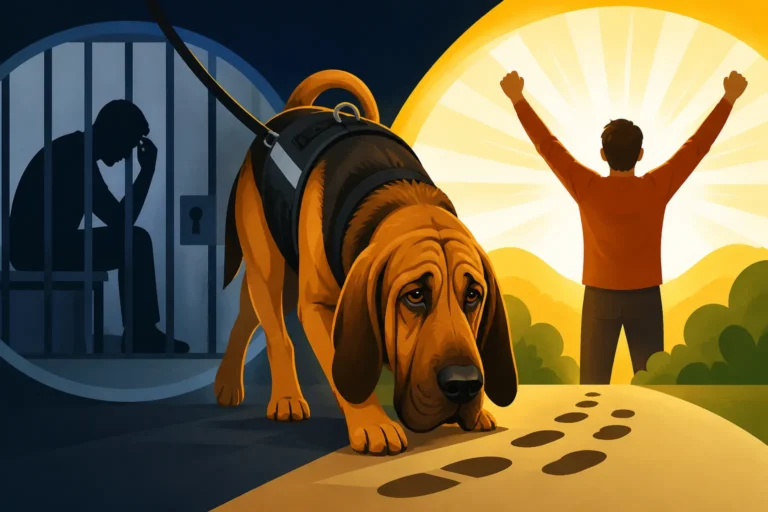
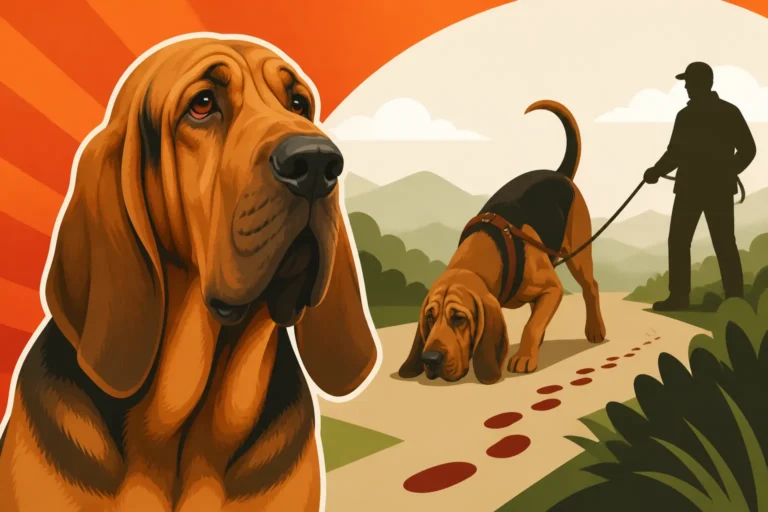
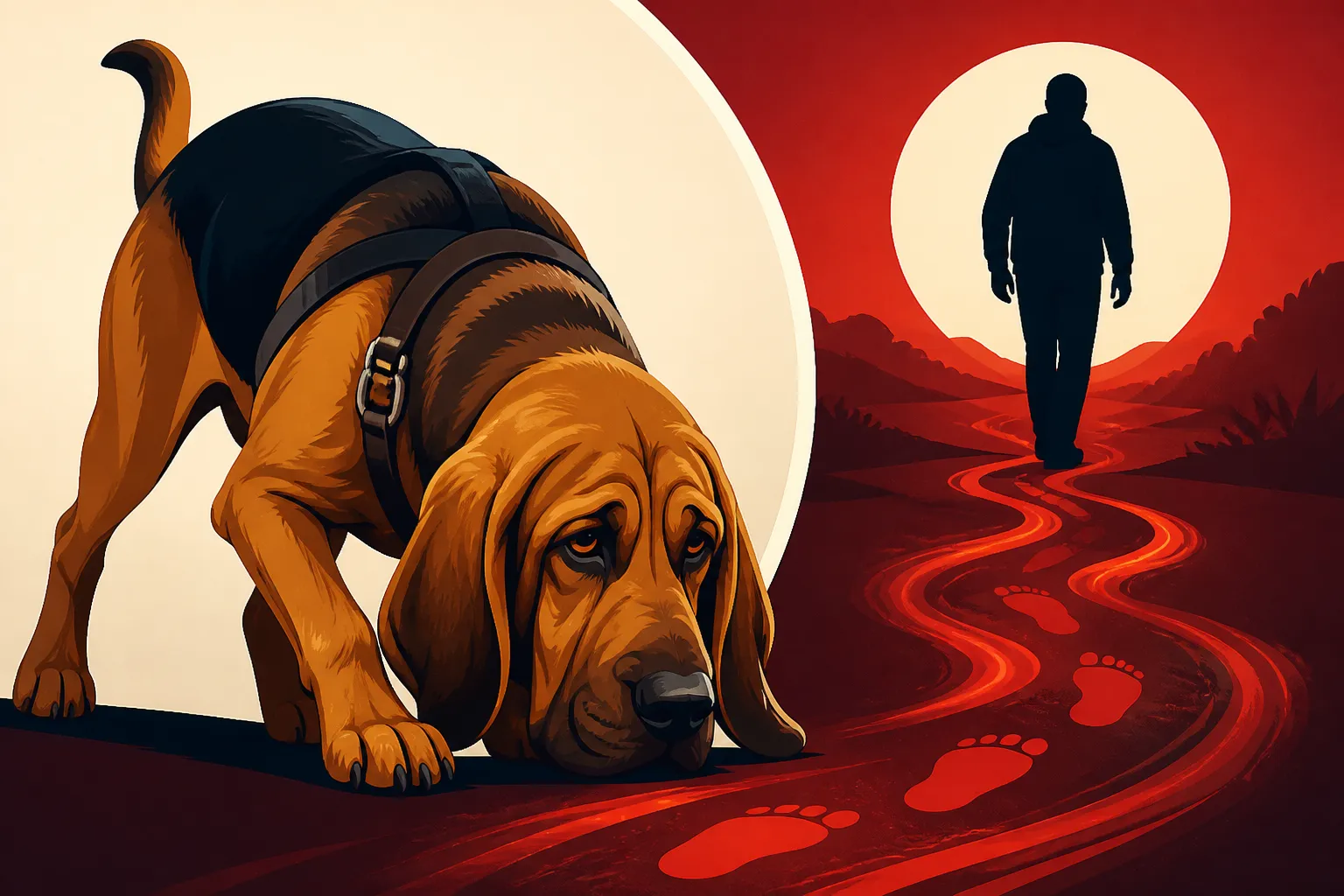
Over time, people began to recognize that a hound could be useful not only for finding game but for following a particular person. This change was practical: the dog’s nose could help locate someone who had fled, disappeared, or moved through difficult terrain. Human tracking became one use of a scent hound, rather than an instant replacement for hunting.
When human tracking becomes easier to identify
Late medieval and early modern references
Descriptions of hounds tracking people appear in the historical record before the modern Bloodhound was fully standardized. Some accounts refer broadly to dogs used to pursue criminals, fugitives, or people who had crossed a boundary. But interpreting those references requires care: a writer might describe a “bloodhound” or “sleuth hound” without giving enough detail to confirm that the dog matched today’s breed.
The clearest picture emerges gradually in the late medieval and early modern periods, when hounds were used in parts of Britain to follow human trails. In Scotland and along the border regions, tracking dogs could help pursue people accused of theft or other offenses. The work could be demanding: a trail might cross rough ground, pass through settlements, or be obscured by weather and other scents.
That development did not mean every Bloodhound was a law-enforcement dog. The breed remained associated with hunting, and people used different types of scent hounds for different tasks. The important point is that human tracking was recognized as a valuable skill well before the breed became known chiefly in popular imagination for following people.
Why authorities valued a dog’s nose
Before modern communications and forensic methods, locating a person who had left a scene could be difficult. A dog able to follow scent offered a practical advantage, especially when the trail was fresh and the handler knew where it began. A hound could cover ground in a way a search party might not, and it could keep working when visual clues were limited.
Still, a dog’s trail was not magic, and historical handlers faced many of the same complications people discuss today: weather, crowds, interruptions, and uncertainty about the starting point. A hound might lose a scent or follow a misleading one. The dog’s behavior had to be interpreted by a handler, and a trail alone did not automatically establish what had happened or who was responsible.
Human tracking also carried serious ethical and historical consequences. Bloodhounds and other scent hounds were used in harmful systems of pursuit and control, including the tracking of enslaved people in some contexts. That history should not be softened or treated as a colorful footnote. The same scenting ability could be used to find a missing person or to help enforce violent and unjust systems. For related historical context, see Whether Bloodhounds Were Used to Track Enslaved People.
How the Bloodhound reached England and developed
A name and a breed take shape over time
The Bloodhound’s English history is part of a longer movement of hounds, breeding practices, and hunting traditions across Europe. The dogs associated with Saint Hubert became linked with England, where breeders and hunters shaped the hound according to local preferences and uses. That journey was not a single transfer of a finished modern breed. It was an ongoing process of importing, breeding, and distinguishing types of hound. See How the Bloodhound Reached England for more on that route.
As breeding became more deliberate, the Bloodhound came to be recognized as a particular kind of hound rather than simply one name for any dog that followed a trail. Its reputation for scenting helped make it useful in more than one setting. Hunting remained part of its story, while tracking people became an increasingly prominent association.
This is why a question such as “When did Bloodhounds start trailing people?” does not have a neat answer like a date on a calendar. The broader skill existed before the breed was consistently defined by its modern name. Human tracking appears in accounts over time, while the breed’s form and identity continued to develop. For the English breeding side of that story, see What English Breeders Changed About the Bloodhound.
Hunting and people-tracking continued side by side
A shift in reputation is not the same as a complete shift in use. Bloodhounds and related scent hounds continued to be associated with hunting even as their ability to follow human scent gained notice. Depending on time and place, a dog might be used to pursue game, track a person, or serve in more than one role during its working life.
This overlap is easy to miss when modern stories present the Bloodhound as though it has always had one defining job. In reality, working dogs are shaped by what people ask of them. The same physical and behavioral traits that support persistent tracking can be useful across different tasks. What changes is the handler’s purpose and the social context around the work.
| Historical development | What it suggests | Important caution |
|---|---|---|
| Saint Hubert hounds were associated with hunting | The ancestry is rooted in scent hounds bred for game work | They should not be treated as identical to the modern Bloodhound |
| Hounds were described tracking people in older records | Human tracking developed as a practical use of scenting ability | Historical labels do not always identify a precise breed |
| Human tracking became more visible in late medieval and early modern accounts | The role grew in recognition over time | There is no single, agreed-upon starting date |
| English breeding helped define the Bloodhound more clearly | Breed identity and working reputation developed together | Hunting and people-tracking did not replace one another neatly |
What the historical shift means today
Separate the dog’s ability from the purpose of the work
When people ask when Bloodhounds began trailing people, they are often asking two questions at once: when did handlers first use scent hounds to follow a person, and when did the Bloodhound become recognized for that work? Those are related but not identical. Human tracking appears in older records, while the modern breed identity took shape over a longer period.
It also helps to distinguish a dog’s ability from how people use it. A Bloodhound can follow scent with remarkable persistence, but that ability does not make every trail accurate or turn a dog’s behavior into proof on its own. A trained handler, a clear starting point, and careful interpretation matter. The history is more meaningful when we acknowledge both the skill and its limits.
For a broader look at how the breed’s tracking legacy became part of its reputation, see The Bloodhound Is the Only Dog Whose Evidence Stands in Court. The title reflects a modern cultural association, but legal use and evidentiary standards vary. It should not be read as meaning that a dog’s trail independently settles a case.
Keep historical accounts in their proper context
Older descriptions can be fascinating, but they are not always easy to compare with present-day working practice. A brief account may leave out how the dog was trained, how the trail was established, or how the handler judged the result. It may also use a breed name loosely. Read those records as evidence of a developing role, not as a complete technical manual.
For present-day owners, the history can prompt practical questions about living with a scent-driven dog: how to provide safe enrichment, how to manage a dog that wants to follow a smell, and how to keep daily care consistent. A retailer such as Chewy may be one place owners browse for food or basic grooming items, but a veterinarian can help match care choices to an individual dog. Some people use Chewy to look at enrichment options, too; scent games should still be introduced safely and suited to the dog. Chewy is a modern retailer, not a source for interpreting historical claims, and contemporary pet-care products should not be mistaken for historical working equipment.
The most accurate answer, then, is that Bloodhounds did not suddenly abandon game trails for human ones. Their people-tracking role grew over time from the broader skill of following scent. Historical references become clearer across the late medieval and early modern periods, while the breed’s name, identity, and reputation continued to develop in parallel. The story is one of gradual adaptation, overlapping work, and changing human purposes.
Disclaimer
This article is for general informational purposes only and does not constitute professional advice. Laws, prices and regulations vary by location and change over time. Consult a qualified professional for guidance on your specific situation.