Which Other Bloodhounds Are Famous
Bloodhound fame tends to gather around a few memorable names, while many working dogs did remarkable things without becoming household names. That can make it hard to separate documented history from legend or to tell which beloved cartoon dogs are actually Bloodhounds. This guide looks at notable real and fictional Bloodhounds, explains what made them famous, and puts their stories in context.
Nick Carter and the famous working Bloodhounds
Why Nick Carter became a household name
When people ask about famous Bloodhounds, they often mean Nick Carter, a celebrated American tracking dog from the early twentieth century. He is remembered for following human trails and helping law enforcement locate people. In stories about the breed, he became a symbol of what a determined Bloodhound could do: keep working a scent trail long after a person might have given up.
Nick Carter’s fame is also a reminder that a working dog’s reputation can grow beyond the details we can confidently establish. Accounts credit him with an extraordinary number of successful finds, sometimes repeating a specific tally as if it were settled fact. But figures and stories associated with famous working dogs can be repeated, embellished, or counted in different ways. It is more responsible to describe Nick Carter as a widely celebrated tracking hound than to treat every claim about his record as independently verified.
For more about the stories attached to him, see Nick Carter, the Bloodhound With Six Hundred Fifty Finds and Who Owned the Bloodhound Nick Carter. The distinction between a dog’s handler, owner, and public promoter matters: the human partner usually plans the search, interprets the dog’s behavior, and explains the result to others. The dog contributes an extraordinary nose, but the work is a team effort.
What Nick Carter’s story tells us about scent tracking
A Bloodhound following a person does not simply move along a visible line on the ground. It investigates scent left by a person and works through a changing mix of odor, wind, terrain, weather, and other people’s activity. A handler watches the dog closely, gives it room to investigate, and has to judge when the animal is following a trail, checking an area, or losing the scent.
That partnership is part of why famous tracking stories can be difficult to evaluate from a distance. A dog may locate someone, but the handler and investigators still need to work out what the find means. A trail can support an investigation; it does not, by itself, establish every detail of what happened. For a closer look at the historical claims surrounding Nick Carter, see How Many Convictions Nick Carter's Nose Produced in 1903 and Whether Nick Carter's Finds Were Documented.
Stories about Nick Carter also tend to focus on dramatic moments: a difficult route, a long search, or a trail that seemed unlikely to succeed. Those details make for compelling storytelling, but the less theatrical parts of tracking matter just as much. Training, a suitable scent article, careful handling, and corroborating evidence all help make a search meaningful. The same caution applies to tales about an especially astonishing trail, including Whether Nick Carter Trailed a Man Across a River.
Famous does not mean infallible
A Bloodhound’s sense of smell is remarkable, but no dog is a flawless instrument. A dog can be distracted, encounter confusing scents, or fail to follow a trail. A handler can also misread the dog’s behavior. That does not make scent work useless; it means a dog’s indication should be interpreted carefully and considered alongside other evidence.
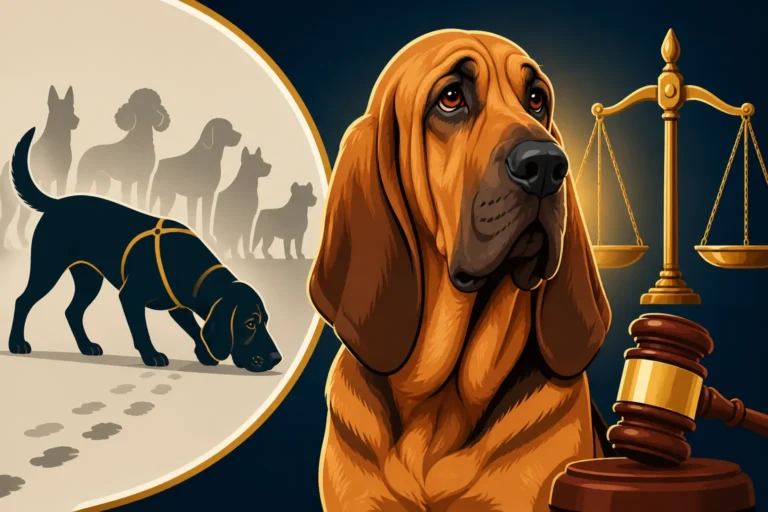
Nick Carter’s fame has also become entangled with broader arguments about how courts and investigators have used tracking dogs. Legal standards and practices vary, and a dog’s work is not automatically accepted as proof in every setting. The history is more complicated than the popular image of a Bloodhound leading directly from a scent to a certain verdict. For the legal background, see Which Court First Accepted a Bloodhound's Trail and Whether a Bloodhound's Trail Alone Can Convict.
Fictional Bloodhounds people remember
Trusty from Lady and the Tramp
Trusty, the older Bloodhound in Disney’s Lady and the Tramp, is one of the breed’s most recognizable fictional representatives. He is warm, loyal, and a little wistful about getting older. His character uses familiar Bloodhound features, including long ears and loose facial skin, but his personality is what makes him memorable: he is the kind of friend who offers encouragement even when his own confidence is wearing thin.
Trusty’s storyline also gives the breed a gentler screen image than the dramatic tracking hound often found in crime stories. He is a companion and neighbor, not a relentless investigator. That matters because a single dramatic role can become the public’s entire impression of a breed, even though everyday Bloodhounds are individual dogs with their own temperaments, routines, and needs.
The film’s version is, of course, a character rather than a guide to living with the breed. A real Bloodhound may be affectionate and sociable, but the long ears, facial folds, strong scent drive, and deep voice call for practical planning. If you are curious about what those traits mean in a home, The Household a Bloodhound Was Built For offers a broader look at the breed’s everyday fit.
Bruno from Cinderella
Bruno, Cinderella’s dog, is another well-known animated Bloodhound. He is portrayed as devoted to Cinderella and eager to chase Lucifer, the household cat. His role is brief compared with a main character’s, but his broad head, drooping ears, and hound-like appearance make him easy to recognize as a Bloodhound-inspired dog.
Bruno’s story is a useful example of how animation often turns a breed into a handful of instantly readable traits. A long-eared dog becomes a faithful companion; a cat chase becomes a bit of comic action. Real household relationships are less scripted. A Bloodhound can live with other animals, but introductions, supervision, and individual temperament matter more than a character’s breed label on screen.
Trusty and Bruno are more securely identifiable as fictional Bloodhounds than many other dogs people casually assign to the breed. Film and television often use “hound” as a general visual shorthand: droopy ears, a long muzzle, or a mournful expression do not necessarily mean the character is a Bloodhound. For more on screen portrayals, see Whether the Bloodhound Appears in Film and Television.
The famous hound that is not necessarily a Bloodhound
A familiar source of confusion is the hound in The Hound of the Baskervilles. The story is famous, and adaptations often show a large, menacing dog with features that viewers associate with Bloodhounds. But the word “hound” in a title is not enough to identify a character as a Bloodhound. Different versions of the story may depict the dog differently, and adaptations often take artistic liberties.
It is worth separating three things: the breed a fictional character is explicitly described as, the dog used in a particular screen adaptation, and the general hound-like look that audiences recognize. Those categories can overlap, but they are not interchangeable. The same caution applies to any famous fictional dog whose identity is not clearly stated. A familiar silhouette alone is weak evidence of breed.
This distinction helps keep breed history grounded. A character may borrow the Bloodhound’s long ears and solemn expression without representing the breed accurately or even being intended as one. For historical context on why the breed’s image has sometimes been shaped more by storytelling than by ordinary life, see Whether the Bloodhound's Reputation Was Damaged by Fiction.
Why some Bloodhounds became famous and most did not
A combination of skill, timing, and storytelling
A working Bloodhound can do impressive work without ever becoming famous. Public recognition usually depends on more than ability: the dog needs a notable story, people willing to share it, and circumstances that attract attention. An unusual trail or a high-profile search is easier to remember than years of steady work that never makes the news.
That is why famous names are not a complete record of the breed’s contributions. Many dogs have worked with police departments, search teams, or individual handlers without becoming widely known outside their communities. Their value may lie in repeated, practical work rather than one dramatic episode. When the dog is part of a team, the handler, investigators, and local agency also shape how the work is understood and remembered.
A clear example is the difference between a famous name and a proven result. A story can be memorable even if details are incomplete; a careful account may be less exciting but more useful. When reading about a celebrated Bloodhound, ask what the dog actually did, who was present, what was recorded, and whether the story distinguishes the dog’s tracking work from the outcome of an investigation.
How to read historical accounts responsibly
Older accounts of Bloodhounds often reflect the attitudes and institutions of the time in which they were written. That context matters, especially because dogs were used in the pursuit of enslaved people and in other forms of racialized violence. Those histories should not be softened into a simple tale of canine talent. The dog’s ability may be part of the record, but so are the human purposes behind its use. Whether Bloodhounds Were Used to Track Enslaved People addresses this difficult part of the breed’s history.
When you encounter a dramatic claim, look for specifics. Does the account identify the dog and handler? Does it describe when and where the event happened? Does it explain what “success” meant? Is a number being repeated without any information about how it was counted? These questions do not automatically disprove a story. They help distinguish a documented event from a legend that has become more polished with each retelling.
This balanced approach is especially useful with historic tracking dogs. It allows people to recognize genuine working ability without treating every celebrated tale as unquestionable fact. It also helps avoid a common mistake: assuming that a dog’s reputation proves it could not have been wrong, or that a dramatic story describes what every Bloodhound can do.
A quick guide to famous Bloodhounds
| Name or reference | Where people know it from | What to keep in mind |
|---|---|---|
| Nick Carter | Stories about American tracking dogs | A prominent real working Bloodhound, though some details and tallies should be treated cautiously |
| Trusty | Disney’s Lady and the Tramp | A fictional Bloodhound portrayed as an older, loyal companion |
| Bruno | Disney’s Cinderella | A fictional Bloodhound whose role reflects familiar hound traits |
| The hound in The Hound of the Baskervilles | Sherlock Holmes fiction and adaptations | A famous “hound,” but not automatically a Bloodhound in every version |
The best-known Bloodhounds are a mix of a celebrated working dog and fictional characters that audiences have enjoyed for generations. Nick Carter’s name is tied to the breed’s tracking reputation, while Trusty and Bruno offer friendlier, domestic portrayals. At the same time, famous stories deserve a little scrutiny: not every number is firmly established, not every hound character is a Bloodhound, and a tracking dog’s work should not be confused with proof of a case.
Disclaimer
This article is for general informational purposes only and does not constitute professional advice. Laws, prices and regulations vary by location and change over time. Consult a qualified professional for guidance on your specific situation.