Whether the World Wars Cut Bloodhound Numbers
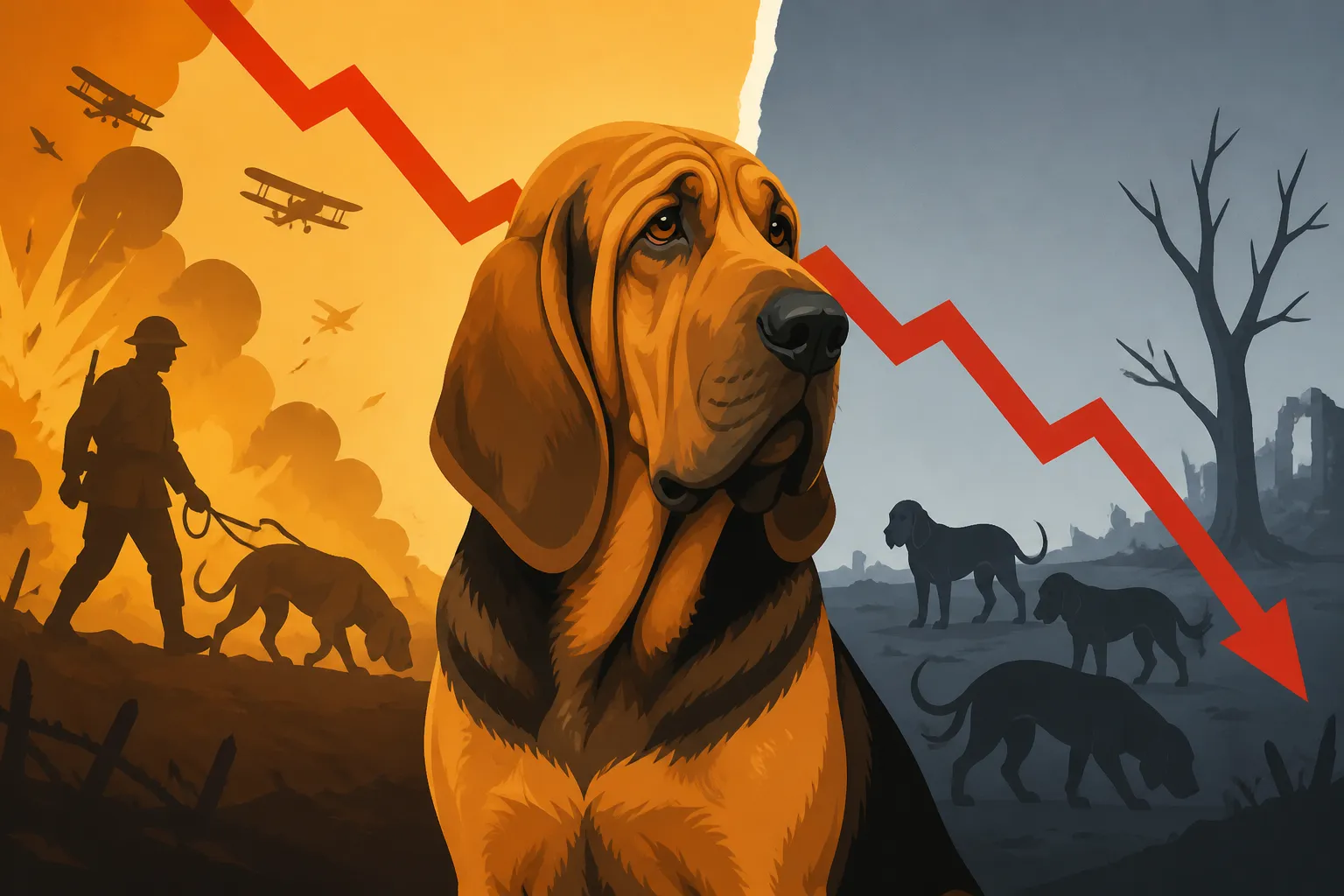
The World Wars did reduce Bloodhound numbers, especially in Britain and parts of continental Europe, by interrupting breeding and making it harder to keep large dogs. But there is no single reliable wartime census that shows exactly how many Bloodhounds were lost. The clearest picture is a serious strain on an already uncommon breed, followed by gradual rebuilding.
How the World Wars affected Bloodhound numbers
Why the First World War disrupted breeding
Before the First World War, Bloodhounds were established in Britain and elsewhere, but they were never a numerous, everyday breed. Their specialist purpose, size, and demanding upkeep meant that breeding depended on a relatively small network of owners and kennels. That left the breed more vulnerable to disruption than a common dog with a much larger population.
During the war, ordinary life became difficult for people and animals alike. Food and other necessities were restricted, owners were separated from home, and kennels had fewer people available to care for dogs. Breeding also requires planning and continuity: suitable dogs must be kept, paired, and cared for through pregnancy and puppyhood. When families were coping with wartime pressures, maintaining that work could become impossible.
Bloodhounds’ size made the challenge especially practical. Feeding and housing a large dog required resources that were harder to come by during a period of scarcity. Some owners may have had to reduce their kennel operations or stop breeding altogether. Even where adult dogs survived, fewer litters could mean a smaller pool of young dogs available to carry the breed forward.
This is one reason historians and breed enthusiasts describe a serious decline without always being able to give a precise count. Wartime records do not provide a complete, consistent headcount of every Bloodhound in every country. Breed registrations, where available, can show changes in recorded breeding activity, but they do not tell us exactly how many dogs were alive or how many were lost outside formal records.
Why the Second World War added another setback
The Second World War brought another period of disruption before the breed had necessarily returned to its earlier strength. Once again, families faced shortages, travel restrictions, separation, and pressure on the resources needed to keep and breed dogs. Kennels could close, breeding plans could be abandoned, and dogs could be lost when owners’ circumstances changed.
The effect was cumulative. A breed with a modest population can be weakened not only by deaths but also by years in which fewer litters are born. If a small number of breeding dogs are unavailable, the next generation has fewer options. That can narrow the range of bloodlines, make it harder to find suitable mates, and slow recovery even after daily life becomes more stable.
It is important not to treat the two wars as identical events or to assume that every Bloodhound population suffered equally. The sharpest pressure appears to have been in Europe, where conflict and disruption were most direct. The experience in the United States was different, though American breeders were part of a wider dog world affected by international upheaval. The breed’s history also includes movement between countries, so the fate of one regional population could influence rebuilding elsewhere. For more on those distinctions, see Whether American Bloodhounds Differ From English Ones.
What “cut the numbers” means in this context
When people ask whether the wars cut Bloodhound numbers, they may be imagining a documented population falling from one known total to another. That kind of clean comparison is difficult to make. Historical dog populations were not consistently counted in the way a modern conservation census might be, and a registry records registered dogs rather than every living dog.
A more defensible conclusion is that the wars reduced breeding and put existing dogs at risk, contributing to a smaller and more fragile population. The scale of the effect varied by place and period. A kennel that stopped breeding for several years might leave no dramatic record of individual losses, yet its absence could still matter to the breed’s recovery.
| Wartime pressure | How it could affect Bloodhounds | What the historical record can show |
|---|---|---|
| Food and household shortages | Owners may have struggled to feed and maintain large dogs | Evidence of hardship, but not a complete count of dogs lost |
| Kennel closures or reduced operations | Fewer planned matings and litters | Changes in breeding activity may be visible in records |
| Owners away from home or facing displacement | Care arrangements could fail or ownership could change | Individual stories may survive, while many cases went unrecorded |
| Interrupted travel and communication | Breeders had fewer opportunities to exchange dogs or arrange matings | Regional isolation and delayed rebuilding |
| Smaller breeding population after the war | Fewer choices for future pairings | Long-term effects on rebuilding and bloodline diversity |
The table is a useful way to separate direct losses from quieter damage. A dog did not have to die in a battlefield or air raid for the breed’s numbers to be affected. If no litter was produced, or if a kennel could not resume its work, the population could contract all the same.
How the breed survived and rebuilt
A small breed can recover slowly
The end of a war does not immediately restore a breed’s numbers. Owners need stable homes and access to food, and breeders need healthy dogs, time, and reliable records. Even when surviving Bloodhounds remained, rebuilding a kennel population required deliberate effort rather than simply waiting for numbers to bounce back.
That is particularly true for a breed that was never widely kept. Bloodhounds have distinctive needs and a specialized history as scent hounds. They were not a breed that every household was likely to acquire, so recovery relied on people who were committed to maintaining and breeding them. The reasons the breed remained relatively uncommon are explored in Why the Bloodhound Never Became a Popular Breed.
Breeding recovery also depends on having enough unrelated or appropriately matched dogs. If too few breeding animals remain in a region, breeders may need to look beyond their local area. Cross-border exchanges can help, but they depend on transport, communication, and a willingness to coordinate. Those conditions are not guaranteed immediately after a major conflict.
The history of the breed is tied to movement across Europe and Britain, which is part of why regional populations should not be treated as entirely separate stories. To understand the longer background, see Which Country the Bloodhound Comes From and How the Bloodhound Reached England. Those histories help explain how dogs and breeding traditions moved between places before modern registries and international travel became routine.
Why numbers and genetic diversity are not the same thing
A population may look as though it has recovered because more dogs are being born or registered, while still having a limited genetic base. If a relatively small group of survivors contributes most of the next generation, the number of dogs can rise faster than genetic diversity does.
This distinction matters when interpreting postwar recovery. A kennel may restart breeding, and the breed may again be visible in shows or working settings, yet the available breeding lines can remain narrow. It is not possible to infer the full genetic effect of the wars from population numbers alone, especially when historical records are incomplete.
The same caution applies to claims that the breed “nearly died out.” That phrase can describe a severe regional decline, but it may overstate the situation if readers take it to mean that no viable Bloodhounds remained anywhere. The breed’s story is better understood as one of serious vulnerability and recovery, with the exact severity differing by country and by period. For a closer look at the British experience, see Whether the Bloodhound Nearly Died Out in Britain.
There is also a difference between a breed surviving in small numbers and remaining secure. A handful of dedicated breeders can preserve a breed through a difficult period, but that is not the same as having a broad, resilient population. Recovery can take generations, and it depends on people continuing to value the breed once the immediate crisis has passed.
The role of registries and organized breeding
Breed registries can help document dogs and their pedigrees, but they are not complete historical censuses. Registration figures can reveal activity among participating breeders. They cannot necessarily account for unregistered dogs, dogs whose papers were lost, or dogs kept in places where records were interrupted.
Formal breeding organizations also become more useful once people can communicate and coordinate again. They help preserve pedigrees, promote breed standards, and connect owners and breeders. However, a registry cannot restore dogs that were lost or automatically widen a narrow gene pool. It is a record-keeping and coordination tool, not proof that every aspect of a breed’s population has recovered.
The American Kennel Club’s recognition history is one part of the broader story of how Bloodhounds became organized as a recognized breed in the United States. It offers a different lens from the wartime experience in Britain and Europe. See When the AKC Recognized the Bloodhound for that background.
What the wartime decline means for Bloodhounds today
It is a history of vulnerability, not a precise death toll
The most accurate answer is yes: the World Wars contributed to a decline in Bloodhound numbers, with serious consequences for breeding in Britain and parts of Europe. The wars made it harder to keep large dogs and maintain kennels, and breeding disruptions compounded the losses. But no single reliable figure captures the total number of Bloodhounds that died or the full decline across every country.
That distinction is not a way of minimizing the impact. It is a reminder that population history is often reconstructed from incomplete evidence. A breed can be badly affected even when no exact tally survives. The clearest evidence may come from the combination of disrupted breeding, reduced kennel activity, and accounts of later efforts to rebuild.
It also helps explain why the breed’s modern history is sometimes described through periods of scarcity rather than neat statistics. The same issue appears in discussions of whether the breed’s numbers are declining today. Registration totals, breeder activity, and the number of dogs living as pets all measure different things. See Whether Bloodhound Numbers Are Falling for a related discussion of how those measures can diverge.
What prospective owners can learn from that history
For someone considering a Bloodhound, wartime population history is not a reason to expect a particular health problem or temperament. It is a reminder that breed survival depends on responsible breeding and continued interest from people who understand the dog. A healthy future population is not secured merely because a breed has survived a past crisis.
Prospective owners can ask breeders about health testing, pedigrees, and the way they make breeding decisions. A responsible breeder should be able to explain the strengths and limitations of the lines they use, rather than presenting registration papers as a guarantee of health. The question of how breeding practices have changed is covered in Whether Bloodhounds Are Being Bred for Health Now.
For historians, the main lesson is to avoid oversimplifying the wars into a single dramatic statistic. The conflicts did not affect every region in the same way, and the surviving records cannot always separate deaths from reduced breeding or changes in ownership. For breed enthusiasts, the lesson is more personal: small populations can be fragile, and the commitment of a relatively small group of people may determine whether a breed has the chance to recover.
Disclaimer
This article is for general informational purposes only and does not constitute professional advice. Laws, prices and regulations vary by location and change over time. Consult a qualified professional for guidance on your specific situation.