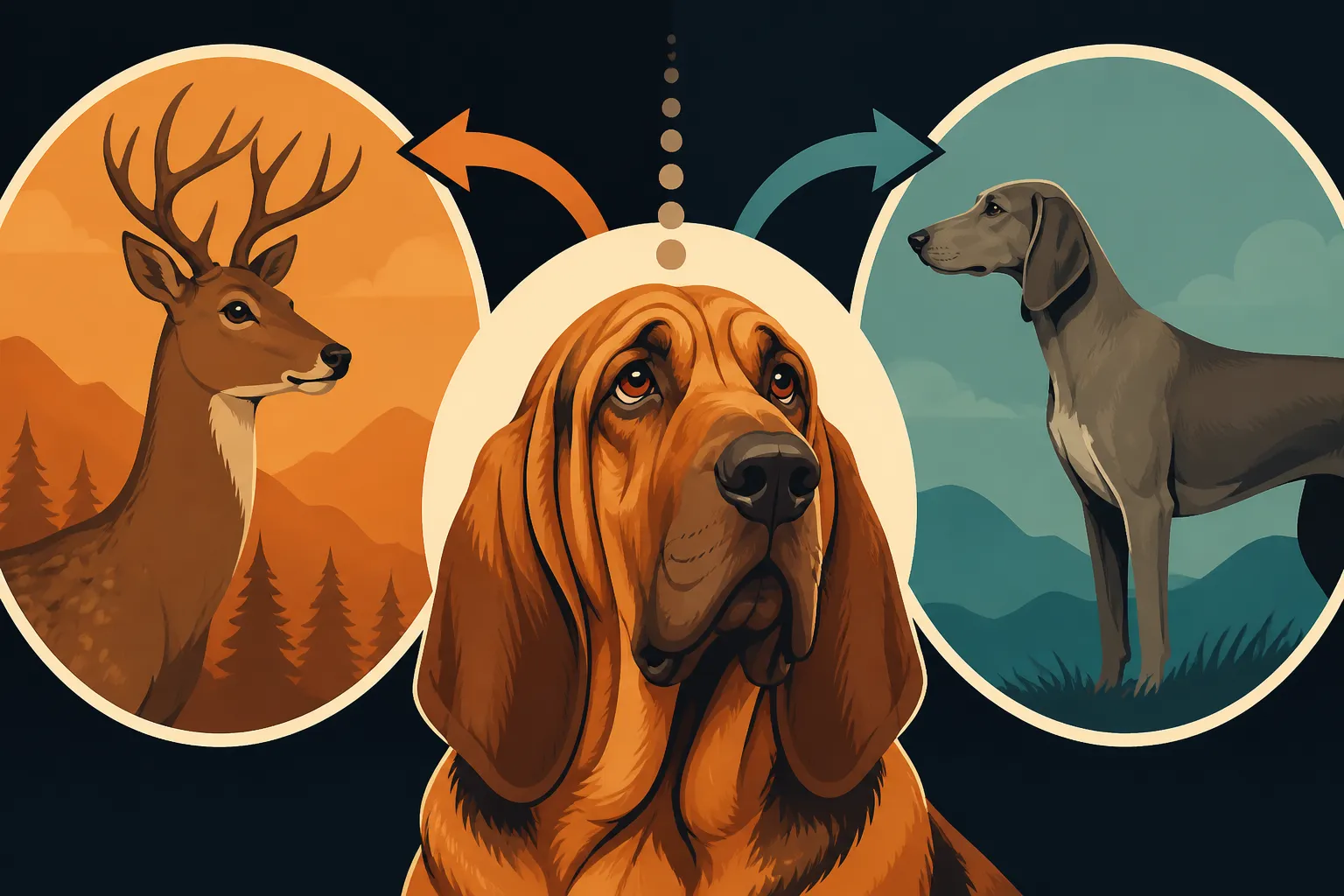
Whether the Bloodhound Was a Deer Hound First
The Bloodhound was not originally a Scottish Deerhound or a separate breed formally called a “deer hound.” Its ancestors were scent hounds used to hunt large game, including deer, before the breed became especially associated with following human scent. The useful distinction is between a dog’s early work and its later breed identity: a Bloodhound could hunt deer without having been a Deerhound.
Was the Bloodhound first used to hunt deer
The short answer: deer hunting was part of its ancestry
The Bloodhound’s history is connected to old European scent hounds bred to follow the trails of large animals. Deer hunting was one of the jobs such hounds could perform. They worked by following scent over distance, a skill that suited hunters trying to locate game through woodland and rough terrain. In that broad sense, the Bloodhound’s ancestry includes deer-hunting work.
But that does not mean the modern breed began as a clearly defined dog called a “deer hound.” Historical records do not always use breed names in the tidy, consistent way we expect today. People described hounds by their work, place of origin, or perceived lineage, and those labels could shift over time. A dog might be described as a St Hubert hound, a blooded hound, or a tracking hound without those terms mapping perfectly onto a modern breed category.
So the most accurate answer is that the Bloodhound’s forebears were used for hunting game, including deer, while the breed’s identity developed over a long period. Deer hunting is part of the story, not a neat first chapter in which a fully formed Bloodhound breed had one official name and one single purpose.
“Deer hound” does not necessarily mean the Deerhound breed
There is an easy source of confusion here: “deer hound” can sound like the name of a specific breed. The Scottish Deerhound is a distinct breed, traditionally associated with pursuing deer by sight and speed. The Bloodhound, by contrast, is a scent hound known for working by nose. The two names describe different histories and styles of hunting.
A Bloodhound trailing a deer and a Deerhound pursuing one are not doing the same job in the same way. The Bloodhound’s strength is scent work: it can follow a trail left by an animal. A sighthound such as the Scottish Deerhound was developed to spot and chase quarry, relying much more on vision and speed. Everyday language can blur the difference, but the distinction matters when discussing breed history.
That is why it is better to ask whether Bloodhound ancestors hunted deer than whether the Bloodhound “was a Deerhound first.” The first question is about historical work; the second can mistakenly suggest the modern Bloodhound and Scottish Deerhound are successive names for one breed. They are not.
How deer hunting fits into the Bloodhound’s origins
The connection to St Hubert hounds
The Bloodhound is commonly linked with the hounds associated with Saint Hubert and the Ardennes region of what is now Belgium. These hounds were valued for tracking game, and their reputation became part of the breed’s origin story. The relationship between historical regional hounds and the modern Bloodhound is a long lineage story, rather than a simple moment when one breed was renamed another.
To understand the deer-hunting connection, it helps to look at what scent hounds were expected to do. A hunting party might rely on dogs to pick up and follow the scent of quarry, including deer. A strong nose, persistence, and the ability to work a trail were practical traits. Those same qualities later made Bloodhounds particularly suited to trailing people.
The history of the St Hubert hounds is explored in The Abbey of Saint Hubert Bred the Bloodhound's Ancestor. Their original work is also relevant to What the Chien de Saint Hubert Was Used For. Those topics help explain why deer hunting can be part of the Bloodhound’s ancestry without being the entire definition of the breed.
Why historical labels are difficult to pin down
Breed history is rarely as clean as a modern pedigree chart. Written accounts may use the same term differently, or different terms for dogs with related working roles. Over generations, breeders may also select for particular features or tasks, gradually changing how a type of hound looks and behaves.
This is especially important when reading older references to hunting hounds. “Bloodhound” may be used to describe a recognized type, a lineage of carefully bred dogs, or an animal believed to have a particular ancestry. The word does not always tell us exactly what a dog looked like or which single kind of game it hunted.
The term itself has its own history and should not be read as proof that the dog was bred to track wounded deer specifically. What the Name Bloodhound Actually Means explains why the name is generally associated with “blooded” or carefully bred stock, rather than a literal diet or exclusive hunting task. The name alone cannot settle the question of what the earliest dogs did.
From game trails to tracking people
A nose suited to more than one kind of trail
A dog’s scenting ability is not restricted to a single target. A hound selected to follow game could, with training and the right circumstances, use its nose to track other scents as well. The underlying skill—detecting and following a trail—could be applied to different work, even though the training and purpose changed.
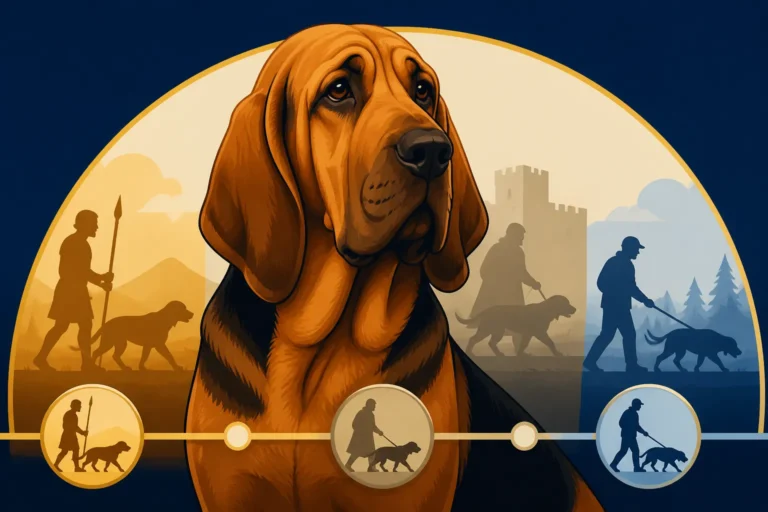
The Bloodhound’s later reputation for following human scent became so strong that it can overshadow its earlier association with hunting. That can make the history sound like a sudden switch: first deer, then people. In reality, working roles evolved over time, and regional traditions, breeding choices, and practical needs all shaped how hounds were used.
For the breed, the important continuity is not simply “deer hunting” or “human tracking.” It is sustained scent work. The dog’s ability to follow a trail gave people options, and human tracking eventually became the work most closely associated with the Bloodhound. When Bloodhounds Began Trailing People Instead of Game looks more closely at that change in use.
The journey from continental Europe to England
The Bloodhound’s development is often described through connections between continental European hounds and English breeding. As dogs and breeding traditions moved between regions, names and traits could change. English breeders helped shape the type that became familiar as the modern Bloodhound, but that does not mean the breed’s earlier history was exclusively English.
This also explains why accounts can seem to disagree about whether the Bloodhound is Belgian or English. The answer depends partly on whether someone is talking about its ancestral roots, the development of the recognizable breed, or the country where particular breeding traditions became established. How the Bloodhound Reached England and Whether the Bloodhound Is Belgian or English address those overlapping pieces of the story.
It is also worth resisting the urge to assign every historical hound to a modern breed name. The Bloodhound’s origins are often discussed alongside other old hound types, including the Talbot hound. That connection is part of a broader debate about ancestry, not proof that the Bloodhound was simply one earlier breed under a new label. See Whether the Bloodhound Descends From the Talbot Hound for more context.
Bloodhound and Deerhound compared
The table below separates the main ideas that can get tangled up when someone asks whether the Bloodhound “was a deer hound first.”
| Term | What it refers to | Connection to the question |
|---|---|---|
| Bloodhound | A scent hound known for following trails, especially human scent | Its ancestors were used for game hunting, including deer |
| Scottish Deerhound | A distinct breed traditionally associated with pursuing deer by sight and speed | Not an earlier name for the Bloodhound |
| Deer-hunting hound | A broad description of a dog used to hunt or trail deer | Can describe work performed by ancestors without naming a modern breed |
| St Hubert hound | Historical hounds associated with the Bloodhound’s ancestry | Helps explain the breed’s continental roots and hunting background |
| Human-trailing Bloodhound | The familiar working role strongly associated with the breed | Developed from scent-trailing ability that could be applied to different targets |
What changed as the breed developed
The modern Bloodhound is not simply an unchanged medieval deer hunter. Breeding over time shaped the dogs people recognized and valued, while their work also changed. English breeding traditions contributed to the breed’s later form and reputation. What English Breeders Changed About the Bloodhound explores that part of the story.
This does not erase the hunting background. Instead, it puts that background in proportion. A dog can have ancestors used to trail deer and still become known for tracking people. The history of a working breed is often a story of traits being adapted to new tasks, not a list of unrelated jobs.
If you picture a Bloodhound following a deer trail, you are not imagining something incompatible with its history. If you picture a Scottish Deerhound and assume it is the same breed at an earlier stage, however, that is where the terminology goes astray. The shared reference to deer describes a hunting connection, not a direct breed identity.
The clearest way to describe the Bloodhound’s early role
A careful answer without overstating the evidence
A precise way to put it is: the Bloodhound’s ancestors belonged to scent-hound traditions used to hunt game, including deer, and the modern breed later became especially celebrated for trailing people. This wording recognizes the deer-hunting background without claiming that a fully standardized Bloodhound breed began under the name “deer hound.”
That distinction is useful because historical accounts often mix three separate questions: what a dog was called, what kind of ancestry it had, and what work it performed. Those answers do not always line up neatly. A hound might have been part of a lineage associated with the Bloodhound, used to trail deer, and known locally by another name.
So, was the Bloodhound a deer hound first? In a broad working sense, its ancestry includes deer-hunting hounds. In the strict breed-name sense, no: the Bloodhound was not simply the Scottish Deerhound under an earlier label, and there is no need to treat “deer hound” as a formal first identity for the modern breed.
Why the distinction matters
Getting the terminology right makes the breed’s history more interesting, not less. The Bloodhound did not appear fully formed with one unchanging job. It emerged from older scent-hound traditions, carried forward traits useful for trailing, and became associated with work that took advantage of those traits in new ways.
That same distinction helps when comparing the Bloodhound with other breeds. Similar work does not automatically mean shared breed identity, and a shared quarry does not mean two hounds hunted in the same way. A scent hound and a sighthound can both be connected to deer hunting while relying on very different abilities.
The enduring thread is the Bloodhound’s extraordinary commitment to scent. Deer may be part of its early working history, but the breed’s defining reputation grew from its ability to follow a trail with focus and persistence. That is why the most accurate answer is not simply “yes” or “no”: the ancestors hunted deer, but the Bloodhound was not just a Deerhound by another name.
Disclaimer
This article is for general informational purposes only and does not constitute professional advice. Laws, prices and regulations vary by location and change over time. Consult a qualified professional for guidance on your specific situation.