How Many Times Better a Bloodhound Smells Than a Person
A Bloodhound’s nose is astonishingly capable, but “how many times better” it smells than a person does not have one reliable scientific answer. The often-repeated multiplier depends on which odor is tested and what “better” means. This guide explains what the comparisons can tell you, why Bloodhounds excel at trailing, and where popular nose claims go too far.
How many times better does a Bloodhound smell than a person
There is no single, universally accepted number that measures a Bloodhound’s entire sense of smell against a human’s. Smell is not one ability with one score. Researchers can compare how faint an odor a subject detects, how accurately it distinguishes two odors, or how well it follows a changing scent trail. A dog may perform remarkably well on one test and less dramatically on another.
That is why confident claims such as “40 times better” can be misleading when presented as a rule for every odor and every situation. They may be repeated without saying what was tested, how the comparison was made, or whether the result applies specifically to Bloodhounds. The practical truth is impressive enough without turning it into a universal multiplier: Bloodhounds are exceptionally equipped to detect and follow human scent.
Why there is no universal smell multiplier
Imagine asking whether a person is “better at seeing” than a dog. The answer changes depending on whether you mean color vision, motion detection, or seeing in dim light. Smell is similarly complicated. An odor that is easy for a dog to detect may not be the one used in a particular experiment, and the same odor can be easier or harder to notice depending on its concentration and surroundings.
A useful comparison must also define what counts as success. Detecting that an odor exists is different from identifying it, separating it from other smells, or following it over distance. A Bloodhound working a trail is doing more than noticing an odor in a controlled test: it must keep searching, sort relevant scent from competing smells, and adjust as conditions change.
So when you see a claim that Bloodhounds smell a certain number of times better than people, ask what the number measures. If it does not identify the odor, test conditions, and definition of “better,” treat it as a catchy shorthand rather than a precise measurement. For a related look at one frequently repeated figure, see Whether a Bloodhound Really Smells Forty Times Better Than a Person.
What scent receptor numbers can and cannot tell us
Dogs have far more olfactory sensory tissue than people, and estimates often describe dogs as having hundreds of millions of scent receptors compared with only several million in humans. Figures commonly quoted for Bloodhounds are estimates, not a direct performance score. Counting receptor cells does not tell us exactly how faint an odor a particular dog can detect or how well it will follow a trail outdoors.
The nose is only part of the system. Airflow through the nose, the surface area devoted to smelling, the brain’s processing of scent, and the dog’s experience all help shape performance. Breed anatomy and working motivation matter too. A dog with a highly capable nose still needs to be able to concentrate, move comfortably, and make sense of what it encounters.
That distinction matters for owners because it keeps impressive anatomy from becoming a promise that every Bloodhound will perform the same way. Individual dogs differ, and practice, health, age, weather, and distractions can affect a real-world search. For more on the limits of receptor-count comparisons, read How Many Scent Receptors a Bloodhound Has.
Why Bloodhounds are so gifted at following human scent
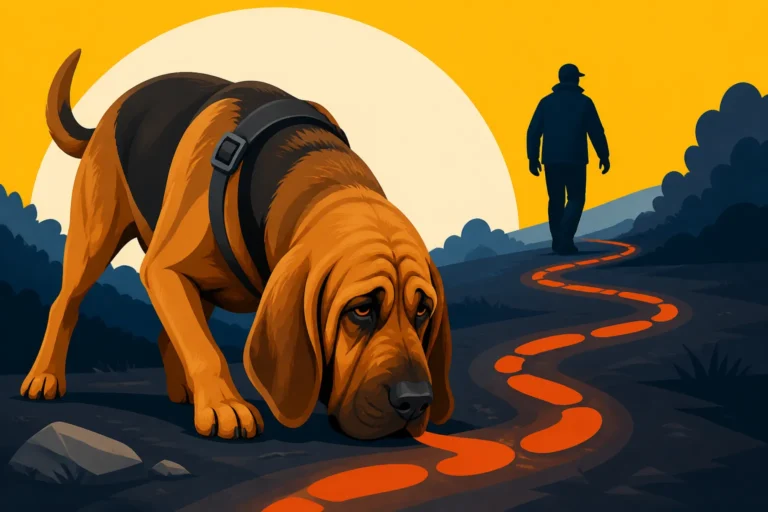
A Bloodhound’s specialty is not simply smelling something that is nearby. It is following a person’s scent trail over time and through an environment where many other odors are present. That takes a combination of sensory equipment, persistence, and the ability to work methodically. The dog is not reading a visible line on the ground; it is responding to scent information that people usually cannot perceive.
A handler may see the Bloodhound slow down, circle, or change direction when the trail becomes less clear. Those movements are part of working through scent information, not proof that the dog has stopped smelling. For an owner watching a trail exercise, it can look like the dog has become distracted when it is actually investigating a change in the odor picture.
A trail is made of more than one smell
A person leaves scent in several ways, including skin cells and other biological material. Those particles and odors interact with surfaces, air movement, temperature, moisture, and time. A Bloodhound following a trail is responding to a shifting scent picture rather than tracing a perfectly continuous line.
The dog also encounters unrelated smells from people, animals, food, plants, and the environment. Part of the task is staying with the target scent instead of switching to every interesting odor along the way. This is one reason a Bloodhound may pause to investigate a spot or move off the most obvious route: the trail’s scent may have drifted or collected somewhere other than where a person expects it to be.
How a dog follows a trail depends on conditions, not just nose strength. Wind may carry odor away from the path, while rain can change how scent behaves on surfaces. For a closer look at the dog’s perspective, see What a Bloodhound Is Actually Smelling on a Trail, Whether Wind Moves the Scent a Bloodhound Follows, and Whether Rain Destroys a Bloodhound's Trail.
The Bloodhound’s ears and head help with scent work
Bloodhound features are often discussed as if any single trait explains the breed’s tracking ability. In reality, the whole dog matters. Its long ears can sweep along the ground as it moves, and the loose skin around the head may help channel scent toward the nose. These features contribute to the breed’s distinctive appearance, but they do not function like a guaranteed scent-catching device.
A dog still has to work out what to do with the information it detects. A strong nose cannot make every trail clear, and the dog’s ability to follow one depends on factors such as scent conditions, training, and the handler’s approach. It is more helpful to think of Bloodhound anatomy as part of an excellent scent-working toolkit than as a single explanation for every successful trail.
If you are curious about how this anatomy fits into the breed’s work, Why a Bloodhound's Ears Sweep Scent Toward Its Nose explores the role of the ears. The broader comparison with other dogs is covered in Whether a Bloodhound's Nose Is the Best of Any Breed.
How to interpret the most common Bloodhound smell claims
The most useful way to read a smell claim is to separate measurable anatomy from a dog’s actual performance. Receptor counts describe one part of the sensory system. Detection tests describe performance under particular conditions. A working trail combines scent detection with movement, attention, training, and the ability to keep searching when the odor picture changes.
A Bloodhound may be exceptional without being infallible. That is an important distinction for families, handlers, and anyone fascinated by scent work. Extraordinary ability is not the same as certainty, and a dog’s behavior needs to be understood in context.
| Claim | What it may refer to | What it does not prove |
|---|---|---|
| A dog has far more scent receptors than a person | A difference in parts of the olfactory system | A universal multiplier for every odor |
| A Bloodhound can follow a person’s trail | A specialized working ability under particular conditions | That every trail is clear or every search succeeds |
| A dog can detect a faint odor | Sensitivity to a particular odor in a specific test | Equal sensitivity to all odors |
| A Bloodhound is a scent-trailing breed | A combination of anatomy, instinct, and training | That the dog cannot be distracted or mistaken |
Why the “40 times better” claim needs context
The phrase “40 times better” sounds precise, but without a defined test it is hard to interpret. It might be intended to convey that dogs are substantially more sensitive to some smells. It does not mean a Bloodhound can detect every scent exactly 40 times farther away, identify every odor 40 times more accurately, or track every person with 40 times the reliability of a human.
The same caution applies to larger or smaller multipliers found in casual explanations. A number can sound scientific even when it is being used as a broad analogy. If the claim does not explain which odor was measured and how, it is safer to understand it as “dogs have a much stronger sense of smell in many contexts,” not as a precise conversion.
This does not diminish the Bloodhound’s abilities. It simply avoids promising something no single number can capture. The breed’s real strength is its capacity to work a human scent trail with remarkable persistence and sensitivity, while still being affected by the conditions around it.
Can a Bloodhound ever be wrong
Yes. A Bloodhound can lose a trail, follow an unintended scent, or need a handler to reassess the situation. Weather, busy environments, competing odors, trail age, physical condition, and training can all affect what happens. A dog’s confident body language should not automatically be treated as proof that its interpretation is correct.
In a trained setting, handlers learn to observe the dog, understand its working behavior, and account for the environment rather than assuming that a powerful nose removes uncertainty. That is useful even for pet owners doing casual scent games: let the dog explore, but do not turn a fun exercise into a claim that the dog has made an unquestionable identification.
For a fuller discussion of uncertainty in scent work, read Whether a Bloodhound Can Be Wrong. If you are interested in how dogs distinguish one person’s odor from others, How a Bloodhound Separates One Person's Scent From a Crowd offers a related look at that challenge.
Enjoying a Bloodhound’s nose at home
You do not need a search team or a formal tracking course to give a Bloodhound a satisfying chance to use its nose. Simple scent games can offer enrichment: hide a few pieces of food around a room, let the dog search for a familiar toy, or create a short, easy trail with a safe reward at the end. Keep early games uncomplicated so your dog can succeed and learn the routine.
If you want to build a small home setup, focus on safe, familiar materials rather than strong or irritating scents. A washable container for treats, a few toys, and a quiet place to search are often enough to start. When comparing general dog-training supplies through retailers such as Chewy, check product details and choose items that are appropriate for your dog’s size and intended activity.
Make nose games easy and rewarding
Begin indoors, where you can limit distractions and keep the search area small. Let your Bloodhound see you hide a treat or toy at first, then gradually make the hiding spot less obvious. Give the dog time to investigate instead of repeatedly pointing or calling it away from the scent. The purpose is to encourage calm searching, not to test how quickly it can perform.
Use short sessions and end while your dog is still interested. A dog that wanders off may be tired, distracted, or simply done for the moment; it does not mean its sense of smell has suddenly failed. Keep the reward safe and suitable for your dog, and avoid placing food or objects where the dog could chew something harmful or get stuck.
For a practical starter kit, Chewy can be one place to browse ordinary dog supplies, but no special branded equipment is required for simple games. Think first about what your dog enjoys and what is easy to clean. A favorite toy and a few treats can be more useful than a pile of gear that makes a simple activity complicated.
Keep expectations realistic
A home scent game is enrichment, not a test that proves how much better your Bloodhound smells than you do. The dog may find a hidden treat quickly one day and take longer the next because the setup, distractions, and motivation have changed. Celebrate the search itself rather than comparing your dog against a fixed multiplier or expecting it to perform like a trained working dog.
If your Bloodhound enjoys these activities, you can make the search gradually more interesting by changing rooms, hiding places, or the path to a reward. Keep the environment safe and make sure the dog can stop when it needs to. For owners looking for basic supplies, Chewy may be worth checking alongside local pet shops, especially when comparing washable toys or storage options; choose based on suitability rather than marketing claims about a dog’s nose.
Disclaimer
This article is for general informational purposes only and does not constitute professional advice. Laws, prices and regulations vary by location and change over time. Consult a qualified professional for guidance on your specific situation.