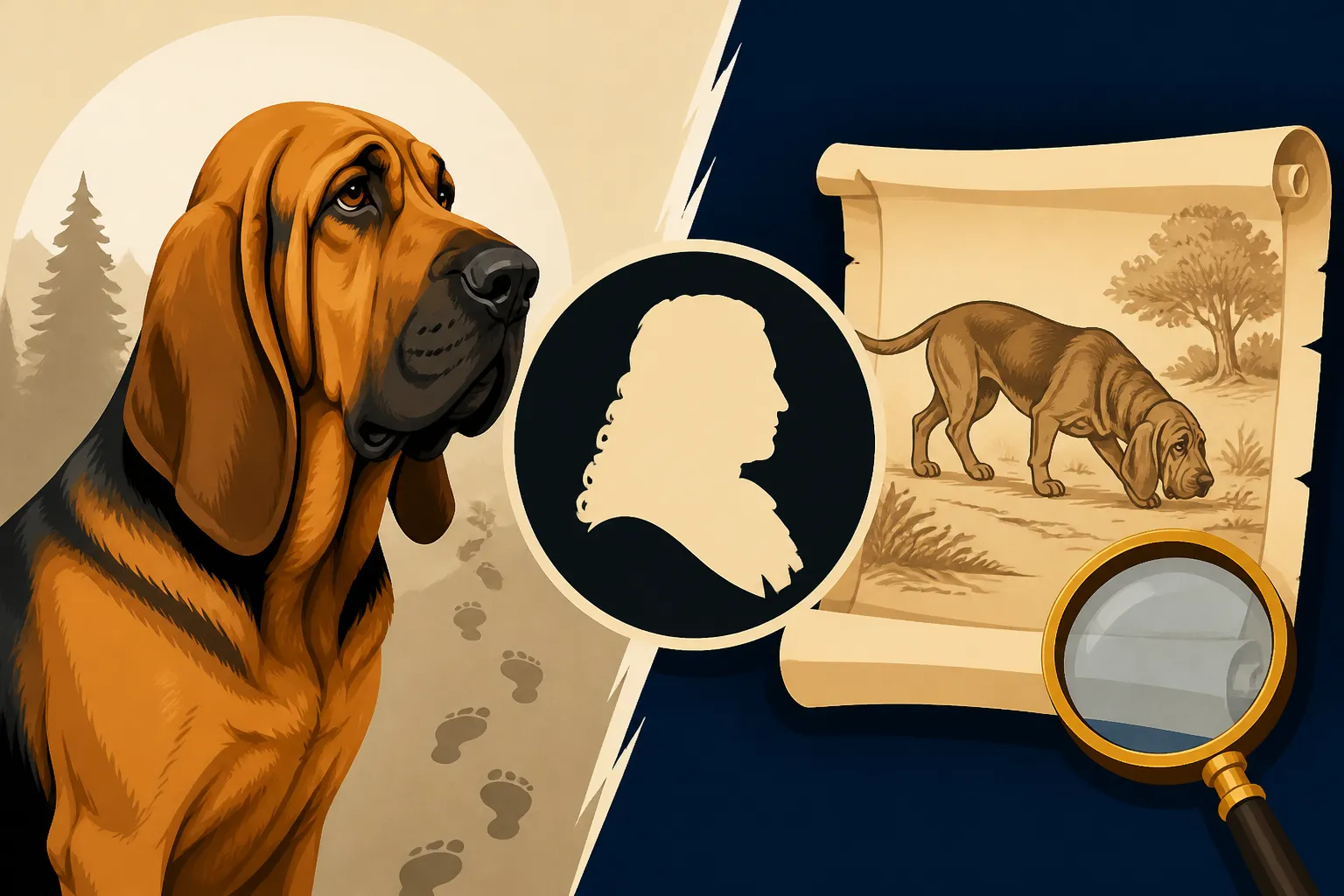
Whether Boyle’s Account Is the Earliest Bloodhound Record
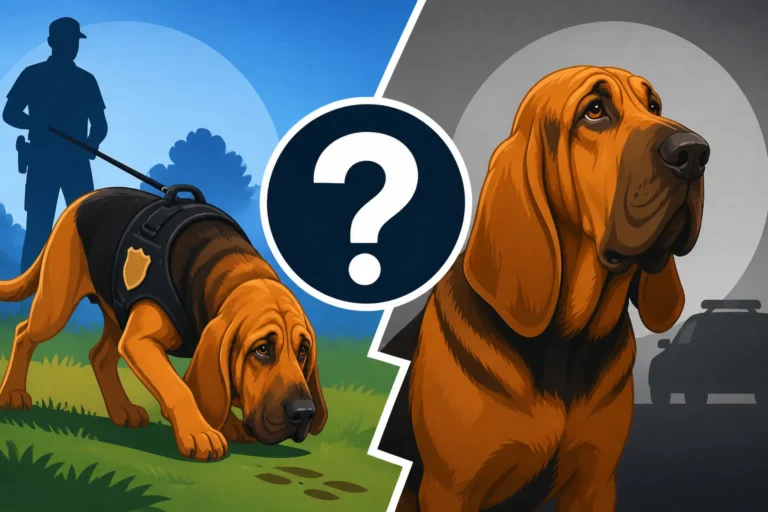
Robert Boyle’s account is among the earliest well-known written descriptions of a dog following a human scent, but calling it the first Bloodhound record goes further than the evidence allows. The difficulty is partly one of definition: Boyle described a scent-tracking hound, while the modern Bloodhound breed took shape over a long period. Here’s what his account can—and cannot—tell us.
What Boyle’s account describes
Robert Boyle and the story of the tracking hound
Robert Boyle was a seventeenth-century natural philosopher whose writing explored how observation and experiment could help explain the natural world. In an account published during his lifetime, he described a dog able to follow a person’s scent with striking persistence. The story became notable because it presented scent tracking as something readers could observe and discuss, not merely as a tale about a dog’s hunting ability.
That distinction matters. Boyle’s account is often brought up in histories of the Bloodhound because it is an early written description of a hound following a human trail. But the account is not a modern breed registry, a controlled scent-work trial, or a detailed record showing that the dog belonged to the Bloodhound breed as we now define it. It is evidence that a remarkable tracking dog was described in print—not proof that the dog was a Bloodhound in the present-day sense.
It is also worth separating Boyle’s own contribution from the way later writers retell the story. Boyle recorded and circulated an account; he was not necessarily the dog’s handler or the person who conducted a standardized test. In historical writing, those details can blur together. A careful reading asks who observed the dog, what Boyle actually reported, and which parts of the story were added or sharpened in later retellings.
Why the story caught people’s attention
A dog following a human scent sounds familiar to us now, but it was a vivid example of animal ability in Boyle’s time. The feat invited questions: How could the dog distinguish one person’s trail from others? What conditions helped or hindered it? How much did the handler’s expectations influence what people believed the dog had found?
Those questions are part of the account’s historical interest. Boyle’s writing belongs to a period when natural philosophers were collecting observations about animals, bodies, and the physical world. A dog tracking a person could serve as an example of a keen sense that people did not yet understand in the way modern scent science attempts to explain it.
For present-day readers, the story also provides a useful reminder: an impressive anecdote is not the same thing as a repeatable experiment. The account can show that people were writing about human-scent tracking early on. It cannot, by itself, establish how often such dogs succeeded, how the trail was laid, or whether the observers ruled out other explanations. That does not make the story worthless. It simply sets a sensible boundary around what it proves.
Was Boyle’s account the earliest Bloodhound record
The short answer depends on what “record” means
If “record” means an early published account of a dog tracking a person, Boyle’s story is an important early example. If “record” means the first documented Bloodhound, with a verifiable breed identity and a reliable account of its work, the claim is much harder to support. Those are different standards, and they should not be treated as interchangeable.
The word Bloodhound itself creates a historical complication. The name has been associated with a lineage of carefully bred hounds, but the breed did not appear all at once in the form recognized today. Historical writers used different terms for hounds, and those labels did not always map neatly onto modern breed categories. A text can describe a hound with an exceptional nose without establishing that it was a member of the modern Bloodhound breed.
There is a similar problem with the word record. A contemporary printed passage may be a record in the broad sense, but it is not necessarily a complete case file. A stronger claim would need details such as the dog’s identity, its breeding, the circumstances of the trail, and an account that can be checked against other documentation. Without that kind of evidence, it is safest to describe Boyle’s passage as an early written account of human-scent tracking rather than the first Bloodhound record.
| Question | What Boyle’s account can support | What it does not establish on its own |
|---|---|---|
| Was a hound described as following a human scent? | Yes, the story is an early written report of that ability. | That every detail was independently verified. |
| Was the dog a modern Bloodhound? | It may be discussed in the breed’s history as an early tracking hound. | A confirmed modern breed identity. |
| Was it the first such account ever made? | It is an important early account known to later readers. | That no earlier written or oral account existed. |
| Does it prove Bloodhounds were routinely used for this work? | It shows that human-scent tracking attracted attention. | How widespread or systematic the practice was. |
The difference between an early account and the first account
To call any surviving text “the earliest” is a claim about all the evidence that came before it, including material that may have been lost, never printed, or never identified. That is a demanding claim. A document may be the earliest one historians commonly cite without being the first time anyone witnessed or described the event.
The distinction is especially important for working dogs. People used hounds long before modern breed organizations kept standardized pedigrees and formal records. A dog might be known locally by its work, its owner, or its appearance. Its abilities could be remembered in conversation or recorded in a document that did not use the name Bloodhound at all. The absence of an earlier surviving description does not prove that no earlier tracking dog existed.
This is why responsible breed histories tend to use careful wording: “an early account,” “one of the earliest known descriptions,” or “an early written reference.” Those phrases recognize the value of Boyle’s story while avoiding a certainty that the historical record may not support. For more context on the origins of the breed, The Abbey of Saint Hubert Bred the Bloodhound's Ancestor and The Bloodhound Reached England are useful related topics to explore.
How to read the account without overstating it
Separate the event, the source, and later interpretation
When you encounter Boyle’s account in a breed-history article or book, try to separate three layers. First is the event as it was reported: a hound followed a human scent. Second is Boyle’s written account of that report. Third is the interpretation added by later writers, who may connect the dog directly to the Bloodhound breed or describe the story as the first of its kind.
That third layer is where overstatement often creeps in. A short historical passage can be retold repeatedly until a cautious description turns into a definite claim. Words such as “proved,” “first,” and “Bloodhound” may appear in a later summary even if the original passage supports a narrower conclusion. Checking the wording in the original text, where possible, can help you see what the account actually says.
A practical way to assess the story is to ask: Does the source name the dog? Does it identify the breed? Does it explain who observed the trail? Does it describe how the trail was set and what counted as success? If those details are missing, the account may still be historically valuable, but it should not be used to claim more than it documents. That same approach helps when reading about later famous tracking dogs such as Nick Carter, the Bloodhound With Six Hundred Fifty Finds.
What the account tells us about Bloodhound history
Even with those limits, Boyle’s story has a meaningful place in the broader history of scent hounds. It illustrates that human-scent tracking was a subject people wrote about centuries before modern search-and-rescue teams, police dog units, or organized trailing tests. The story also helps explain why the Bloodhound became so closely associated with tracking: the breed’s exceptional scenting reputation has a long cultural history, even when individual early dogs cannot be confidently assigned to today’s breed.
The account is not a shortcut to the breed’s full origin story. Bloodhound history involves older hound lineages, regional breeding traditions, and changes in how people used and described dogs. To understand that larger picture, it helps to read about Which Country the Bloodhound Comes From and How the Bloodhound Reached England. Those topics put early references to tracking dogs into a wider setting instead of making one anecdote carry the whole history.
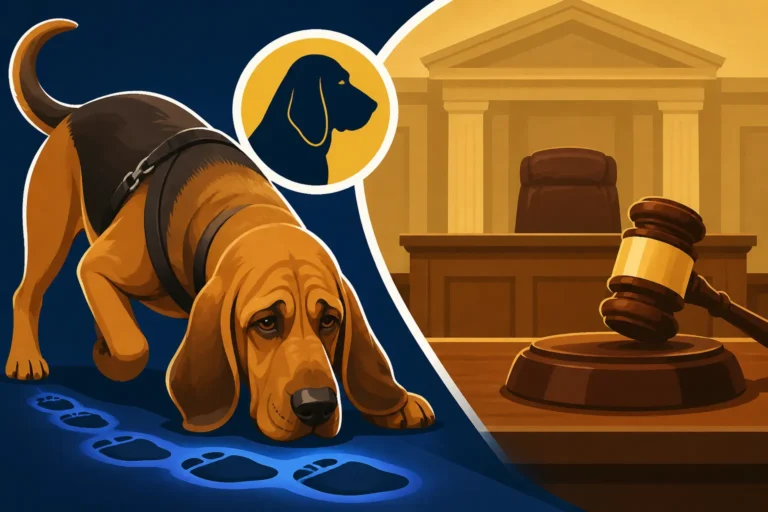
It is also useful to distinguish historical reputation from present-day evidence. A breed’s long association with tracking does not mean every Bloodhound will work the same way, or that a historical account proves a dog’s ability under modern testing standards. For the modern role of the breed, The Bloodhound Is the Only Dog Whose Evidence Stands in Court examines how Bloodhounds have been discussed in legal contexts, while Whether a Bloodhound's Nose Is the Best of Any Breed considers the familiar claim about the breed’s scenting ability more directly.
Finding reliable information about Boyle and Bloodhounds
Look for the original wording and bibliographic details
If you want to follow Boyle’s account beyond a short retelling, search for the title and publication details of the work in which it appeared. Older writings can be reproduced in collected editions, digitized books, or scholarly histories. Check that a modern article gives enough information to identify the passage, rather than repeating a colorful version without pointing to where it came from.
When sources disagree, compare what each one actually claims. One author may call the dog a hound, another may call it a Bloodhound, and a third may label the story the first recorded trail. Those descriptions can reflect interpretation rather than a difference in the underlying historical document. Give greater weight to accounts that distinguish the original wording from later commentary and that explain why they use a particular breed label.
A general pet retailer such as Chewy may be a place readers encounter modern dog books or care materials, but product descriptions are not a substitute for historical references. If you use Chewy to discover a title, check its author, publication information, and references through a library catalog or the book itself. Treat Chewy as a possible starting point for finding reading material—not as evidence for what Boyle wrote.
Use cautious language when repeating the story
If you are sharing Boyle’s account in a school project, article, or conversation, a modest description is both clear and accurate: Boyle recorded an early report of a hound tracking a person’s scent. You can add that the story is often connected with Bloodhound history, while noting that it does not establish the dog’s identity as a modern Bloodhound or prove it was the earliest tracking account ever made.
That wording may feel less dramatic than calling it “the first Bloodhound,” but it is more useful. It lets the story remain impressive without turning an uncertain point into a settled fact. Historical writing is not diminished by careful language; it becomes more trustworthy because readers can tell where evidence ends and interpretation begins.
Readers looking for modern books on dogs may also browse Chewy’s catalog, then verify historical claims through sources that provide publication details and citations. In other words, Chewy can help someone find a book to read, but a well-documented historical work is what should support a claim about Boyle or the origins of Bloodhound tracking. The same distinction applies whether you are researching Whether the Bloodhound Descends From the Talbot Hound or another debated point in the breed’s past.
The most defensible conclusion
Boyle’s account is best treated as an important early written report of a dog following human scent, and as a story later connected to Bloodhound history. It is not firm proof that the dog was a modern Bloodhound, nor does it demonstrate that no earlier account existed. The careful answer to “Was Boyle’s account the earliest Bloodhound record?” is therefore: it is one of the earliest notable accounts commonly discussed in connection with Bloodhounds, but “the earliest” depends on what counts as a record and how strictly the breed is identified.
Disclaimer
This article is for general informational purposes only and does not constitute professional advice. Laws, prices and regulations vary by location and change over time. Consult a qualified professional for guidance on your specific situation.