Whether a Lost Bloodhound Comes Home
It's every Bloodhound owner's worst nightmare: the gate left ajar, the leash slipped, or a moment of distraction, and suddenly, your beloved hound is gone, nose to the ground and utterly deaf to your frantic calls. This isn't just a fleeting worry; it's a very real and terrifying possibility for anyone sharing their life with one of these magnificent scent hounds. This guide will delve into the profound instincts that make a lost Bloodhound so challenging to recover, explore the real dangers they face when wandering, and arm you with both preventive strategies and immediate actions to take if your hound ever goes missing.
The Instinct That Overrides All Else
Let's be brutally honest: Bloodhounds are built differently. Their entire being is engineered for one purpose – to follow a scent. When that nose hits a trail, the world around them ceases to exist. It's not that they don't love you, or that they aren't trained; it's that their primary directive, hardwired into their DNA over centuries, takes precedence. This isn't a quirk; it's the fundamental truth of owning a Bloodhound, and understanding it is the first step in keeping them safe.
Nose to the Ground, Ears Sweeping the Scent
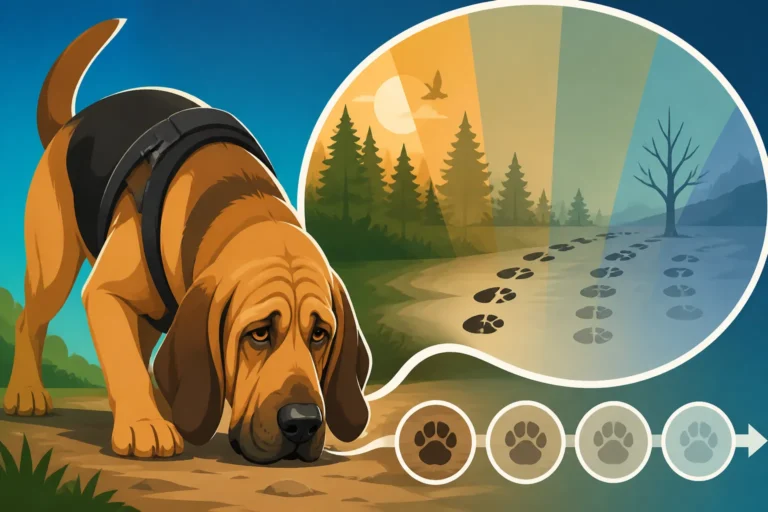
Imagine a world where every single whiff of air tells a vivid story, a compelling narrative that you simply must follow to its conclusion. That's a Bloodhound's reality. With up to 300 million olfactory receptors (compared to our mere 5-6 million), their noses are biological marvels. When they put their nose down, they're not just smelling a scent; they're differentiating individual human cells, tiny skin rafts that have fallen off a person hours, even days, ago. These particles are like breadcrumbs, and your Bloodhound is on a mission to gobble up every single one.
Their physical structure further aids this incredible ability. Those iconic long, pendulous ears, for instance, don't just look charmingly goofy. They drag along the ground, effectively sweeping scent particles up towards the nostrils, concentrating the odor for a more intense read. Their loose skin, especially around the face and neck, creates folds that can momentarily trap scent, allowing them to process it more thoroughly. So, when your Bloodhound goes missing, it's not because they're being rebellious; it's because they've locked onto a scent that, to them, is the most important thing in the universe. This powerful drive is why attempting to call them back from a hot trail is often futile, leading to immense frustration for owners who mistake instinct for defiance. You can read more about this fascinating aspect in Why a Bloodhound's Ears Sweep Scent Toward Its Nose.
The Disappearing Act: Why They Don't Turn Back
Once a Bloodhound picks up a compelling trail, they enter a state often described as "scent-induced tunnel vision." Their focus is absolute, their hearing often diminishes, and their environment outside the trail becomes secondary. They are literally following a thread through a tapestry of countless other smells, completely absorbed in the pursuit. This means that as they move further away from your home, the familiar scents of their own yard, their bed, and even you are quickly replaced by the dominant, exciting scent they are following.
Unlike some other breeds that might have a natural inclination to circle back to familiar territory or seek out their owners if lost, a Bloodhound's primary directive is forward. The trail leads them onward, and their internal compass is geared towards the source of that scent, not a return journey. They don't typically "get lost" in the human sense of not knowing where they are; they are simply following where the scent takes them, often for miles. This makes the idea of a lost Bloodhound just "finding its way home" a dangerous myth. They are not intentionally running away; they are just single-mindedly following their purpose, often into unknown and dangerous territory.
The Realities of a Lost Bloodhound's Journey
The thought of your Bloodhound being lost is harrowing, and for good reason. Their singular focus on scent, while magnificent in their intended work, makes them uniquely vulnerable when they are unsupervised and on the loose. The world is full of hazards that a scent-driven Bloodhound, nose to the ground, is oblivious to until it's too late.
Hazards Beyond the Scent Trail
When a Bloodhound is lost, their immediate danger isn't just the possibility of not finding their way back to you; it's the very real threats of the modern world. Roads and traffic become invisible dangers to a dog completely absorbed in a scent. A Bloodhound, despite its size, is incredibly focused and may not lift its head to notice an approaching car until impact is imminent. They can wander onto busy highways, cross unfamiliar intersections, or even get disoriented in urban environments, where their natural trailing abilities are overwhelmed by a chaotic mix of scents.
Beyond traffic, they face environmental risks. They can get tangled in fences, fall into ditches, or encounter aggressive wildlife. Other off-leash dogs or even humans who might not understand their gentle nature could pose a threat. The weather can also turn quickly, and a lost Bloodhound, especially one that isn't used to long stretches outside, can suffer from exposure to heat, cold, or rain. This is why every moment counts once a Bloodhound goes missing; their safety is directly tied to how quickly and efficiently you can locate them. Preparing for this means considering tools like a GPS tracking collar, which can be found on platforms like Amazon, to provide crucial location data in an emergency. This can be literally life-saving, as discussed in Whether a Bloodhound Needs a Tracking Collar.
The Time Factor and Diminishing Returns
The moment your Bloodhound goes missing, a ticking clock begins. The fresher the trail, the easier it is for another Bloodhound (or even a search team with their own scent hounds) to follow. For your own dog, the longer they are out, the further they can wander. A Bloodhound can cover significant distances in a relatively short amount of time when driven by a strong scent. Miles can be put between them and their point of escape before you even realize they're gone.
As time passes, the primary scent they were following may fade or conclude, leaving them disoriented and then potentially picking up another compelling scent, leading them in a completely different direction. This makes their journey unpredictable. The sheer difficulty of tracking a dog that has been moving for hours or days, potentially crossing multiple scent trails and busy areas, becomes astronomical. This emphasizes the critical importance of immediate action rather than waiting to see if they'll "pop up" later. You can learn more about how long a Bloodhound can follow a trail in How Old a Trail a Bloodhound Can Follow.
The Myth of the "Homeward Bound" Instinct
Many dog owners, understandably, project their own anxieties and expectations onto their pets. The romanticized idea of a dog traveling hundreds of miles to return home is a powerful one, often seen in movies or heartwarming news stories. While some breeds might possess a stronger "homing" instinct, relying on visual cues, familiar sounds, or an inherent sense of direction, the Bloodhound is fundamentally different. Their homing instinct is subordinate to their olfactory drive.
Their world is one of scent corridors. When they lose a trail, they don't necessarily default to "let's go home." Instead, they might cast about for another interesting scent, or become genuinely confused and stressed. Their focus isn't on the geographic location of "home" but on the next compelling odor. This is a crucial distinction that many owners struggle to grasp until it's too late. Understanding that your Bloodhound is unlikely to simply retrace their steps or navigate home independently, especially after a significant period or distance, is vital for proactive prevention and effective search efforts. Instead, they are more likely to exhibit behaviors described in What a Bloodhound Does When It Loses the Trail rather than a deliberate return.
Proactive Measures: Preventing the Great Escape
Given the inherent risks and the Bloodhound's powerful instincts, prevention isn't just a good idea; it's absolutely essential. Being a Bloodhound owner means thinking several steps ahead, constantly assessing potential escape routes, and investing in tools and training that mitigate their unique vulnerabilities. It's about accepting their nature and working with it, not against it.
Fortifying Your Home Perimeter
If you own a Bloodhound, your yard isn't just a yard; it's a potential launchpad for a scent adventure. A standard 4-foot fence, common for many breeds, is often woefully inadequate. Bloodhounds, while not typically known for scaling fences like some other breeds, can certainly clear a shorter fence if motivated, and a low fence offers little deterrent to a determined nose on a hot trail. Many owners find a 6-foot solid fence to be the minimum, as it discourages jumping and also prevents them from seeing potential "targets" (squirrels, people walking) that might initiate an escape attempt.
Beyond height, consider the material and foundation. Bloodhounds can be prodigious diggers, especially if they catch a scent under a fence line. Burying fence wire or a L-footer made of mesh hardware cloth at least a foot deep can prevent tunneling. Gates are another weak point; they must be self-latching, secure, and regularly checked for gaps or weaknesses. An invisible fence, while appealing for its aesthetics, is generally not recommended for Bloodhounds. The shock might deter them briefly, but if an irresistible scent is on the other side, many Bloodhounds will blow right through it, enduring the static correction, and then be too disoriented or driven to return. For more detailed insights on securing your yard, check out How High a Fence a Bloodhound Needs and Whether an Invisible Fence Stops a Bloodhound.
Leash and Line: Your Bloodhound's Lifeline
Let's be unequivocally clear: in any unfenced area, a Bloodhound should always be on a leash. This isn't a suggestion; it's a non-negotiable rule for their safety. The call of the wild, or rather, the call of the scent, is simply too strong. Even a Bloodhound with impeccable recall in a distraction-free environment might completely ignore you once a truly captivating scent thread pulls them away. Why Off Leash Is Not a Goal With a Bloodhound drives this point home.
For walks, invest in a sturdy, well-fitting harness rather than just a collar. A harness distributes pressure across their chest and shoulders, preventing injury to their neck and throat, especially if they lunge after a scent. For exercise in larger open spaces, or for introducing them to mantrailing, a long line (a sturdy leash ranging from 15 to 50 feet or more) is your best friend. This allows them to explore scents with more freedom while still maintaining a secure connection to you. You can find durable long lines for this purpose on sites like Amazon. Remember, the goal isn't to prevent them from smelling, but to allow them to do so safely and under your control.
Training for Recall (and Accepting Its Limits)
Training a Bloodhound for recall is an exercise in patience, consistency, and realistic expectations. Yes, you should work on recall, starting from puppyhood and continuing throughout their lives. Use high-value treats and enthusiastic praise to make coming back to you the most rewarding thing they can do. Companies like BAXTER & Bella offer excellent online resources for positive reinforcement training that can be very effective in building a strong foundation. Practice in increasingly distracting environments, but always with a long line or in a securely fenced area.
However, you must accept that even with the best training, a Bloodhound's recall can fail in the face of an overwhelmingly tempting scent. Their nose is a force of nature. Understanding this limitation isn't about giving up on training; it's about being pragmatic and proactive in managing their environment. A reliable recall is a wonderful safety net, but for a Bloodhound, it should never be your only safety net. Always assume that if the opportunity arises, their nose will win. For a deeper understanding of why recall can be so challenging, read Why Recall Fails on a Bloodhound Outdoors.
What to Do When a Bloodhound Goes Missing
Despite all precautions, accidents can happen. A visitor leaves a gate open, a leash breaks, or a child forgets to secure the door. When that heart-stopping moment occurs and you realize your Bloodhound is gone, panic is a natural reaction. But rather than succumbing to it, immediate, strategic action is your best chance of a reunion.
The Golden Hour: Immediate Action
The first hour after your Bloodhound goes missing is arguably the most critical. Don't wait. Don't assume they'll "be back in a minute." Bloodhounds are fast and driven, and the farther they get, the harder they are to find. Your first step should be to thoroughly search your immediate property and the surrounding area. Call their name, shake a treat bag, or use a familiar whistle. Often, in the initial moments of excitement, they might not have gone far, or they might be momentarily disoriented before picking up a more distant trail.
Simultaneously, alert anyone nearby: neighbors, family members, or friends who can help spread out and look. Get eyes on the ground as quickly as possible. The goal is to catch them before they have a chance to get truly focused on a distant scent and travel far. If you have a tracking collar on them, check its location immediately. This isn't the time for gentle, measured steps; it's a full-on emergency response.
Spreading the Word Effectively
Once the immediate area has been scoured, it's time to leverage your community. Create clear, concise "lost dog" posters with a recent, high-quality photo of your Bloodhound. Include their name, your contact number, and emphasize that they are a scent hound and may be following a trail, potentially deaf to calls. Mention any distinguishing features. Distribute these posters widely in your neighborhood, at local businesses, and veterinary clinics.
Crucially, contact your local animal shelters, animal control, and Bloodhound-specific rescue groups immediately. Provide them with the same clear photo and description. These organizations are often the first point of contact when a lost dog is found. Utilize social media: post on local community groups, lost pet pages, and breed-specific forums. Many online platforms exist solely for reuniting lost pets with their owners, and the wider your net, the better. Be prepared for calls, and always confirm identity before meeting anyone.
Leveraging Their Own Instincts (Carefully)
While a Bloodhound on a hot trail is unlikely to turn back for a "homeward bound" journey, once that initial high-value scent dissipates or concludes, they can become confused. At this point, familiar scents can become incredibly powerful attractants. One effective strategy is to create a "scent station" near the point of escape or a location where they might cross paths. This involves placing their unwashed bed, a favorite toy, and a worn article of your clothing (like a t-shirt you've slept in) outside in a sheltered, visible spot.
The idea is that if your Bloodhound eventually loses the primary trail they were following, or if they circle back in confusion, they may pick up the powerful, reassuring scent of home and their beloved human. This can act as a beacon. Also, leave out water and a bowl of food, though food can sometimes attract other animals. When you do find your Bloodhound, or if someone calls with a sighting, approach slowly and calmly. A lost Bloodhound, even after being found, can be incredibly flighty or disoriented. Get down to their level, speak softly, and lure them with high-value treats.
Here's a quick reference on what to expect if your Bloodhound goes missing:
| Aspect | Typical Bloodhound Behavior | Implications for Recovery |
|---|---|---|
| Scent Drive | Will follow a compelling scent with absolute focus, ignoring calls. | Will travel far and wide, often through dangerous areas, unlikely to return on their own. |
| Recall Reliability | Generally poor when on a strong scent, even if well-trained. | Do not rely on recall as a primary safety measure in unfenced environments. |
| "Homing" Instinct | Overridden by scent drive; will not typically retrace steps or navigate home. | Active search efforts and scent lures (familiar items) are crucial, rather than waiting. |
| Reaction to Strangers | Usually friendly but may be wary or flighty if stressed or disoriented when lost. | Approach found Bloodhounds calmly; have high-value treats. Be cautious of unknown callers. |
| Pace & Distance | Can cover several miles quickly when focused on a trail. | Time is critical; immediate search and alerts are vital to reduce search area. |
| Physical Hazards | Oblivious to roads, traffic, fences, water bodies when tracking. | High risk of injury or death from vehicles, exposure, or getting trapped. |
| Search Success | Highly dependent on immediate, organized search efforts and community alerts. | Proactive prevention (secure fencing, leashes) is the most effective strategy. |
Remember, the best scenario is one where your Bloodhound never goes missing in the first place. By understanding their incredible instincts and implementing robust preventive measures, you can significantly reduce the chances of experiencing this terrifying ordeal.
Disclaimer
This article is for general informational purposes only and does not constitute professional advice. Laws, prices and regulations vary by location and change over time. Consult a qualified professional for guidance on your specific situation.