Whether the Bloodhound Belongs to the AKC Hound Group
If you are checking whether a Bloodhound belongs to the AKC Hound Group, the answer is yes. The American Kennel Club classifies the breed in that group because Bloodhounds are scent hounds, bred to follow a trail. Here’s what that classification means, how it relates to the breed’s working history, and what it does—and does not—tell you about living with one.
Why the Bloodhound Is in the AKC Hound Group
The short answer and the reason behind it
The Bloodhound belongs to the AKC Hound Group. The group brings together breeds historically developed to hunt or track using scent, sight, or a combination of the two. Bloodhounds are especially known for scent trailing: they follow the scent left by a person or animal rather than relying primarily on eyesight to chase visible prey.
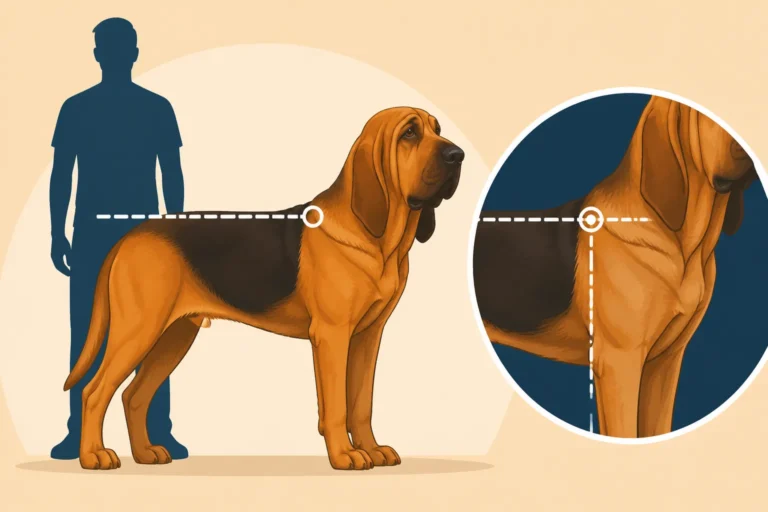
That purpose is reflected in the Bloodhound’s build and instincts. A long nose, loose skin, and long ears are among the features associated with the breed’s traditional work. The breed’s distinctive appearance is more than decoration; it developed alongside its function as a persistent scent tracker. For a closer look at the breed’s proportions, see What a Bloodhound Weighs and How Tall It Stands.
The AKC group name is a classification, not a complete description of a particular dog. It tells you where the breed sits within the organization’s breed categories, but it cannot tell you whether an individual Bloodhound is calm at home, enthusiastic on a trail, or easy to handle on a walk. Those traits depend on the dog, its upbringing, training, health, and surroundings.
Hound does not mean one uniform kind of dog
The Hound Group includes breeds with different histories, body types, and ways of finding game or following a trail. Some hounds are sighthounds, developed to spot and pursue quarry in open terrain. Others, including the Bloodhound, are scent hounds, built around following odors.
So “hound” is a broad category, not a promise that every dog in it behaves the same way. A Bloodhound’s working style is distinct even among scent hounds: it is known for sustained tracking, while other breeds may be used for different kinds of hunting or scent work. If you are comparing breeds, The Bloodhound Against the Other Scenthounds can help put those differences in context.
The classification also does not mean that every Bloodhound is currently used for hunting or search work. Many are companions, and some take part in organized trailing activities or public-safety work. The group reflects the breed’s history and type; an individual dog’s present-day job is another matter.
What the Hound Group Classification Means
It is an AKC breed category
The AKC places recognized breeds into groups for organizational and competition purposes. In conformation shows, dogs are evaluated first against others of their own breed. Breed winners may then compete within their group, and group winners may advance to the overall Best in Show competition.
For a Bloodhound in the show ring, being in the Hound Group means it competes in that group’s stage of the event. It does not mean the dog is being tested in a tracking trial at the same time. Conformation judging focuses on how closely a dog’s physical characteristics and movement match its breed standard—not on whether it can follow a particular person’s trail.
This distinction can be confusing if you encounter a Bloodhound in more than one setting. A dog might participate in conformation events, scent activities, or search work, but each activity has its own purpose and evaluation. The AKC group designation is not a certification of working ability.
It is not a measure of temperament or training difficulty
A group label is not a personality assessment. It does not establish that a Bloodhound will be stubborn, noisy, gentle, or easy to train. Breed tendencies can offer useful background, but individual dogs vary, and daily behavior is shaped by much more than group membership.
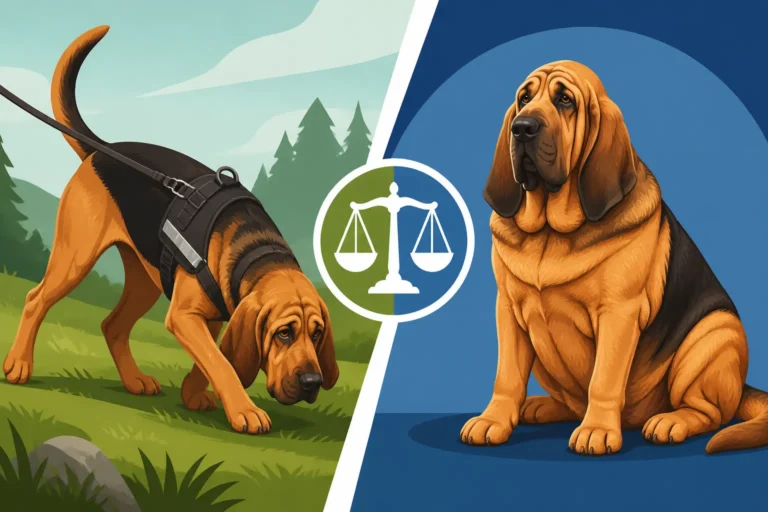
A Bloodhound’s strong interest in scent is worth taking seriously in everyday life. On a walk, a compelling odor may capture its attention so completely that the dog seems to tune out familiar cues. That does not mean the dog is deliberately defying its person; it may be intensely focused on something it was bred to notice. Secure handling, patient training, and appropriate outlets for sniffing can make a real difference.
If you are considering the breed, it helps to look beyond the AKC category and learn about the practical demands of Bloodhound ownership. Whether a Bloodhound Suits a First Time Owner is a useful next read if you are weighing the breed against your household, experience, and daily routine.
It does not determine a dog’s legal or professional role
Bloodhounds have a long association with tracking people, including in law-enforcement and search contexts. But the fact that the breed belongs to the Hound Group does not grant any special legal status to a dog’s findings, nor does it mean every Bloodhound is trained or suitable for police or search work.
In those settings, the dog’s training, the handler’s experience, the circumstances of the trail, and the rules that apply to the case all matter. A breed category cannot substitute for those factors. The history of Bloodhounds in tracking has drawn public attention, but it is separate from their AKC group placement. For background on how tracking and legal questions intersect, see Which Court First Accepted a Bloodhound's Trail and Whether Police Departments Still Keep Bloodhounds.
| Question | What the AKC Hound Group classification tells you | What it does not tell you |
|---|---|---|
| Is the Bloodhound an AKC Hound Group breed? | Yes | It does not describe every individual dog’s behavior |
| Why is it grouped with hounds? | The breed has a history as a scent-trailing hound | It does not mean all hounds work in the same way |
| Does the group label certify tracking ability? | No; it is a breed classification | It does not prove training, reliability, or professional suitability |
| Does it mean the dog competes in tracking at a conformation show? | No; conformation judging evaluates breed type and structure | It does not assess a dog’s scent-work performance |
How the Bloodhound’s History Fits the Classification
A breed developed around following scent
The Bloodhound’s Hound Group placement makes sense when you understand the work the breed was developed to do. Bloodhounds are associated with following scent trails, a task that depends on careful attention to odor and persistence over distance or changing terrain.
That history helps explain why a Bloodhound may investigate a scent with such determination. When a dog drops its nose and moves steadily along an odor trail, it is showing a behavior closely tied to the breed’s traditional purpose. A pet Bloodhound may display the same instinct during an ordinary walk, even when there is no formal trail to follow.
The breed’s name can also lead to mistaken assumptions about its history. It does not mean the dog was bred specifically to track blood. The name is connected to its status as a carefully bred, or “blooded,” hound. What the Name Bloodhound Actually Means explores that distinction, while The Abbey of Saint Hubert Bred the Bloodhound's Ancestor provides more historical context about the breed’s ancestry.
A working reputation is not the same as a group label
Bloodhounds are widely associated with tracking, but a working reputation and an AKC group designation answer different questions. The group answers, “Where does the breed fit in the AKC’s classification system?” A working role answers, “What has this particular dog been trained and selected to do?”
That difference matters because people sometimes assume the label automatically predicts a dog’s abilities. A Bloodhound’s ancestry may make scent work a natural activity to explore, but training still takes time, suitable handling, and attention to the dog’s welfare. Not every dog will become a search dog, and a dog does not need a professional job to have a satisfying life.
A companion Bloodhound can have a strong nose and still spend its days as a family pet. It may enjoy supervised scent games, training, or a structured trailing activity, but those options should be considered according to the individual dog and the household—not simply because the breed appears in the Hound Group.
What to Consider If You Are Choosing a Bloodhound
Look at daily needs, not just the category
If you are deciding whether a Bloodhound is right for you, use the group classification as a starting point rather than a final answer. Think about how you will manage a large dog that may be drawn toward interesting scents, what kind of secure walking setup you can provide, and whether you have time for regular training and companionship.
It is also worth considering the less glamorous routines. Bloodhounds can need ongoing attention to their ears, eyes, skin folds, and drool. Their care needs do not come from their AKC group membership, but they are part of the real-life picture of owning the breed. A thoughtful choice accounts for the whole dog: size, scent interests, grooming routines, exercise, and health care.
Before committing, talk with people who know the breed well, such as responsible breeders, breed clubs, veterinarians, or rescue organizations. Ask what an ordinary week looks like with an adult Bloodhound, not only what the breed is famous for. Day-to-day life is a better guide than a show-group label alone.
Separate breed recognition from registration and activity
People sometimes use “AKC breed,” “AKC group,” and “AKC event” as though they mean the same thing. They do not. Breed recognition concerns whether the organization recognizes a breed. Group placement identifies the category in which that breed is classified. An event is a specific activity in which an eligible dog may participate under that event’s rules.
The Hound Group designation therefore does not automatically tell you whether a specific dog is registered, eligible for a particular competition, or trained for scent work. If those details matter to you, check the rules for the relevant AKC activity and the dog’s individual records.
For a prospective owner, the practical takeaway is straightforward: yes, the Bloodhound belongs to the AKC Hound Group because it is a scent hound. That classification gives useful context about the breed’s historical type, but it is only one piece of the larger picture. Understanding the Bloodhound’s instincts, care needs, and individual temperament will tell you much more about what life with one may actually be like.
Disclaimer
This article is for general informational purposes only and does not constitute professional advice. Laws, prices and regulations vary by location and change over time. Consult a qualified professional for guidance on your specific situation.