Whether a Fenced Field Is Safe for a Bloodhound
Oh, the dream of letting your Bloodhound loose in a big, securely fenced field, watching them run and sniff to their heart's content, knowing they're safe. It’s a vision many of us Bloodhound owners hold dear. But the reality, as we often discover, is far more complex than just putting up a fence. Your Bloodhound's incredible nose and relentless drive mean that what looks "secure" to us might just be a suggestion to them. This guide is here to unpackage the truth about whether a fenced field is truly a safe haven for your scent-driven companion, and what "safe" actually means when you have a Bloodhound.
Understanding the Bloodhound's Drive: Why Fences Aren't Always Enough
Let's be honest, we love our Bloodhounds for their unparalleled noses and that deep, soulful bay. But those very traits, the ones that make them world-class trackers, are precisely why traditional fencing often falls short. It’s not about their loyalty or love for you; it’s about an instinct so profound it can override almost everything else.
The Irresistible Call of Scent
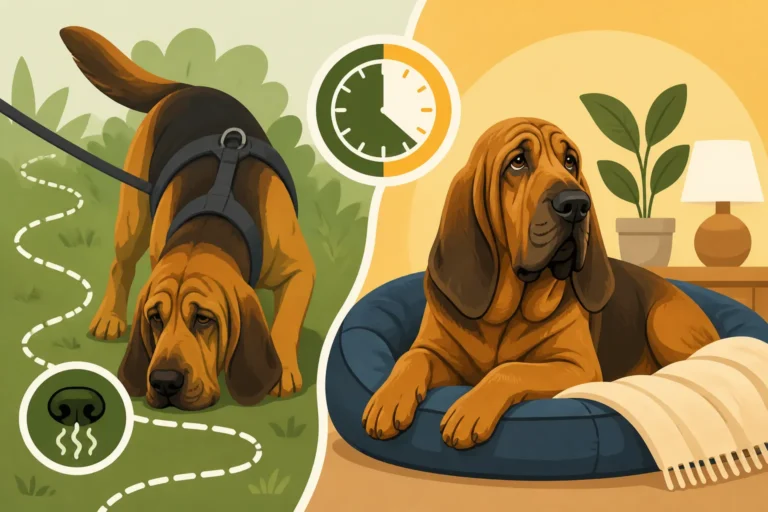
Imagine living in a world where every single whiff of air tells a story. That's your Bloodhound's reality. A faint human scent from a passerby an hour ago, a deer that ambled through yesterday, or even a buried vole from last week – these aren't just passing smells; they're rich narratives compelling them forward. When a Bloodhound catches an interesting scent, it's like an alarm bell goes off in their brain, screaming "Follow me!" This isn't disobedience or stubbornness; it's the very core of who they are. Their long, pendulous ears, those magnificent dewlaps, even the wrinkles on their face – they all work in concert to sweep and funnel scent particles towards their nose, making that call even louder. It's a physiological marvel, but it means that if that tantalizing scent trail leads outside your fence, their entire being is focused on getting to it. You can almost feel the pull yourself, the way their body language changes, their head drops, and their tail starts to work. It’s truly remarkable, but also incredibly challenging to manage.
A Nose That Overrides Everything
This isn't your average dog's curiosity. A Bloodhound's nose operates on a different plane. When they lock onto a trail, the rest of the world fades away. Your calls, treats, even a favorite toy – they all become secondary, almost imperceptible background noise to the symphony of scent unfolding before them. This is why the common advice to never trust a Bloodhound off-leash isn't just a suggestion; it's a vital safety warning. That powerful instinct means that if they detect a compelling trail, their internal GPS locks onto it, and they will pursue it with single-minded devotion. They aren't trying to escape from you; they're trying to get to the scent. This unwavering focus means that a simple four-foot fence or even a slightly open gate can become an irresistible invitation to adventure. It’s not personal; it’s just how they’re wired. When they're focused on a trail, the concept of boundaries often becomes entirely irrelevant. It's truly a marvel to witness, but it requires constant vigilance from us, their human companions, to keep them safe.
Intelligence and Problem-Solving
Don't mistake a Bloodhound's focused nature for a lack of intelligence. Far from it! They are incredibly smart, especially when it comes to achieving their goals, and their primary goal, often, is to follow a scent. This intelligence extends to problem-solving, particularly regarding obstacles like fences. They observe. They learn. They test. If there’s a loose board, a gate latch that isn't quite secure, a low spot in the fence, or even a gate that swings outward, they will figure it out. They might spend days "casing the joint," nudging, pawing, pushing, or digging, until they find that one weak point. They learn what works and what doesn't. This means that a fence that held them yesterday might not hold them today if they've had an epiphany about its structural integrity. It's not malicious; it's simply a highly intelligent animal using its brainpower to access what it desires most.
What Makes a Fence "Bloodhound-Proof"?
So, if a Bloodhound's nose is so powerful, what can you do to create a truly safe, fenced environment? It’s going to take more than just throwing up a standard fence. Think of it less as a barrier and more as a fortress designed specifically to contain a scent-driven escape artist.
Height and Material
When it comes to Bloodhounds, higher is almost always better. A minimum of six feet is often recommended, but even that can sometimes be challenged by a highly motivated individual. Some Bloodhounds are surprisingly agile and can use any footholds – think horizontal fence slats or even landscaping – to get leverage. For this reason, smooth, solid materials like vinyl or tightly woven mesh fencing can be more effective than chain link, which offers easy climbing opportunities.
Consider the material carefully. A standard picket fence might look charming, but it offers too many gaps and too little height to be effective. A wooden privacy fence is better for visual barriers, but remember that wood can rot or be chewed through, especially if a scent is particularly strong on the other side. Chain link, while strong, can be climbed, and the bottom can be easily lifted. The best solutions often involve solid panels or tightly woven, heavy-gauge wire mesh that doesn't offer any toeholds.
Digging Prevention
This is perhaps the most critical, and often overlooked, aspect of Bloodhound-proofing a fence. If there's a scent trail that goes under the fence, your Bloodhound will become an expert excavation engineer. They won't just scratch at the surface; they'll dig with a purpose, often quickly and efficiently.
To combat this, you need to go below ground. Here are some effective strategies:
- Burying Wire Mesh: Extend heavy-gauge wire mesh (like hardware cloth) at least 12-18 inches below the ground along the entire fence line. Bend the bottom portion of the mesh at a 90-degree angle, forming an "L-footer" that extends into the yard, making it nearly impossible for your Bloodhound to dig directly beneath the fence.
- Concrete Runners: Pouring a concrete footer along the base of the fence is another highly effective, albeit more expensive and permanent, solution. This creates an impenetrable barrier below ground.
- Large Rocks or Pavers: For existing fences, laying large, heavy rocks or pavers along the inside perimeter can deter digging, though a determined Bloodhound might just shift them. This is often a temporary or less reliable solution.
Whatever method you choose, remember that consistency is key. One weak spot in the digging prevention will be found and exploited.
Gates and Latches
You've built your fortress, but if the drawbridge isn't secure, the whole effort is for naught. Gates are notoriously weak points for any dog, and particularly for intelligent, motivated Bloodhounds. They'll push, pull, lean, and even attempt to manipulate latches.
Here’s what to look for:
- Double-Latching Mechanisms: Don't rely on a single, simple latch. Install two latches, ideally at different heights, and consider ones that require two distinct actions to open. A simple thumb latch is an open invitation for a Bloodhound to learn. Carabiner clips or snap hooks on top of the primary latch add an extra layer of security.
- Self-Closing Hinges: These ensure that if a gate is accidentally left ajar, it will swing shut on its own. While not foolproof, it's a critical safety feature.
- Gate Swings Inward: Ensure your gates are hung to swing into the yard, not out. This prevents your Bloodhound from leaning their weight against it and potentially forcing it open, or causing it to swing out into a street.
- Reinforced Gate Posts: Make sure the posts holding the gate are firmly set in concrete and robust enough to withstand repeated pushing and leaning from a large, powerful dog.
- Regular Inspection: Just like the rest of the fence, gates need regular checks. Are the hinges tight? Is the latch mechanism working smoothly? Are there any gaps at the bottom or sides that your Bloodhound could exploit?
The Illusion of Invisible Fences
Ah, the invisible fence. Many a hopeful Bloodhound owner has considered this, thinking it might offer the freedom of an unfenced yard. Let me be unequivocally clear: an invisible fence is generally not a safe or reliable solution for a Bloodhound.
Here’s why:
- Scent Overrides Shock: The Bloodhound's drive to follow a scent is often so powerful that it will override the discomfort or pain of an electric shock. They will bolt through the boundary, driven by their nose, ignoring the warning. Once they're on the other side, they've likely forgotten about the deterrent and will be completely lost.
- One-Way Trip: The biggest danger isn't just that they'll run through it, but that once they are outside the boundary, they are highly unlikely to cross back into the yard through the painful shock. This means a lost Bloodhound, unable to return home.
- No Barrier for External Stimuli: An invisible fence does nothing to keep other animals or people out. If a stray dog wanders into your yard, or a child inadvertently steps over the boundary, your Bloodhound has no physical barrier to protect them or stop them from interacting.
While they might work for some breeds with lower prey drive or scent focus, for a Bloodhound, an invisible fence is a dangerous gamble, often leading to heart-wrenching scenarios where your beloved companion is lost and confused. It simply cannot compete with the primal call of a compelling scent trail.
Beyond the Fence: Managing a Bloodhound's Instinct in a Fenced Area
Even with the most robust, Bloodhound-proof fence, the fence itself is only one part of the equation. Your active involvement, training, and understanding of their unique needs are equally, if not more, important.
Supervision is Non-Negotiable
A fence, no matter how well-built, should never be considered a "babysitter" for your Bloodhound. Leaving a Bloodhound unattended in a fenced yard, even for "just a minute," is an invitation for trouble. That's all the time it takes for them to find a new scent, discover a previously unnoticed weakness in your fencing, or simply become bored and decide to explore beyond the confines.
Active supervision means being out there with them. It means watching them, engaging them, and being ready to redirect their attention if you see them focused intently on a suspicious spot along the fence line. It means walking the fence line with them regularly, checking for signs of digging or attempts to climb. Think of your fenced yard as a safe training environment, not a hands-off playground. This constant presence not only ensures their safety but also strengthens your bond, turning yard time into quality time.
Training for Boundaries Within Limits
While getting a Bloodhound to reliably ignore a scent once they're on it is a Herculean task, you can certainly work on general manners and awareness within the confines of your secure yard. This isn't about teaching them to ignore their nose, but about teaching them to check in with you, or to come when called when they aren't actively tracking.
Programs like those offered by BAXTER & Bella can be incredibly helpful for foundational obedience and focus. Learning cues like "watch me" or a solid "come" in a low-distraction environment can lay the groundwork for better management in your fenced space. Practice these skills frequently, rewarding generously, so that your Bloodhound learns that you are also a source of great things. This builds a working relationship where, even if they're sniffing intently, they might momentarily disengage for a high-value treat from your hand. Remember, it's about building positive associations and making you more interesting than every single blade of grass.
Enrichment and Scent Work Within the Yard
A bored Bloodhound is a Bloodhound looking for an adventure – an adventure that often leads beyond your fence. Instead of letting them get bored, leverage their natural instincts within your secure yard. Make the yard an exciting place for their nose!
- Hide and Seek: Hide treats or favorite toys around the yard and let your Bloodhound "find" them. This is a low-impact way to engage their nose.
- Scent Trails: Lay simple scent trails for them to follow in your yard. Use a favorite human's scent, or even a specific treat scent, and let them follow it from one end of the yard to another. This channels their energy positively. For example, using specialized scent articles or even just a piece of worn clothing from a family member can be great starting points. Many specialized tools and accessories for scent work can be found on Amazon.
- Puzzle Toys: Invest in durable puzzle toys that dispense kibble or treats as they're manipulated. This provides mental stimulation and keeps them engaged.
By providing regular, structured mental and physical enrichment that uses their nose, you make your yard a satisfying place to be, reducing the urge to "escape" in search of their own entertainment.
The Long Line as a Safety Net
Even in a well-fenced yard, there might be times you feel a need for an extra layer of control, perhaps when introducing a new Bloodhound to the space, or if you're trying to identify a weak spot in the fencing. This is where a long line comes in as a fantastic safety net.
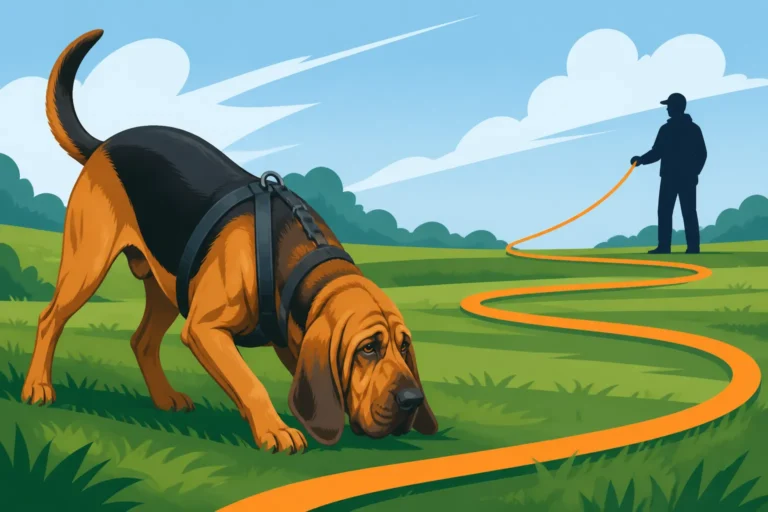
A long line (typically 15-30 feet) allows your Bloodhound more freedom to explore and sniff than a standard leash, while still keeping them safely connected to you. It's especially useful for training in a fenced area, allowing you to practice recall or other cues without the immediate fear of them bolting if a particularly potent scent wafts in. If they suddenly get that "nose-down, ignore-the-world" look, you can gently redirect them with the line, preventing them from testing the fence or finding an escape route. It's a bridge between full off-leash freedom (which, let's face it, is a rare commodity for a Bloodhound) and restrictive leashed walks, allowing them more enrichment while maintaining your control.
Alternative Safe Spaces and Exercise for Your Bloodhound
Given the challenges of keeping a Bloodhound securely contained, it's worth exploring other avenues for exercise and mental stimulation. Sometimes, the safest and most satisfying experiences for your Bloodhound will come from outside your own property.
Dedicated Secure Dog Parks and Sniff Spots
While standard public dog parks are generally not recommended for Bloodhounds due to their strong scent drive and potential for roaming, a growing number of private facilities offer highly secure, often double-fenced, "sniff spots" or secure dog parks. These are usually rentable by the hour, providing a safe, controlled environment where your Bloodhound can truly stretch their legs and indulge their nose without the risk of escape or encountering unexpected dogs.
These dedicated spaces are built with high-drive dogs in mind, often featuring:
- Tall, secure fencing: Typically 6-8 feet high, made of solid materials or heavy-gauge mesh, often with digging prevention features.
- Double-gated entries: Creating an airlock system to prevent escapes when entering or exiting.
- Varied terrain: Offering interesting smells and textures for your Bloodhound to explore.
Searching online for "private dog park rentals" or "secure sniff spots near me" can reveal these hidden gems, providing invaluable opportunities for your Bloodhound to truly be a dog in a safe setting.
Mantrailing as the Ultimate Outlet
If there's one activity that truly speaks to a Bloodhound's soul and satisfies their deepest instincts, it's mantrailing. Instead of fighting against their incredible nose, mantrailing embraces and channels it. This structured activity involves teaching your Bloodhound to follow a specific human scent trail, often laid hours or even days before, across varied terrains.
Mantrailing is not just exercise; it's intense mental stimulation. It allows your Bloodhound to do exactly what they were bred for, in a controlled, safe environment, typically on a long line with a handler. The focus and mental effort required to discriminate and follow a specific scent are profoundly tiring and satisfying for them. A Bloodhound that regularly engages in mantrailing is often a much calmer, happier, and less escape-prone dog at home, simply because their core needs are being met. This activity provides an unmatched sense of purpose and fulfillment for these magnificent hounds. Many local dog training clubs or specialized organizations offer mantrailing classes, and it's a truly rewarding journey for both dog and owner.
Leashed Walks and Exploring
Never underestimate the power of a good, long, sniffy walk on a leash. While it might not offer the same free-running experience as a field, it is incredibly enriching for a Bloodhound. Instead of rushing them along, let them take their time. Let them follow that interesting patch of grass, investigate that lamppost, or carefully dissect the scent left by another dog.
These walks are not just about physical exercise; they are about mental stimulation. Every sniff is information, every new scent is a newspaper. Allow them to immerse themselves in their world of scent. A Bloodhound who has had an hour of dedicated, unhurried sniffing on a leash is often more tired and content than one who has had a quick, frantic run in a less stimulating environment. Invest in a comfortable, sturdy harness and a good, secure leash, and explore different neighborhoods, parks, and even hiking trails (where allowed and safe) to keep things interesting.
Here’s a quick overview of how different fence types measure up against a Bloodhound’s determined nature:
| Fence Type | Bloodhound Escape Risk | Digging Prevention Required | Climbing Risk | Maintenance Level | Notes |
|---|---|---|---|---|---|
| Standard Chain Link (4-6 ft) | High | Significant | Moderate | Low | Offers footholds, easy to lift bottom; needs buried skirt/concrete. |
| Wood Privacy (6 ft) | Moderate | Significant | Low | High | Visual barrier, but wood can be chewed; needs buried skirt/concrete. |
| Solid Vinyl (6 ft) | Moderate | Significant | Low | Moderate | Smooth surface deters climbing; needs buried skirt/concrete. |
| Secure Mesh (e.g., welded wire with small openings) | Low | Essential | Low | Moderate | Small openings prevent climbing, often comes with buried skirt design. |
| Electric/Invisible Fence | Very High | N/A | N/A | Low | Scent drive often overrides shock; high risk of lost dog. |
Ultimately, while a securely fenced field can be a valuable part of your Bloodhound's routine, it's rarely a set-it-and-forget-it solution. It requires constant vigilance, intelligent design, and a deep understanding of what makes your Bloodhound tick. By combining a truly secure physical barrier with engaging mental and physical activities that honor their incredible nose, you can provide your Bloodhound with a happy, safe, and fulfilling life.
Disclaimer
This article is for general informational purposes only and does not constitute professional advice. Laws, prices and regulations vary by location and change over time. Consult a qualified professional for guidance on your specific situation.