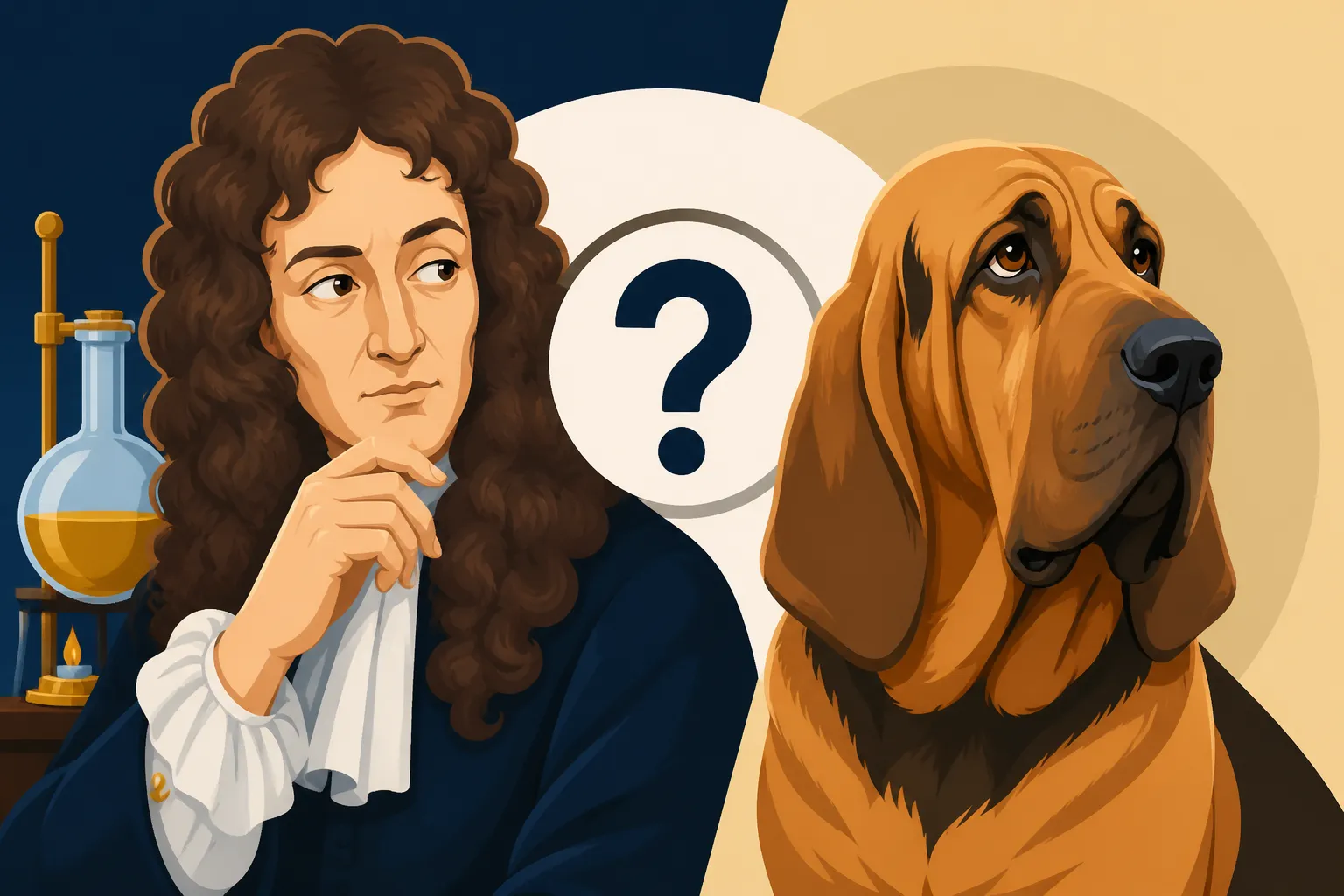
Whether Robert Boyle Owned a Bloodhound
Robert Boyle is sometimes linked to an early account of a hound following a human scent, which can make it sound as though the seventeenth-century natural philosopher kept a Bloodhound himself. The distinction matters: recording an animal’s reported feat is not the same as owning it. This guide explains what Boyle’s story can tell us, what it cannot establish, and why the dog’s breed is uncertain.
Did Robert Boyle own a Bloodhound?
The careful answer is that there is no well-established evidence that Robert Boyle personally owned a Bloodhound. He is remembered in connection with a written account of a hound’s scent-trailing ability, but that account does not by itself show that the animal lived with him or belonged to him.
That distinction can get blurred when a story about an impressive dog is retold many times. A writer may describe a hound’s performance, a later summary may call it a Bloodhound, and an abbreviated version may then make Boyle sound like the dog’s owner. Each step can make the story seem more definite than the available details allow.
The difference between describing a dog and owning one
Boyle was a natural philosopher who wrote about observations and reports concerning the natural world. A dog’s ability to follow a person’s scent was relevant to his interest in how animals perceived and responded to their surroundings. Describing such an account does not mean he conducted the event himself, handled the dog, or kept it at home.
The ownership question calls for a different kind of evidence: a statement that the dog belonged to Boyle, a reliable biographical record of his keeping the animal, or a clear account that identifies him as its owner. The story usually associated with Boyle is not enough on its own to supply those details. It is safer to say that Boyle recorded or discussed a hound’s tracking feat, rather than that he owned the hound.
That may feel like a small distinction, but it changes what the historical anecdote can support. Boyle’s name can be attached to the written report without implying that he was the dog’s owner or handler. For more on the story itself, see Robert Boyle Wrote Down the First Bloodhound Trial.
Why the story is linked with Bloodhounds
Bloodhounds are strongly associated with tracking people by scent, so a historical report about a hound following a human trail naturally invites comparison with the breed. But a description of a dog as a “hound” does not automatically identify it as a Bloodhound in the modern breed sense.
Names and breed categories have changed over time. A writer in Boyle’s period could use “hound” broadly, without specifying a pedigree or the kind of formal breed identification familiar to dog owners today. Even if later retellings use “Bloodhound,” that label may be an interpretation rather than a detail supplied in the original account. The broader history of the name and its meaning is explored in Why Bloodhound Does Not Mean a Hound That Tracks Blood.
There is another complication: dogs that could follow human scent were not necessarily all the same type. People have used scent hounds for different kinds of tracking over many generations, and the distinction between an early working hound and a modern registered Bloodhound matters when interpreting an old story. The historical question of when Bloodhounds began trailing people rather than game is discussed in When Bloodhounds Began Trailing People Instead of Game.
What Boyle’s account can and cannot tell us
Boyle’s connection to the story is historically interesting because it shows that people were discussing canine scent-trailing well before modern tracking organizations, breed registries, or standardized trials. It is not, however, the same as a carefully documented modern test. Without a full description of the circumstances, readers should be cautious about treating the account as proof of a specific dog’s breed, ownership, or measurable performance.
An early report is not a modern trial record
A modern trailing test might specify how a track was laid, how old it was, what the surface and weather were like, whether the handler knew the route, and how success was judged. A historical anecdote may not give those details. It may focus on the surprising result rather than describing a repeatable procedure.
That does not make the report meaningless. It can still show what people believed or observed about a dog’s nose, and it can help explain why Boyle considered the topic worth recording. But without the sort of information that makes a test repeatable, it is hard to compare the feat fairly with present-day tracking work.
It also helps to separate the observation from the explanation. A dog may have followed a person’s scent, but a brief account may not tell us how the track was laid, what other clues were available, or whether anyone independently checked the route. The anecdote can be an early account of tracking without answering every question a modern reader might reasonably ask. For a closer look at its place in the historical record, see Whether Boyle's Account Is the Earliest Bloodhound Record.
The distance is not the whole story
Stories about old tracking feats often become more striking as they are retold. A distance may be repeated without enough context to know whether it describes the full journey, the distance between two points, or the portion of a route the dog actually followed. If conditions and measurement methods are missing, a precise-sounding number can create more confidence than the account deserves.
Distance alone would not prove that a dog followed a continuous human trail. Ground type, weather, elapsed time, other people’s movement, and the way the dog was guided could all affect the interpretation. A trail across open countryside is also not directly comparable with one through a crowded street or across frequently disturbed ground.
For that reason, it is sensible to treat the reported distance as part of the anecdote, not as a benchmark for what every Bloodhound can do. The account’s route and mileage deserve their own careful examination in How Many Miles Boyle's Hound Trailed. The central point remains the same: a reported feat does not establish that Boyle owned the dog or that the animal was definitively a modern Bloodhound.
Why identifying the dog’s breed is difficult
When people ask whether Boyle owned a Bloodhound, they are often asking two questions at once: who owned the dog in the story, and what kind of dog it was. The surviving description may not answer either question clearly. It is worth keeping those uncertainties separate rather than letting one assumed detail fill in the other.
Historical names do not map neatly onto modern breeds
Modern breed names are familiar and specific. In older accounts, terms such as “hound” could be used more generally, and written descriptions might emphasize what a dog did rather than its ancestry or appearance. A dog could be valued for following scent without anyone identifying it by a precise breed label.
This is especially important in accounts that predate today’s formal systems for recording pedigrees and defining breed standards. A historical dog might have had traits associated with later Bloodhounds, but that resemblance would not establish a documented lineage. Retrospectively assigning a modern breed name can be tempting, especially when the activity matches the breed’s reputation, yet it goes beyond what a broad historical label can prove.
The Bloodhound’s history also crosses national and linguistic traditions. The breed is often associated with both Belgium and England, and tracing how names, types, and breeding practices developed takes more than matching an old word to a modern label. The question is explored in Whether the Bloodhound Is Belgian or English. For the earlier history connected with the Saint Hubert hound, see Who Saint Hubert Was.
Scent ability alone does not identify a Bloodhound
A dog’s performance can suggest that it had a strong sense of smell, but scent ability is not a breed certificate. Many dogs can follow a trail to some degree, and working ability varies between individuals. Even a remarkable tracking story would not tell us, by itself, the dog’s ancestry or whether it met a breed standard.
That is why the safest description is often the simplest: Boyle wrote about a hound associated with tracking a person. If the original wording does not securely identify the dog as a Bloodhound, a later label should be treated as a possibility rather than a confirmed fact. The more general question of the breed’s reputation for scent is considered in Whether a Bloodhound's Nose Is the Best of Any Breed.
This distinction does not diminish the Bloodhound’s historical importance. It simply prevents a fascinating old account from being made to prove more than it can. A story may illuminate early interest in human scent-trailing even when the dog’s exact breed and owner remain unclear.
How to describe Boyle’s connection accurately
A useful way to handle this question is to separate what is reasonably supported from what would require additional evidence. That makes the answer both clear and fair to the historical record.
| Question | Careful answer |
|---|---|
| Did Boyle write about a hound’s tracking ability? | He is associated with a historical account of a hound following a human scent. |
| Does that prove Boyle owned the dog? | No. Recording or discussing a dog’s feat does not establish ownership. |
| Was the dog definitely a modern Bloodhound? | The broad historical term “hound” does not, by itself, confirm a modern breed identity. |
| Can the story be treated like a modern tracking trial? | Not without details on the route, conditions, methods, and how the result was verified. |
| What wording avoids overstating the evidence? | Say Boyle recorded or discussed a hound’s tracking feat, rather than saying he owned a Bloodhound. |
A practical way to answer the question
If you are explaining the story to someone else, start with the distinction: Boyle is connected with a written account of a hound’s tracking ability, but that does not establish that the dog was his. Then note that the breed identification is not necessarily certain. This gives a direct answer without making the story sound less interesting than it is.
It is also useful to avoid turning a historical anecdote into a modern performance claim. A story from an earlier period can show that people recognized dogs’ ability to follow scent, but it does not automatically tell us how the dog would perform in a controlled test today. Nor does it confirm the details that can be missing from a short retelling, such as the handler’s role or the conditions on the route.
The most accurate short version is: Robert Boyle is known for writing about a hound’s scent-trailing feat, but that connection is not evidence that he personally owned a Bloodhound. The dog’s exact breed may also be uncertain, because the historical word “hound” does not necessarily map to a modern breed label. That phrasing keeps the key distinction intact while leaving room for the story’s genuine historical interest.
Disclaimer
This article is for general informational purposes only and does not constitute professional advice. Laws, prices and regulations vary by location and change over time. Consult a qualified professional for guidance on your specific situation.