Whether a Bloodhound Finds People With Dementia
The gut-wrenching fear that grips you when a loved one living with dementia wanders off is unlike anything else. You frantically search, call out their name, and every second feels like an eternity. In such dire situations, many people instinctively think of the incredible tracking abilities of a Bloodhound. This guide will delve deep into how these scent-driven heroes can assist in locating individuals with dementia, exploring their unique capabilities, the realities of such searches, and how you can best prepare for such an unthinkable event.
The Unparalleled Nose of the Bloodhound
When we talk about a Bloodhound's nose, we're not just talking about a good sense of smell; we're talking about a biological marvel. These dogs are truly in a league of their own, and it's this extraordinary gift that makes them invaluable in search and rescue efforts, particularly for vulnerable individuals like those with dementia.
Why the Bloodhound's Scenting Ability Stands Alone
A Bloodhound's nose isn't just a nose; it's a finely tuned, highly specialized instrument. Their olfactory receptors are legendary, far outnumbering those of most other breeds, and certainly ours. Think about it: a human has around 5 million scent receptors, but a Bloodhound? They boast an astonishing 300 million! This sheer volume allows them to detect and process a kaleidoscope of odors that we can't even begin to imagine. Beyond just the number of receptors, their physical characteristics play a massive role too. Those long, pendulous ears sweep scent particles up towards their nose, effectively acting like a net, while the abundant loose skin and wrinkles on their face create additional surface area to trap scent molecules. It's like nature designed a perfect scent-tracking machine. This unique anatomy, combined with their incredible neural processing power for scent, means they can identify and follow a scent trail even when it's incredibly faint, old, or mixed with a million other smells. If you've ever wondered How Many Scent Receptors a Bloodhound Has, you'll understand why they're so special.
Distinguishing Individual Human Scent
One of the most remarkable aspects of a Bloodhound's ability is their capacity to differentiate one individual's scent from all others. This isn't just about detecting "human smell"; it's about isolating a specific person's unique odor signature. Every single one of us has a distinct scent, a unique blend of skin cells, bacteria, sweat, and environmental factors that sloughs off our bodies constantly. It's like a personal fingerprint floating in the air, leaving a trail wherever we go. A Bloodhound is trained to focus on this singular signature. You give them a "scent article" – something that person wore or touched recently – and that's their target. They don't get distracted by the scent of other people, animals, or even strong perfumes. They lock onto that one specific odor and follow it with an unwavering focus that can truly seem miraculous. This ability to home in on a particular individual's unique scent is what makes them so crucial in cases where someone has gone missing in a populated area. Understanding How a Bloodhound Separates One Person's Scent From a Crowd really highlights their precision.
Bloodhounds in Search and Rescue Scenarios
When the call goes out for a missing person, a Bloodhound and their handler are often among the first specialized teams deployed. Their method of working is unique and highly effective, but it's important to understand how they operate and the particular nuances that arise when the missing person is someone with dementia.
How Bloodhounds Track Missing Persons
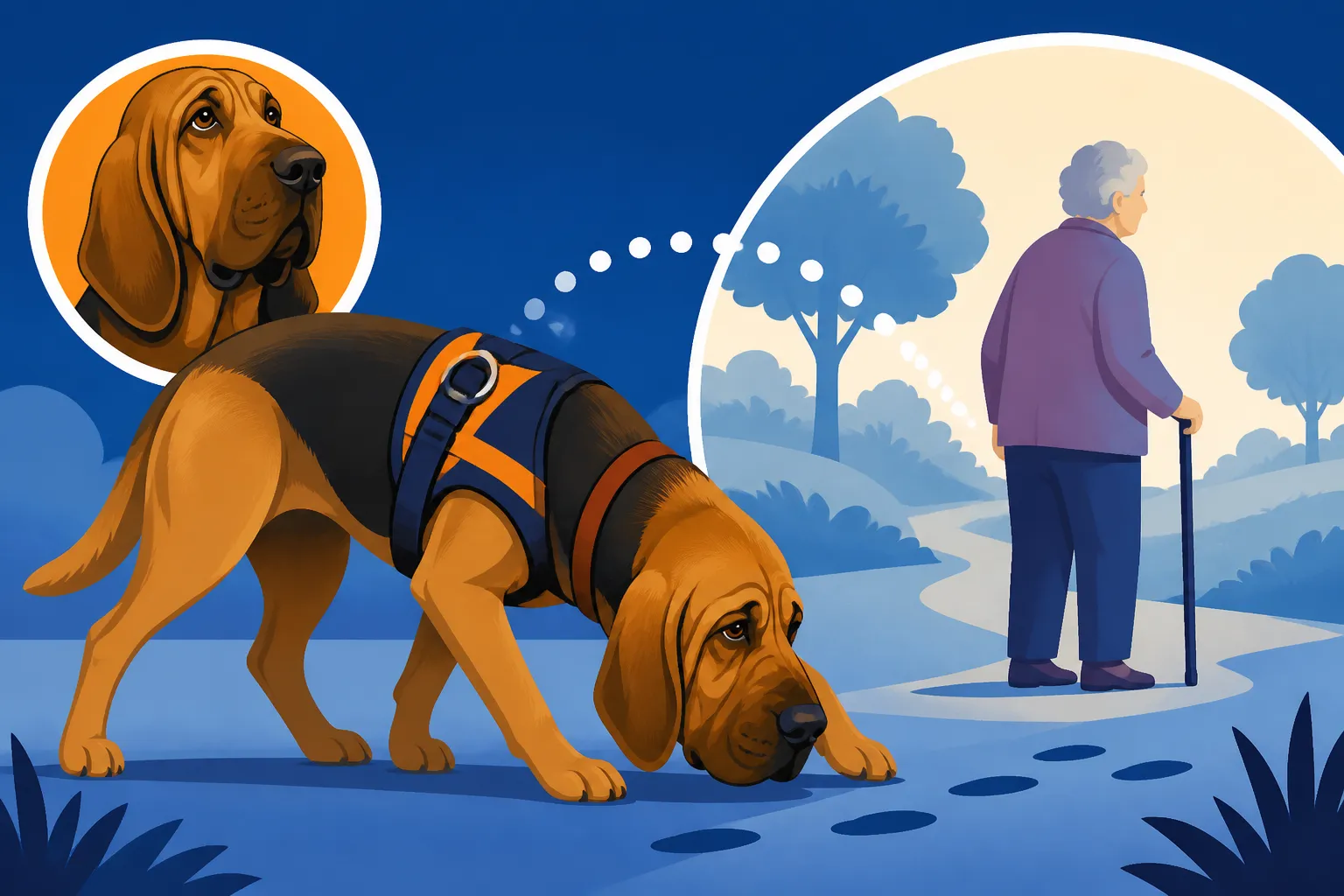
When a Bloodhound team arrives on scene, the first thing they need is a "scent article." This is typically a piece of clothing, a brush, or anything that has a strong, uncontaminated scent of the missing individual. The Bloodhound takes a deep sniff, absorbing the target scent, and then they're off. They work on a long line, often 15-30 feet long, with their handler guiding them but ultimately trusting the dog's nose. The Bloodhound will meticulously follow the scent trail, ignoring visual cues or distractions. They can track over various terrains – through woods, across fields, even on hard surfaces like asphalt, though the quality of scent retention differs greatly. Their persistence is legendary; they will keep their nose to the ground, working through twists and turns, until they reach the end of that trail. When they successfully find the person, their trained response, often a distinctive bark or a physical indication, tells the handler that the search is over. You might be surprised at How Old a Trail a Bloodhound Can Follow given ideal conditions, but every hour that passes adds to the challenge. And knowing What a Bloodhound Does at the End of a Trail is comforting for families hoping for a successful outcome.
The Specific Challenges of Dementia Cases
While Bloodhounds are incredibly adept, searching for a person with dementia presents its own unique set of challenges. Unlike someone who might be trying to evade capture, or even a lost hiker who follows a somewhat predictable path, individuals with dementia can behave erratically. They might wander aimlessly, enter a building and hide, or even try to appear "normal" to avoid being helped, which can make them less likely to call for help or draw attention to themselves. Their movements can be unpredictable, sometimes walking in circles, other times changing direction abruptly, or even getting into vehicles. This can create a very convoluted scent trail. Furthermore, if a person with dementia has been indoors for an extended period before wandering, the scent article may not be as strong or current as desired, leading to a weaker initial trail. The urgency is also amplified because individuals with dementia are often more vulnerable to exposure, dehydration, or injury, making every moment critical. This is where proactive measures and rapid response from trained teams become paramount.
Limitations and Realities of Bloodhound Searches for Dementia Patients
While Bloodhounds are astonishing, it's crucial to approach their capabilities with a realistic understanding. They are not magic bullet solutions, and their success hinges on many variables. It's a team effort, and even the best team faces inherent challenges.
The Role of the Handler and Training
A Bloodhound is only as effective as its handler. These are not dogs you can just "unleash" and expect them to perform miracles. The handler is a highly trained professional who can read their dog's subtle cues, understand when the dog is on scent, when it's working a "pool" of scent, or when it's lost the trail. They know how to encourage the dog, how to manage the long line, and how to navigate different terrains while keeping the dog focused. The training for both dog and handler is extensive and continuous. It involves countless hours practicing on diverse trails, in varying weather conditions, and with different "runaways" to simulate real-world scenarios. A well-trained handler understands the dog's nuances, such as What a Bloodhound Does When It Loses the Trail, and can adjust strategy accordingly. Without a skilled human partner, even the most talented Bloodhound would struggle to be effective in a live search. It's a testament to the dedication required for these teams, and why professionals often need specific certifications; in a court setting, for example, Whether a Bloodhound Handler Must Be Qualified to Testify is a serious consideration.
Environmental Factors and Time Sensitivity
The environment plays a massive role in the success of a Bloodhound search. Wind, rain, heat, and even the type of ground can significantly impact how well a scent trail persists. A strong wind can disperse scent quickly, making it harder to follow. Rain can wash scent away, especially on hard surfaces. Hot, dry weather can make scent evaporate faster. Conversely, cooler, humid conditions can help a scent trail "stick" longer. The passage of time is perhaps the most critical factor. While Bloodhounds are renowned for following old trails, every hour that passes diminishes the strength and integrity of the scent. This is why early notification and rapid deployment are absolutely vital when someone with dementia goes missing. The longer the delay, the more difficult the search becomes. It's a race against the clock, and unfortunately, conditions aren't always ideal. You might find that some specialized gear, available at places like Chewy, can help handlers protect their dogs' paws in rough terrain, but scent itself remains vulnerable to the elements.
Misconceptions About Bloodhound Capabilities
It’s easy to romanticize the image of a Bloodhound, seeing them as infallible four-legged detectives who can find anyone, anywhere. While their abilities are incredible, they are not magical. Bloodhounds can make mistakes, or more accurately, the scent trail can be compromised or simply disappear. They follow the scent that exists, and if a person was picked up by a car, for instance, the trail simply ends. If the person entered a body of water, the trail also effectively ends. They cannot "know" where a person would go, only where their scent has gone. It's also important to remember that they are dogs, susceptible to fatigue, distraction, and the limitations of their own biology. Stories abound, some true, some exaggerated, but it's important to remember Whether a Bloodhound Can Be Wrong. It's more about the limitations of the circumstances than the dog itself.
Proactive Measures and Community Support
Given the intense anxiety and critical nature of a missing person case involving dementia, focusing solely on the search aspect isn't enough. Proactive measures and strong community support can make a monumental difference, often preventing an emergency or speeding up a successful resolution.
Beyond the Search: Prevention and Preparation
The best search is the one that never has to happen. For families with a loved one living with dementia, prevention is truly key. Securing the home with alarms on doors and windows, having tracking devices (like GPS wearables) that the individual can comfortably wear, and creating a strong network of neighbors, friends, and local businesses who are aware and watchful, are all incredibly important steps. Creating a "safe return" program with local law enforcement or community groups, where up-to-date photos, medical information, and emergency contacts are on file, can shave precious minutes off response times. Some families even create "scent kits" – sealed containers with a fresh, uncontaminated scent article (like a worn t-shirt) of their loved one, specifically for a Bloodhound search. This can be critical for the initial deployment. Basic supplies for this, like airtight containers, can often be found at general pet or home goods retailers, even online at a place like Chewy.
| Search Scenario Type | Typical Missing Person | Missing Person with Dementia |
|---|---|---|
| Movement Pattern | Often directional, seeking help/shelter | Can be erratic, disoriented, "purposeful wandering" |
| Scent Trail | May be consistent | Can be broken, circular, or abruptly ended |
| Vulnerability | Varies, often more resilient | High vulnerability to elements, confusion, injury |
| Communication | May respond to calls/commands | May not respond, or may hide/resist help |
| Urgency | High | Extremely high, rapid decline possible |
| Behavior at Find | Relief, cooperation | Confusion, agitation, resistance to return |
When to Call for a Bloodhound Team
Knowing when to involve a Bloodhound team is crucial. The general rule is: as soon as you realize your loved one with dementia is missing, call 911 immediately. Do not wait. Law enforcement will then assess the situation and determine if a Bloodhound team is appropriate and available. The faster a team can be deployed, the better the chances of a successful find, especially given the rapid onset of risk for individuals with dementia. Have that fresh scent article ready, and be prepared to provide as much detail as possible about their last known whereabouts, what they were wearing, and any known habits or places they might gravitate towards. Sometimes, a volunteer Bloodhound team might be involved, so understanding Whether a Volunteer Bloodhound Can Be Called Out can also be helpful for families.
Resources for Families
Beyond immediate emergency services, there are numerous organizations dedicated to supporting families dealing with dementia, many of which offer resources for preventing wandering and assisting in searches. Organizations focused on Alzheimer's and dementia often provide guidance on home safety, identification programs, and support networks. Look into local community groups, senior centers, and law enforcement initiatives like Silver Alerts or Project Lifesaver. These programs are designed to help quickly locate vulnerable individuals. While not directly related to Bloodhounds, ensuring your dog is well-equipped with identification tags and possibly a Whether a Bloodhound Needs a Tracking Collar can also offer peace of mind, and products for these needs are readily available at stores like Chewy. These resources, combined with the incredible dedication of Bloodhound search teams, offer a beacon of hope in what can be an incredibly frightening situation.
Disclaimer
This article is for general informational purposes only and does not constitute professional advice. Laws, prices and regulations vary by location and change over time. Consult a qualified professional for guidance on your specific situation.