How High a Fence a Bloodhound Needs
You’ve welcomed a Bloodhound into your life, and quickly discovered that their incredible nose isn't just for tracking missing persons—it's also a powerful motivator for exploring the world beyond your fence. It’s a common, utterly frustrating dilemma for Bloodhound owners: how do you build a barrier robust enough to contain a dog whose entire being is dedicated to following a scent, wherever it may lead? This guide is here to shed some light on the true realities of Bloodhound containment and help you devise a fencing strategy that actually works.
Understanding the Bloodhound's Unmatched Drive to Explore
Let’s be honest: a Bloodhound isn't like other dogs. Their genetic blueprint is etched with an insatiable desire to trail, to follow a scent until its conclusion, no matter the obstacle. This isn't stubbornness; it's instinct, a powerful, ancient drive that makes traditional fencing advice often fall short. When a tantalizing scent wafts just beyond your property line, that fence, no matter how sturdy it seems, becomes a mere suggestion.
The Nose That Knows No Bounds
The sheer power of a Bloodhound's nose cannot be overstated. They can pick up scents days old, through rain, and over concrete. Imagine catching a whiff of your favorite meal from miles away and being told you can't go get it. That's essentially what your Bloodhound experiences every single day. Their entire world is an intricate tapestry of odors, and every new scent is an irresistible puzzle. This means that a visual barrier, or even a fence that seems physically imposing to us, often doesn't register as a true barrier to them if a compelling scent is on the other side. They're not necessarily trying to run away from you; they're running to a scent. Understanding this innate drive is the first step in creating a secure environment.
This powerful instinct is why the concept of "off-leash" is a near impossibility for most Bloodhounds. Why Off Leash Is Not a Goal With a Bloodhound delves into this in more detail, highlighting that once their nose is engaged, your voice often fades into the background. This single-minded focus is what makes them exceptional trackers, but it also makes them Houdinis when it comes to yard containment. They won't just stand at the fence and bark; they will methodically test it, looking for weaknesses.
Climbing, Digging, and Pushing Prowess
Don't let their somewhat lumbering appearance fool you. While they might not be scaling walls like a Border Collie, Bloodhounds are incredibly resourceful. They have a surprising ability to climb chain-link fences, using the mesh as a ladder. Their powerful legs and heavy bodies can push against weaker fences, testing every joint and post. And then there's the digging. Oh, the digging! A Bloodhound, once fixed on a scent, can excavate an impressive tunnel in a surprisingly short amount of time. If they detect a scent trail continuing under the fence line, they will follow it.
This combination of determination and physical strength means a simple four-foot fence, or one with wide gaps, is essentially an open invitation. They might try to dig their way under, push through a flimsy gate, or even find a way to wedge themselves over a low point. It's not about being mischievous; it's about being driven. They see the world as a giant scent puzzle, and the fence is just one more piece to solve. If an escape leads to injury or an accidental run-in with traffic, the veterinary bills can be staggering, which is where having a reliable pet insurance plan from a company like Healthy Paws can truly make a difference.
The Minimum Standard: What Your Fence Needs to Be
Given their unique talents, securing a Bloodhound requires a much higher standard of fencing than many other breeds. We're not just talking about keeping them in; we're talking about outsmarting a highly motivated, scent-driven escape artist.
The Six-Foot Imperative
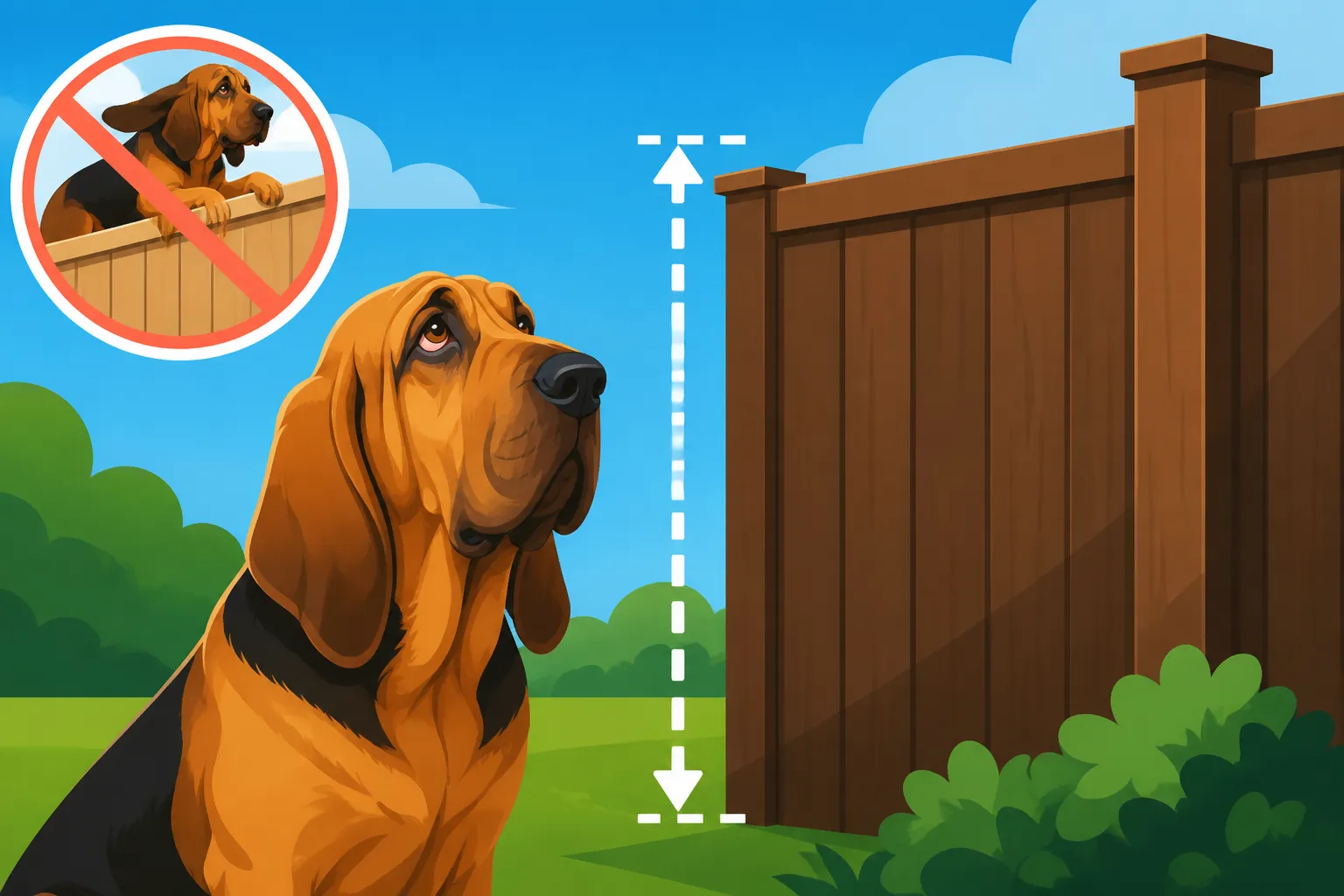
For most Bloodhounds, a minimum of a six-foot fence is highly recommended. Anything less is often considered an invitation for them to test its limits. This height discourages casual jumping and makes it significantly harder for them to get leverage to climb. However, height alone isn't the only factor. A six-foot chain-link fence, while tall, still presents climbing opportunities. A solid privacy fence, while more aesthetically pleasing and scent-blocking, needs to be equally secure at the base.
The material matters, too. For instance, a wooden privacy fence offers a visual barrier that can reduce some of the external scent distractions, but if the boards are flimsy or the posts aren't deeply set, a determined Bloodhound can still find a way through or under. Welded wire fencing, especially with smaller mesh, can be a good option for strength and climb-resistance, but again, the height and ground security are paramount. Remember, a Bloodhound's strength is considerable, and they can lean on or push against even sturdy materials.
Ground Security and Gate Reinforcement
A six-foot fence is great, but if your Bloodhound can simply dig under it, the height becomes irrelevant. You need to focus heavily on securing the ground level. This means burying the fence line or installing a skirt that extends inwards into your yard. Concrete footings, L-footings, or even burying chicken wire horizontally along the fence base can deter digging. For more on this, you might be interested in Whether a Bloodhound Digs Under a Fence.
Gates are another critical weak point. A Bloodhound will quickly learn how to operate simple latches or push open a gate that isn't firmly secured. Double latching mechanisms, self-closing hinges, and even padlocks are often necessary. Ensure there are no gaps between the gate and the posts where a determined nose or paw could create leverage. The gate should open inwards, not outwards, to prevent them from pushing it open. Also, consider the threshold of the gate – can they slip underneath? Filling any gaps with concrete or a sturdy barrier is crucial.
Beyond the Basics: Fortifying Your Perimeter
Sometimes, even a standard six-foot, well-secured fence isn't quite enough for the most determined Bloodhounds. These dogs are intelligent and relentless when a scent is calling, so you might need to go above and beyond to ensure their safety.
Dig Guards and Coyote Rollers
For the persistent digger, special dig guards can be installed. These can be wire mesh panels buried along the fence line, or concrete blocks. Some owners opt for a concrete "curb" poured along the entire base of the fence, making digging virtually impossible. This is a significant undertaking, but for a truly determined Bloodhound, it might be the only sure-fire solution to prevent tunneling. Think of it as creating an underground wall that they simply cannot penetrate.
For the climber, especially on chain-link or mesh fences, "coyote rollers" or lean-ins can be incredibly effective. Coyote rollers are essentially long, smooth pipes installed along the top of the fence. When a dog tries to jump or climb, the roller spins, preventing them from getting purchase. Lean-ins, which are inward-sloping extensions at the top of the fence, make it impossible for the dog to clear the top barrier. These aren't just for wildlife; they're fantastic for outsmarting clever canines. You can often find specialized hardware for these kinds of fence enhancements on pet supply sites like Chewy.
Double Fencing and Secure Runs
In some situations, especially if you have an extra-large property or a Bloodhound with a particularly high escape drive, a double fence might be the ultimate solution. This involves building a second, inner fence a few feet inside your main perimeter. If your Bloodhound breaches the first fence, they are still contained within the second, giving you a crucial buffer and time to intervene. This also creates a "no man's land" that can deter digging or climbing efforts by denying them easy access to the outer boundary.
Another option for secure containment, particularly when unsupervised, is a dedicated, escape-proof kennel or run. This would be a sturdy, covered enclosure with a concrete slab base and reinforced walls, often six to eight feet high. While not ideal for all-day living, it can be invaluable for times when you cannot directly supervise your Bloodhound, ensuring they are safe and secure. It's a significant investment, but for peace of mind and your Bloodhound's safety, it can be well worth it.
Here's a quick comparison of common fencing options and their Bloodhound-specific challenges:
| Fence Type | Pros | Cons | Bloodhound Challenges | Recommended Height | Ground Security Needs |
|---|---|---|---|---|---|
| Chain Link | Relatively affordable, durable | Easy to climb, visible distractions | Can use mesh as a ladder, dig underneath easily, can bend lower sections | 6 feet minimum | Buried mesh/concrete |
| Wood Privacy | Visual barrier reduces distraction, sturdy | Can be chewed, boards can be flimsy, gaps | Can dig underneath, push through weak boards, lean on structure to test integrity | 6 feet minimum | Buried footings/skirt |
| Welded Wire | Strong, climb-resistant (small mesh) | Less aesthetic, visible distractions | Can still dig, some larger mesh sizes can be climbed | 6 feet minimum | Buried mesh/concrete |
| Vinyl Privacy | Low maintenance, no climbing footholds | Can be expensive, can crack, no scent block | Digging beneath is primary concern, can push against panels if not well installed | 6 feet minimum | Buried footings/skirt |
| Brick/Stone | Highly secure, no climbing, no digging | Very expensive, permanent, requires professional installation | Virtually escape-proof from digging/climbing; focus on gate security | 6-8 feet | Built-in footing |
When Fences Aren't Enough: Comprehensive Management Strategies
Even with the most robust fencing, the reality is that no fence is truly 100% Bloodhound-proof if left unchecked. These intelligent, determined dogs require a multi-layered approach to safety and containment. A fence is a tool, but it's part of a larger management strategy that includes training, supervision, and understanding their breed-specific needs.
Constant Vigilance and Training Beyond the Yard
No matter how high or strong your fence is, never assume it’s an excuse for unsupervised outdoor time. A Bloodhound should always be supervised when in the yard, especially if they are new to the property or if you live in an area with a lot of external stimulation. This allows you to intervene immediately if they start testing the fence line, trying to dig, or fixating on a distant scent. The moment you see them focused on an escape route, redirect them. Offer them a high-value treat, maybe even some delicious food from Ollie, and engage them in a different activity.
Beyond the physical barrier, consistent training is vital. While a Bloodhound's recall can be notoriously unreliable when their nose is engaged, working on a strong "leave it" or "come" within the secure confines of your yard or on a long line is still important. Mantrailing Is the Answer to a Bloodhound, Not Obedience highlights how their natural drive can be channeled positively, but foundational obedience is always beneficial. Teach them that staying in the yard is rewarding. Reinforce positive behavior with praise and treats whenever they choose to disengage from the fence line or come when called from a short distance.
The Role of Long Lines and Electronic Fences (with Caution)
For walks and structured outdoor time, a long line is a Bloodhound owner's best friend. This allows your dog to explore scents safely while still being tethered to you. It's a fantastic way to satisfy their natural instincts without risking an escape. Many Bloodhound owners use a 15- to 30-foot long line for sniffaris in open, safe areas. You can purchase these sturdy lines from retailers like Chewy. Remember that if you take your Bloodhound out, they should always be on a leash, especially given the difficulties of recall. Why Recall Fails on a Bloodhound Outdoors explains this critical aspect of their temperament.
Electronic fences, often called "invisible fences," are a controversial topic in the Bloodhound community, and for good reason. While they can work for some breeds, they are generally not recommended as the primary containment for a Bloodhound. Here's why:
- Scent Over Shock: A truly compelling scent will often override the deterrent of a mild static correction. Their drive to follow a trail is simply stronger than the discomfort.
- One-Way Barrier: While it might deter them from leaving, there's nothing to stop another animal or even a person from entering your yard, potentially causing a dangerous situation. Furthermore, if your Bloodhound does get out (which is likely), there's no deterrent for them to come back into the yard, as the shock will prevent them from crossing back over the boundary.
- False Sense of Security: Relying on an electronic fence can give owners a false sense of security, leading to less supervision and a higher risk of escape. For more insights, Whether an Invisible Fence Stops a Bloodhound dives into the specific challenges with this type of containment for the breed.
Ultimately, preventing a Bloodhound from escaping is a commitment. It means investing in the right physical barriers, constantly supervising them, and channeling their incredible scent drive in appropriate, safe ways. Their safety, and your peace of mind, are absolutely worth the effort.
Disclaimer
This article is for general informational purposes only and does not constitute professional advice. Laws, prices and regulations vary by location and change over time. Consult a qualified professional for guidance on your specific situation.