Whether Bloodhound Blood Built the American Coonhounds
A Bloodhound’s reputation for following an old scent makes it tempting to credit the breed as the source of every American coonhound’s tracking ability. The real history is more layered: coonhounds developed from several kinds of hunting hounds, and Bloodhound ancestry may have entered some lines without being the sole or universal foundation.
What “Bloodhound blood” means in hound history
A breed name is not the same as a proven pedigree
When people say a coonhound has “Bloodhound blood,” they may mean one of several things. They could be describing a documented ancestor in a particular dog’s pedigree, repeating a family story about a breeder’s stock, or using “bloodhound” loosely to refer to a hound with an exceptional nose. Those are different claims, and only the first can establish ancestry for an individual dog.
There is another source of confusion: historically, “blood” and “blooded” could refer to a hound’s breeding or pedigree, not necessarily to the modern Bloodhound breed. The word “bloodhound” itself has a complicated history; it does not mean a dog that tracks blood. The distinction is worth keeping in mind when reading older accounts, where descriptions and breed labels were not always used as consistently as they are today. What Blooded Stock Meant When the Bloodhound Was Named
The Bloodhound is an old European scent hound with a history tied to Britain and continental Europe. American coonhounds, by contrast, took shape in the United States through generations of hounds selected for hunting raccoons and other quarry. A link between the groups can exist without making one the direct parent of all the others. For context on the Bloodhound’s own origins, see Which Country the Bloodhound Comes From and Whether the Bloodhound Is Belgian or English.
Why Bloodhound ancestry is plausible in some lines
Hunters have long valued different hound traits for different jobs. A dog might be prized for staying on an older trail, while another is valued for speed, stamina, treeing instinct, or a voice that carries through the woods. Breeders sometimes crossed hounds to combine useful qualities, then selected later generations for the work they needed.
Bloodhounds became especially associated with following human scent, but their scenting reputation naturally attracted interest beyond that role. In some local breeding histories, a Bloodhound or a dog believed to have Bloodhound ancestry may have been introduced to strengthen tracking ability. That kind of cross, where it occurred, does not mean the resulting hunting hound remained a Bloodhound in breed identity. Nor does it establish that every coonhound descended from the same cross.
A dog’s name, appearance, or tracking skill cannot prove ancestry by itself. Long ears, loose skin, a deep voice, or persistence on a trail may reflect shared hound traits, selective breeding, or resemblance rather than a close Bloodhound connection. Breed history is best understood through records and documented breeding practices, not by assuming that a capable nose must have come from one particular breed.
How American coonhounds developed
Coonhounds grew from working hound populations
American coonhounds were shaped by practical hunting. Settlers and later generations of hunters needed dogs that could locate a trail, follow it across varied terrain, and keep working as the quarry moved into a tree or otherwise out of reach. The dogs that became known as coonhounds came from broader populations of hunting hounds, with breeders selecting for the traits that suited local conditions and hunting preferences.
English Foxhounds and other imported or locally developed hounds are part of the wider story of American hound breeding. The development of American hunting dogs involved different influences over time, rather than one simple, uniform cross. Some historical lines may have included additional scent hounds, but the ancestry and emphasis could differ between regions, breeders, and the eventual coonhound varieties.
That history resembles the Bloodhound’s own changing path from European hound stock to the breed known in Britain and elsewhere. The details are not identical, but they show why ancestry should be described as a developing web of working lines rather than a neat, single-parent chain. How the Bloodhound Reached England and What English Breeders Changed About the Bloodhound offer more background on how a breed can change as breeders select for particular roles and traits.
“Coonhound” covers several breeds and histories
Coonhound is not just another name for one uniform dog. The American coonhound group includes distinct breeds, such as the Black and Tan Coonhound, Redbone Coonhound, Bluetick Coonhound, Treeing Walker Coonhound, English Coonhound, and Plott Hound. Each has its own breed history and selection priorities, so a claim about one type should not automatically be applied to all the others.
Even within a recognized breed, dogs can descend from different working lines. A historical cross that mattered to one family of hounds may be absent from another. Breed-wide ancestry claims can flatten these differences and make a varied story sound more certain than the records justify.
| Question | What the history supports | What it does not prove |
|---|---|---|
| Could Bloodhound ancestry occur in some American hound lines? | It is plausible that individual lines included Bloodhounds or dogs believed to have Bloodhound ancestry. | That every coonhound descends from a Bloodhound. |
| Did coonhounds develop from only one breed? | They developed from working hound populations shaped by breeding and hunting needs. | A single, universal origin story for all coonhound breeds. |
| Does a strong nose show Bloodhound ancestry? | It shows useful scenting ability. | A specific breed ancestry without pedigree evidence. |
| Are all coonhounds historically interchangeable? | They share a broad purpose and hound background. | That each breed has the same ancestry, traits, or development. |
Did Bloodhound blood build the American coonhounds
The careful answer is “possibly in some lines, but not universally”
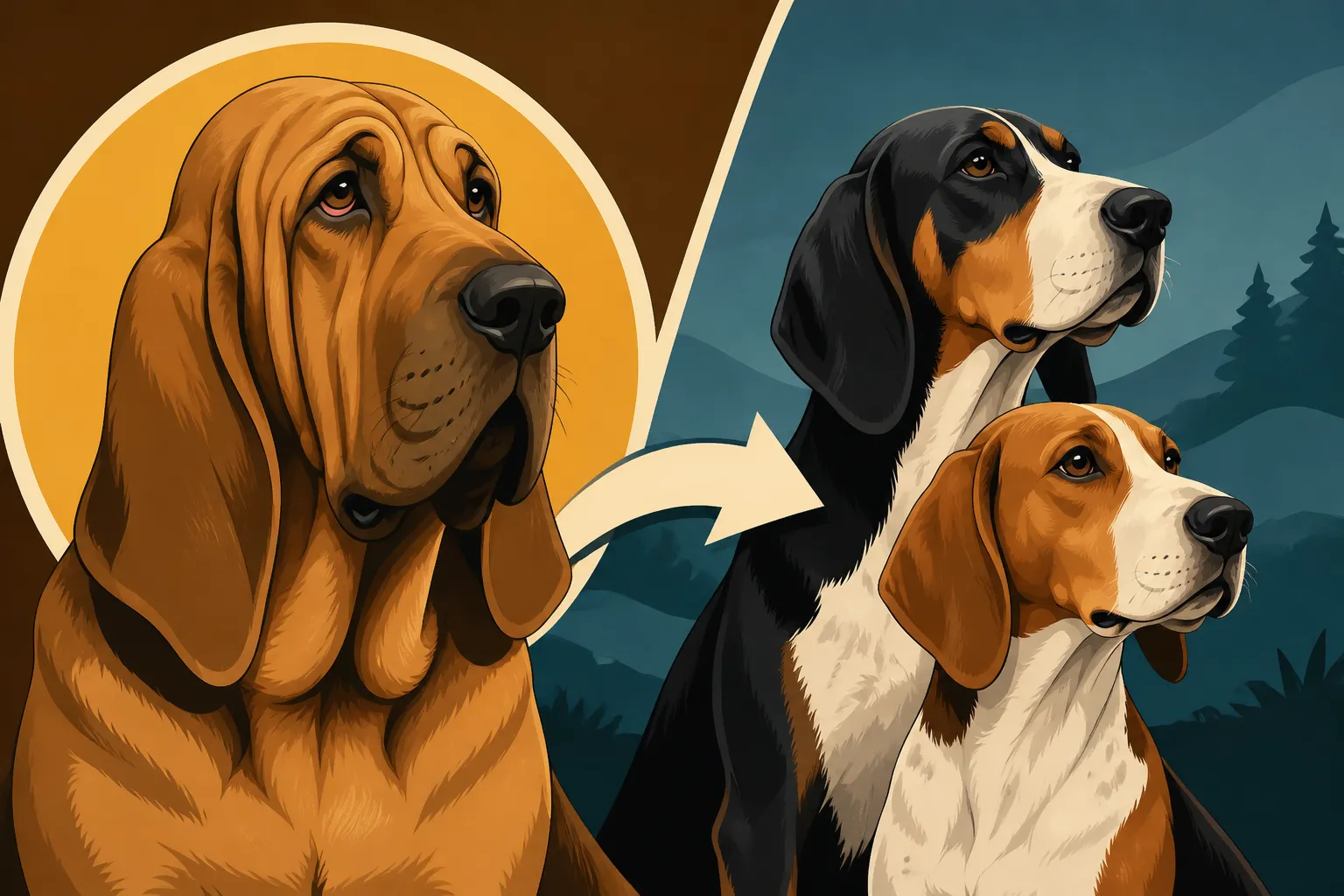
It is reasonable to say that Bloodhound ancestry may have contributed to some American hunting hound lines. It is not accurate to present Bloodhound blood as the single foundation of American coonhounds as a whole. Their development involved multiple hound populations and a long process of selecting dogs for specific hunting work.
This distinction matters because a statement can be partly true and still misleading when it is applied too broadly. A breeder’s local line might have a documented or remembered Bloodhound cross, while another line may have a different history. Without records tied to a particular family of dogs, a sweeping claim about all coonhounds goes beyond what the general breed histories can establish.
For a direct comparison of the two types, The Bloodhound Against a Coonhound is a useful companion topic. It helps separate shared scent-hound qualities from the distinct work each breed was developed to perform. Similarities in behavior and build can reflect related working purposes, not necessarily a close or recent shared ancestor.
Shared abilities do not settle the ancestry question
Bloodhounds and coonhounds are both scent hounds, so overlap in their abilities is unsurprising. Both can show strong persistence when following odor, and both may become deeply focused on a trail. But their work is not identical. Bloodhounds are widely associated with following human scent, while coonhounds were developed around hunting quarry such as raccoons and often working a trail to a tree.
A coonhound that follows a difficult trail is not thereby demonstrating that it has Bloodhound ancestry. The same is true of a Bloodhound-like appearance. Hound breeds share traits because those traits can be useful for scenting work, and breeders can emphasize similar features in separate populations.
The broader lesson is that capability and lineage answer different questions. A dog’s working style tells you something about what it can do; a reliable pedigree or historical record tells you more about where its ancestors came from. The distinction also helps avoid treating “Bloodhound” as a general label for any hound with a powerful nose.
How to assess a Bloodhound ancestry claim
Look for evidence tied to a specific line
If you are researching a particular coonhound family, start with pedigrees, breeder records, kennel histories, and accounts that identify actual dogs and generations. A useful claim should explain which line is involved and how the connection is known. Vague statements such as “all good coonhounds have Bloodhound in them” are not the same as a traceable breeding record.
Older material can be valuable, but read it carefully. Historical authors may use names differently, summarize local traditions, or describe a type of hound without providing a pedigree. It helps to distinguish firsthand breeding records from later retellings. If two accounts disagree, check whether they are talking about the same breed, region, period, or family of dogs.
For a broader view of how hound breeds compare, The Bloodhound Against the Other Scenthounds can help put shared traits in context. And if you are following the Bloodhound’s background itself, What the Name Bloodhound Actually Means explains why the breed’s name is sometimes misunderstood.
Treat certainty and speculation differently
A careful account can acknowledge that Bloodhound blood may have entered some coonhound lines while also noting that the history is not uniform. That is not evasive; it is a more useful way to describe a complicated breeding story. It leaves room for documented local contributions without turning them into a universal explanation.
Be especially cautious when a claim relies only on physical resemblance, hunting reputation, or a general statement that a dog “tracks like a Bloodhound.” Traits can be selected and shared among hounds, and individual dogs vary. A strong nose is evidence of a strong nose—not proof of a particular ancestor.
So, did Bloodhound blood build the American coonhounds? It may have contributed to some hound lines, but American coonhounds emerged through broader, varied breeding histories. The best-supported answer is not that Bloodhounds built every coonhound, but that particular Bloodhound influences may be part of a larger story of American scent-hound development.
Disclaimer
This article is for general informational purposes only and does not constitute professional advice. Laws, prices and regulations vary by location and change over time. Consult a qualified professional for guidance on your specific situation.