Whether the Bloodhound Descends From the Talbot Hound
A Bloodhound’s ancestry is often traced to the medieval Talbot Hound, but the historical record does not establish a simple, documented parent-to-child line between the two. The Talbot may have been one influence among several old scent-hound types. This guide explains what the claim means, what evidence supports it, and why the Bloodhound’s origins remain more complicated than a single ancestor.
The short answer on the Talbot Hound and Bloodhound
The Talbot is often named as an ancestor, not a proven direct parent
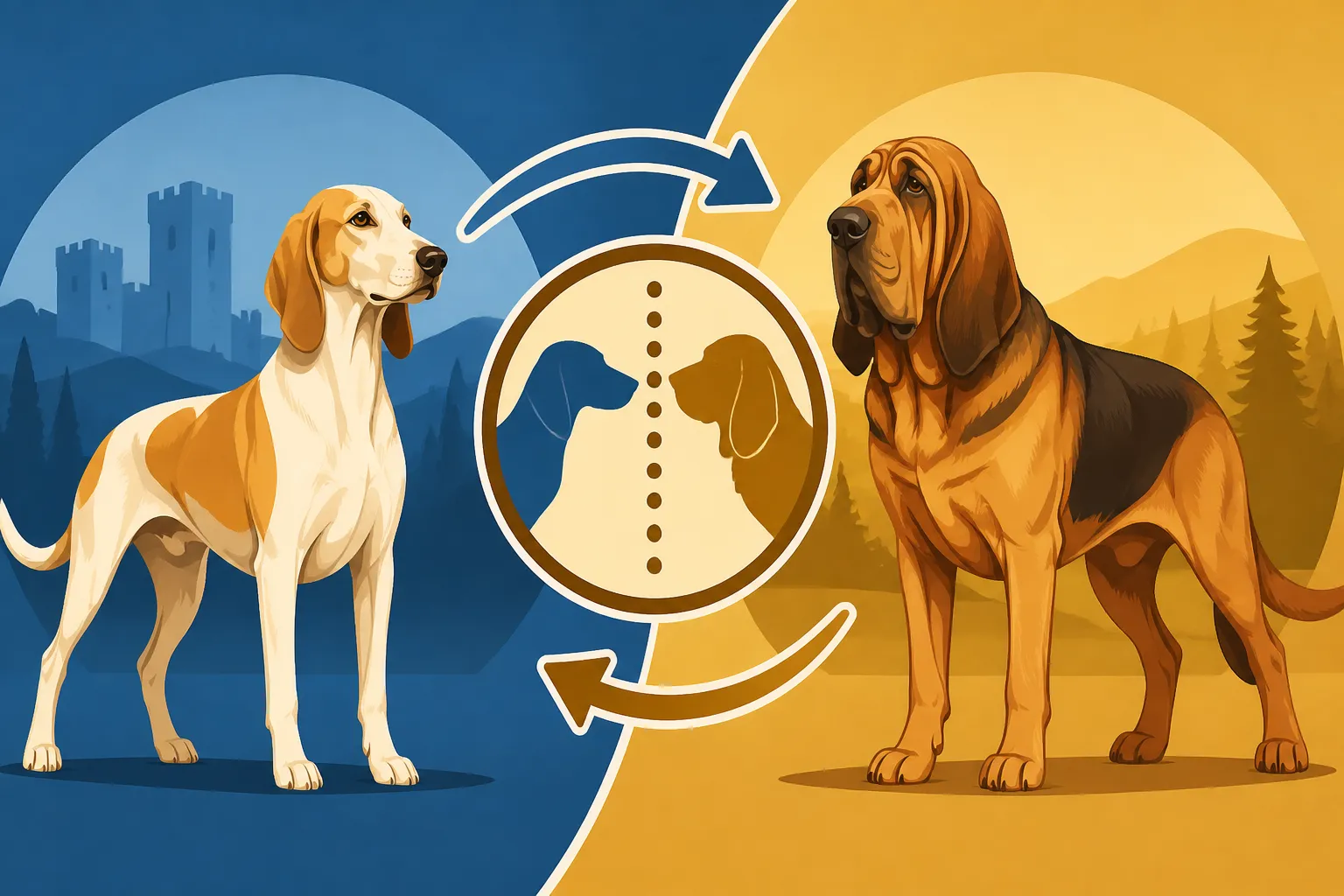
You will often see the Talbot Hound described as an ancestor of the Bloodhound. That is a reasonable way to describe a traditional theory, as long as “ancestor” is not taken to mean that historians can trace a confirmed, unbroken family tree from a particular Talbot to today’s Bloodhounds.
The Talbot was a historical type of scent hound, generally associated with hunting in medieval Britain. The breed or type is now extinct, and surviving records do not provide the kind of detailed pedigrees that modern dog registries use. There is no reliable record that identifies a specific Talbot Hound as the direct founder of the Bloodhound breed.
It helps to separate three different claims:
| Claim | What it means | How firmly it is supported |
|---|---|---|
| The Talbot was an old scent-hound type | Historical accounts refer to a hound called a Talbot | Broadly accepted, though descriptions vary |
| Talbots may have influenced later British hounds | Their traits or descendants may have contributed to later hound populations | Plausible, but difficult to prove precisely |
| Modern Bloodhounds descend directly from a known Talbot line | A documented chain connects the two | Not established by surviving records |
So if someone asks, “Does the Bloodhound descend from the Talbot Hound?” the most careful answer is: possibly in part, according to a traditional ancestry theory, but direct descent has not been proven.
That distinction can feel fussy, but it matters. Historical breed names were not always used consistently, and dogs were often described by what they did or looked like rather than by a standardized breed identity. An old reference to a Talbot does not automatically tell us that every dog called a Talbot belonged to one stable, uniform population.
Why the ancestry story is so easy to repeat
A Talbot-to-Bloodhound story sounds neat: an old British hound, known for tracking, becomes the ancestor of the famous modern tracking hound. It is a tidy narrative, and the Bloodhound’s extraordinary scenting reputation makes the connection feel intuitive.
But historical dog populations did not usually develop in tidy, closed lines. Hunters and breeders crossed useful dogs, moved hounds between regions, and selected for traits such as stamina, scenting ability, size, and temperament. A dog described as a Talbot might have contributed to a broader pool of hunting hounds without being the sole or immediate ancestor of the Bloodhound.
The Bloodhound’s origin story is also tied to continental European hounds, especially the Chien de Saint Hubert. The connection between those dogs and the later Bloodhound is often discussed as part of the breed’s history. For background on that tradition, see The Abbey of Saint Hubert Bred the Bloodhound's Ancestor and What the Chien de Saint Hubert Was Used For.
What historians can and cannot tell us
Medieval dog names did not work like modern breed registries
When we talk about an old breed, it is tempting to picture a modern registration book: named dogs, recorded parents, defined physical traits, and a clear line of descent. That is not what we have for the Talbot Hound. Historical names could describe a kind of hound, a regional tradition, or a working role, and usage could shift over time.
This makes old breed history a little like trying to reconstruct a family tree from scattered letters and portraits, rather than checking a complete archive. A writer might mention a Talbot because it was recognizable to readers, but that mention may not tell us how the dog was bred or whether it was closely related to other dogs carrying the same name.
Descriptions of old hounds also tend to be less precise than modern breed standards. A historical source might emphasize a dog’s hunting ability or appearance without recording measurements, coat details, or pedigree information. Those descriptions can provide clues, but they rarely prove ancestry on their own.
The meaning of the name “Bloodhound” is another example of how historical language can be misunderstood. It is commonly explained in terms of “blooded” or well-bred stock, rather than a hound that tracks blood. What the Name Bloodhound Actually Means looks at that naming question in more detail.
Similar working traits do not prove a shared bloodline
A Talbot and a Bloodhound may both be associated with scent work, but shared work does not establish direct descent. Different dog populations can develop similar abilities when people select for the same practical purpose. A hound bred to follow a scent needs a different set of useful traits than a dog bred mainly for speed or guarding, whether or not the two populations share a recent ancestor.
Likewise, a resemblance in size or general build is not proof of a direct link. A painting or written description may suggest that a Talbot looked like a later hound, but artists and writers did not always aim for precise anatomical documentation. Even when a depiction appears convincing, it cannot function as a pedigree record.
This is why historians generally treat the Talbot connection as a possible contribution to the Bloodhound’s wider ancestry, not as a confirmed one-to-one origin. The careful answer leaves room for influence without pretending that the missing records exist.
How the Bloodhound’s ancestry is usually described
The Saint Hubert tradition is another important part of the story
Many accounts of Bloodhound history place the Chien de Saint Hubert in the breed’s ancestry. The name is linked with hounds associated with the Abbey of Saint-Hubert in what is now Belgium. Over time, hounds and hound types moved across borders, and the Bloodhound developed through a longer history of breeding and selection.
That does not mean every detail of the Saint Hubert story is beyond question. Historical labels and modern breed names do not always line up neatly, and stories about early monasteries can become simplified as they are repeated. Still, the Saint Hubert tradition gives a useful picture of the continental influences often discussed alongside the Talbot theory.
The Bloodhound’s history in England is part of the same broader story. Dogs and breeding practices crossed political and geographic boundaries, and the later English Bloodhound was shaped over generations. For more context, read How the Bloodhound Reached England and What English Breeders Changed About the Bloodhound.
The relationship between the Saint Hubert hound and the modern Bloodhound is also not simply a matter of one old breed being renamed overnight. It is more helpful to think in terms of related hound populations and gradual development, with people selecting for particular qualities over time. Whether the Saint Hubert Hound Still Exists Separately explores the question of whether the historical name refers to a distinct modern breed.
England and continental Europe both matter
Bloodhound histories sometimes get presented as a choice: either the breed is Belgian or it is English. That framing can be misleading. A breed can have important roots in one region and still be developed, standardized, or widely recognized in another.
The Bloodhound as people know it today reflects a long process, not one moment of origin. Dogs may have traveled; hounds with related working traits may have been crossed; and later breeders may have favored certain qualities. That kind of history makes it hard to assign the breed’s entire ancestry to a single country or a single extinct type.
This broader view also helps put the Talbot theory in perspective. The Talbot may belong in the history of British hounds and may have influenced dogs that contributed to later breeds. But the Bloodhound’s story is not well explained by saying that a Talbot simply became a Bloodhound. The question of whether the breed is better described as Belgian or English is discussed in Whether the Bloodhound Is Belgian or English.
The early history is uncertain enough that claims about a precise starting century should be handled cautiously. Which Century the Bloodhound's Line Begins In considers why the date depends partly on what we mean by “Bloodhound”: a modern standardized breed, an older recognizable type, or a broader family of scent hounds.
How to evaluate claims about Bloodhound origins
Look for careful wording rather than a dramatic origin story
When you read that the Bloodhound “comes from” the Talbot, notice whether the writer explains what that phrase means. A careful account will distinguish a possible historical influence from a documented pedigree. If the claim gives no explanation and presents an exact, uninterrupted lineage, treat it cautiously.
It is also worth asking what kind of evidence is being used. A historical text that names a Talbot can support the claim that the type existed or was known. A painting can offer clues about appearance. A later breed history can show how the ancestry story was understood by breeders or writers. None of those sources, by itself, necessarily proves that modern Bloodhounds descend directly from a specific Talbot line.
A useful way to read breed histories is to look for language such as “may have contributed,” “is traditionally considered,” or “is believed to be related to.” Those phrases are not evasive when evidence is incomplete; they are a way of being honest about what can and cannot be established.
Keep the practical takeaway in proportion
For a Bloodhound owner, the Talbot question is mainly historical. It does not change how to care for a modern Bloodhound, how to assess an individual dog’s health, or how to understand that dog’s temperament. A present-day Bloodhound’s needs are shaped by its own health, breeding, experience, and environment—not by whether one particular medieval hound was part of its ancestry.
The history is still worth exploring because it helps explain how the breed developed and why different accounts emphasize different places and hound types. Just keep the conclusion appropriately measured: the Talbot is a possible part of the Bloodhound’s wider ancestry, but the direct line is not documented.
If you want to keep reading about the breed’s origins, Whether William the Conqueror Brought Bloodhounds Over examines another familiar historical claim. It is a useful reminder that memorable stories can survive long after the evidence becomes uncertain.
The best-supported overall picture is a gradual one: old scent-hound populations in Britain and continental Europe contributed to the development of later hounds, while the modern Bloodhound took shape through generations of selection. The Talbot may belong somewhere in that larger history. Confirm the precise lineage from Talbot to Bloodhound before relying on it.
Disclaimer
This article is for general informational purposes only and does not constitute professional advice. Laws, prices and regulations vary by location and change over time. Consult a qualified professional for guidance on your specific situation.