How Many Scent Receptors a Bloodhound Has
When you see a Bloodhound with that magnificent, wrinkled face and those impossibly long ears, you immediately know there's something special about their nose. It's not just a cute feature; it's a finely tuned biological instrument. Many owners and enthusiasts wonder just how powerful that nose truly is, often asking about the underlying mechanics. This guide is here to unravel the mystery, delving into the astonishing number of scent receptors a Bloodhound possesses and how these tiny biological sensors contribute to their legendary tracking abilities.
The Anatomy of a Superior Sniffer: More Than Just the Visible Nose
It’s easy to focus on the external appearance of a Bloodhound’s nose—its broad, moist surface, the way it seems to constantly be working the ground. But the true magic lies far deeper, within a complex internal system that makes their olfactory capabilities utterly unique. Understanding this internal architecture is key to appreciating why these hounds are truly peerless trackers.
Unpacking the Olfactory System in Canines
While all dogs have a fantastic sense of smell compared to humans, the canine olfactory system is incredibly intricate. It starts with the nasal cavity, which is much larger and more complex than ours. Inside, instead of simple, open passages, dogs possess an elaborate network of bony scrolls called turbinates. Think of them like a labyrinth of shelves and passages designed to maximize surface area within a relatively compact space. As air is inhaled, these turbinates filter, warm, and humidify it, but most importantly, they direct the odor-laden air over specialized tissue. This tissue is where the primary work of scent detection actually begins, a remarkable biological interface. For us humans, our nasal passages are more about breathing; for a dog, especially a Bloodhound, they are a dedicated scent laboratory.
Olfactory Epithelium: The Core of Scent Detection
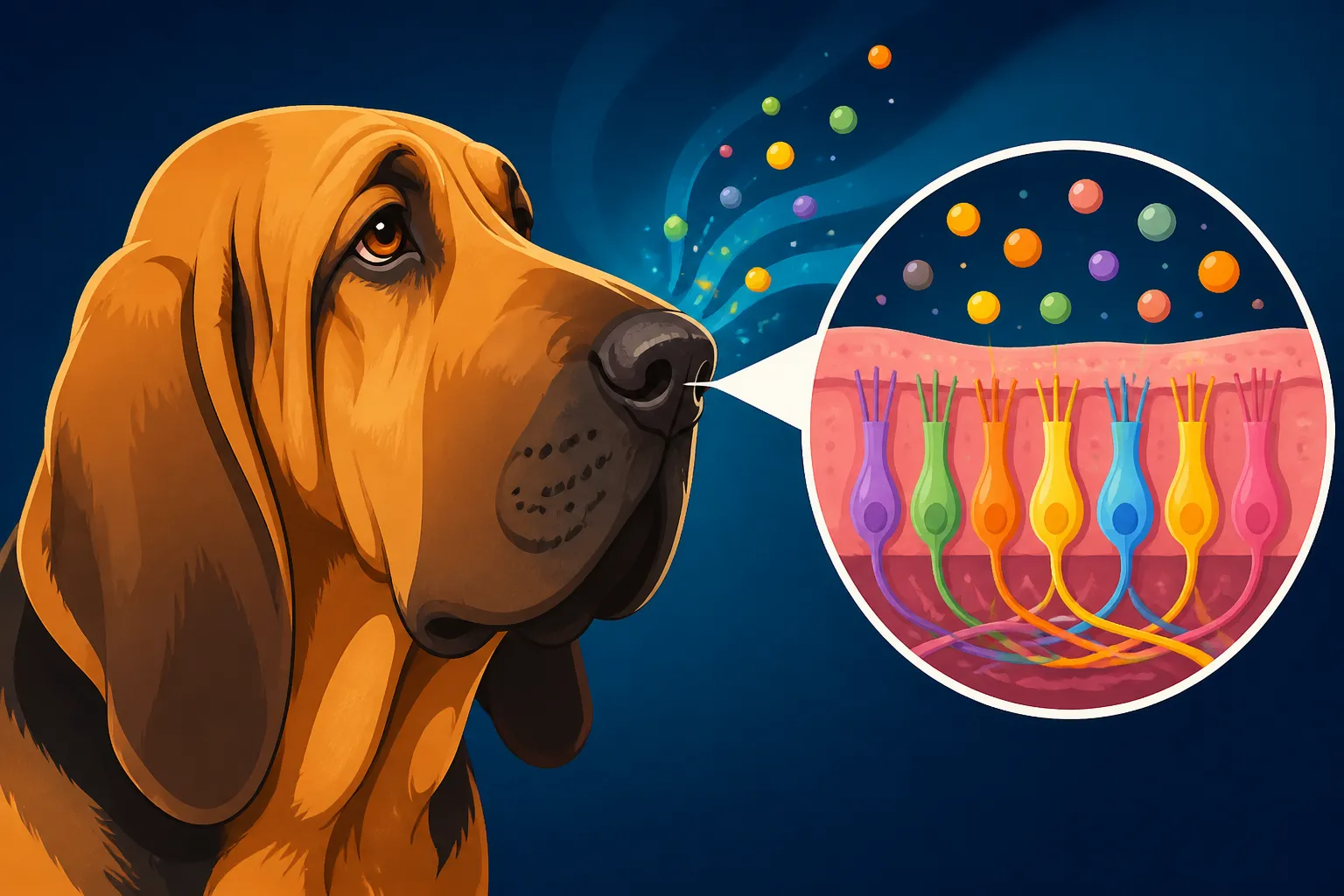
This specialized tissue is known as the olfactory epithelium. It's a mucus-covered lining that blankets a significant portion of the turbinates within the Bloodhound's nasal cavity. Imagine a thick, velvety carpet inside their nose, but this carpet is alive with purpose. When an odor molecule enters the nasal passage, it dissolves in the moist mucus layer of the epithelium. This step is critical, as it allows the molecule to come into direct contact with the actual scent-detecting cells embedded within the tissue. The sheer surface area of this epithelium in a Bloodhound is staggering, far exceeding that of most other breeds, let alone humans. It’s this expansive internal landscape that provides the stage for millions of individual scent detections to occur simultaneously.
The Role of Olfactory Receptor Neurons ORNs
Within the olfactory epithelium are the true heroes of the Bloodhound’s nose: the Olfactory Receptor Neurons, or ORNs. These are the "scent receptors" we talk about, and each one is a specialized nerve cell with tiny hair-like structures called cilia that project into the mucus layer. Each ORN is designed to detect a specific type of odor molecule or a narrow range of similar molecules. When an odor molecule, now dissolved in the mucus, binds to the cilia of a compatible ORN, it triggers an electrical signal. This signal is then transmitted directly to the olfactory bulb in the brain, where it's processed and interpreted as a specific scent. The more ORNs a dog has, and the wider the variety of these specialized cells, the more sensitive and nuanced its sense of smell becomes. This is where the Bloodhound truly shines, possessing an abundance of these cellular detectives.
Quantifying the Bloodhound's Olfactory Power: The Numbers
The sheer numerical advantage of a Bloodhound’s scent receptors is what sets them apart in the canine world. It's not just about having a good nose; it's about having an incredibly dense and efficient one, backed by dedicated processing power in their brain.
The Astounding Count of Scent Receptors in a Bloodhound
Prepare to be amazed: a Bloodhound is estimated to possess up to 300 million or even more olfactory receptor neurons. To put that into perspective, an average human has roughly 6 million. That's a difference of 50 times the sensory input! Even among other dog breeds, which generally have an excellent sense of smell, the Bloodhound stands out. Breeds like German Shepherds or Labradors, highly regarded for their working noses, typically have between 125 million and 250 million receptors. This means a Bloodhound can detect scents at concentrations far lower than other dogs, making them capable of discerning incredibly faint odors that would be imperceptible to other animals, and certainly to humans. This high count means an unparalleled sensitivity and an extraordinary ability to discriminate between even very similar smells.
The Brain's Investment in Scent: Processing Power
Having hundreds of millions of scent receptors would be useless if the brain couldn't process all that incoming information. Thankfully, the Bloodhound's brain is perfectly equipped for the task. The olfactory bulb, the part of the brain responsible for interpreting scent signals, is disproportionately large in a Bloodhound compared to its overall brain size. It's like having a supercomputer dedicated almost entirely to one complex task. A significant portion of their brain's computational power is dedicated solely to analyzing and categorizing the vast amounts of scent data streaming in from their nose. This isn't just about detecting a smell; it's about breaking it down, identifying its components, comparing it to a mental library of known scents, and ultimately, determining its origin and direction. This profound neural investment is why A Bloodhound's Nose Outvotes Its Handler – their brain is constantly urging them to follow the scent.
Physical Dimensions: Nasal Cavity and Turbinates
The impressive number of scent receptors isn't just a genetic lottery; it's supported by specific physical adaptations. The Bloodhound's long, deep muzzle is a direct reflection of the extensive internal architecture required for so many ORNs. Their nasal cavity is elongated and packed with those intricate turbinates, which are bony structures lined with the olfactory epithelium. These turbinates create a complex, convoluted pathway that air must travel, maximizing the contact time between odor molecules and the receptor cells. Imagine a miniature, highly efficient filtration system. As air swirls through this labyrinthine structure, more odor molecules are effectively "caught" and presented to the millions of receptors. This physical design ensures that every sniff is as productive as possible, funneling the maximum amount of scent information to those eager ORNs.
Beyond Internal Anatomy: External Features That Enhance Scenting
While the internal workings of the Bloodhound's nose are undeniably crucial, their distinctive external features are far from mere aesthetics. In fact, every droop, wrinkle, and fold plays a vital role in perfecting their scenting capabilities, acting as a natural extension of their already phenomenal olfactory system.
The Distinctive Bloodhound Nose and Nostrils
Take a close look at a Bloodhound’s nose, and you'll notice it's not like other dogs. Their nostrils are large, wide, and moist, designed for maximum air intake and scent particle capture. What's truly fascinating is their ability to move each nostril independently. This "stereoscopic smelling" allows them to essentially create a mental "map" of scent, helping them determine the direction from which a scent is coming, much like our two eyes give us depth perception. As they breathe out, air exits through slits at the sides of their nose, allowing them to inhale new scents without disturbing the ground-level scent trail with their own exhalations. The moistness of their nose also isn't just for show; it helps trap environmental odor particles, ensuring even the faintest scent doesn't escape detection.
Long Drooping Ears: Scent Funnels
Those iconic, long, velvety ears (often called "leathers") are far more than just charming appendages; they are active tools in the Bloodhound's scenting arsenal. As a Bloodhound lowers its head to the ground to trail, these heavy, pendulous ears act like natural scent funnels. They sweep the ground just ahead of the nose, stirring up dormant scent particles and pushing them directly into the dog's nasal passages. This action helps to concentrate the scent, making it easier for the hundreds of millions of receptors to pick up. Furthermore, the ears create a mini-breeze as they move, pushing air and scent upwards, minimizing scent dispersal and keeping it focused near the Bloodhound’s powerful nose. It's a brilliant, natural design, and it's why Why a Bloodhound's Ears Sweep Scent Toward Its Nose is such a critical part of their trailing success.
Loose Skin and Wrinkles: Scent Traps
The Bloodhound's abundant loose skin, particularly the deep wrinkles around their face, neck, and dewlap, also serves a functional purpose in scent work. These folds don't just give them their wise, melancholic expression; they act as natural scent traps. As the Bloodhound moves and its head swings, these folds gather and hold scent particles from the air and ground. Imagine them like tiny, mobile scent reservoirs, continually presenting a concentrated sample of the environment's odors to the dog's nose. This means that even if a strong gust of wind might disperse a ground trail, some of those crucial scent particles are still clinging to the Bloodhound's own skin folds, providing a continuous olfactory reference point. It underscores why Whether a Bloodhound's Loose Skin Helps It Trail and Whether a Bloodhound's Wrinkles Hold Scent are not just theories but observable advantages for this remarkable breed.
The Art of Trailing: How Bloodhounds Utilize Their Super Senses
Possessing an extraordinary number of scent receptors and an array of physical adaptations only scratches the surface of the Bloodhound's trailing prowess. It's how they masterfully employ these tools, coupled with their innate drive, that truly defines them as the world's premier scenting dog. Their ability to decipher a trail is nothing short of an art form.
Isolating a Specific Scent Amidst Chaos
One of the most mind-boggling aspects of a Bloodhound's ability is their capacity to isolate a single, specific scent target, even in the most bewildering environments. Imagine a busy city sidewalk, teeming with thousands of unique human scents, car exhaust, food odors, and a myriad of other smells. To a Bloodhound, it's not a cacophony of smells; it's a tapestry from which they can pluck a single thread. Their incredible number of receptors, each specializing in different molecular structures, allows them to filter out irrelevant scents and lock onto the unique "human dander" left by the person they are tracking. They essentially have a biological "zoom lens" for scent, focusing with uncanny precision. This is why How a Bloodhound Separates One Person's Scent From a Crowd is a question that often arises – and the answer lies in the sheer volume and discriminatory power of their ORNs.
Following "Aged" Trails and Micro-Scents
It’s one thing to follow a fresh trail, but Bloodhounds are legendary for their ability to follow "aged" trails, sometimes hours or even days old. This remarkable feat is possible because, even after visible evidence like footprints or disturbed vegetation has vanished, microscopic scent particles from the target remain. These particles, shed from skin cells, hair, and even breath, linger in the environment for extended periods. A Bloodhound's overwhelming number of scent receptors makes them exquisitely sensitive to these extremely low concentrations of odor molecules. They're not just sniffing for a strong smell; they're detecting the faintest whispers of a scent that have been left behind. This sensitivity allows them to reconstruct the path of a person long after they've passed, a testament to their unparalleled olfactory endurance. It's truly amazing How Old a Trail a Bloodhound Can Follow.
The Bloodhound's Drive and Focus
All the biological advantages in the world would be moot without the profound, innate drive that propels a Bloodhound to follow a trail to its conclusion. Once a Bloodhound "hits" a scent, their world narrows to that single, compelling olfactory thread. They become utterly absorbed, their focus so intense that external distractions often melt away. This relentless, single-minded determination is not something that can be easily trained out; it's hardwired into their very being. For a Bloodhound, finding the source of that intriguing scent is the ultimate reward, a powerful instinct that overrides almost everything else. This unwavering commitment to the scent makes them phenomenal trackers, but it also means that for owners, A Bloodhound's Nose Outvotes Its Handler almost every single time. It's a drive that shapes their entire personality and dictates many of their behaviors.
Living with and Supporting a Scent Superpower
Bringing a Bloodhound into your life means embracing a dog whose primary motivation is driven by its nose. Their incredible olfactory capabilities shape their needs, their behavior, and the daily care they require. Understanding these aspects is crucial for a happy, healthy, and harmonious life with one of these magnificent hounds.
Providing Appropriate Outlets for Scent Work
Given their astounding number of scent receptors and their inherent drive, a Bloodhound absolutely thrives when given opportunities to use its nose. Simply going for a walk around the block isn't enough; they need structured scent work to truly fulfill their instincts and provide mental enrichment. Activities like mantrailing, where they follow a specific human scent, are ideal. This isn't just a hobby; it’s a necessity for their well-being. It allows them to engage their natural talents and burn mental energy, which can be just as tiring as physical exercise. It's important to understand that Mantrailing Is the Answer to a Bloodhound, Not Obedience for these dogs. Starting a Bloodhound puppy on a trail early on, even with simple games, can build confidence and develop their skills naturally. Starting a Bloodhound Puppy on a Trail should be a priority for any Bloodhound owner.
Managing the Physical Consequences of an Incredible Nose
The very features that make a Bloodhound an elite scent tracker can also pose unique health and care challenges. Their long, heavy ears, which are so effective at sweeping scent, also create a warm, moist environment ripe for ear infections. Regular, thorough cleaning is not optional; it’s a weekly requirement. You'll need good quality ear cleaner, perhaps even specialized solutions for dogs prone to ear issues. Products from retailers like Chewy can be incredibly helpful for stocking up on these essentials. Similarly, their deep facial wrinkles and loose skin, while fantastic for trapping scent, can also trap moisture and debris, leading to skin fold dermatitis. Daily wiping and keeping these areas dry is crucial to prevent irritation and infection. Wiping a Bloodhound's Folds Before They Sour is a daily ritual for many Bloodhound owners, often with gentle cleansing wipes that you can find easily on platforms like Chewy.
Understanding Bloodhound Behavior through Scent
Many behaviors that might be deemed "stubborn" or "disobedient" in other breeds are simply a Bloodhound operating under the powerful influence of its nose. When a Bloodhound catches an interesting scent, their world shrinks to that olfactory input. Their incredible scent receptors tell them where to go, and it can be incredibly difficult to break their focus. This is why Why Off Leash Is Not a Goal With a Bloodhound is almost a mantra for Bloodhound owners – the allure of a distant scent is simply too strong. You might find your Bloodhound ignoring a cue they know perfectly well because their nose is telling them something far more compelling. This isn't defiance; it's instinct. Understanding that Why a Bloodhound Ignores a Cue It Knows often comes down to an overwhelming scent stimulus helps owners manage expectations and train more effectively, focusing on positive reinforcement rather than correction for following their nature. Secure fencing, robust leashes, and clear identification are non-negotiables for this breed.
Disclaimer
This article is for general informational purposes only and does not constitute professional advice. Laws, prices and regulations vary by location and change over time. Consult a qualified professional for guidance on your specific situation.