How the Bloodhound Reached England
The Bloodhound's ancient lineage can feel like a mystery, especially when you consider how such a distinctive breed, renowned for its unparalleled nose, came to grace the fields and courts of England. It's not a simple tale of a dog walking across a border; it's a centuries-long saga woven with royalty, religion, and the evolving needs of hunters and law enforcers. This guide will unravel the fascinating journey of how the Bloodhound, or its direct ancestor, made its way across the English Channel and became the iconic scent hound we know today.
The Ancestry Across the Channel: The Chien de Saint Hubert
Before the Bloodhound as we understand it truly existed in England, its foundational genetics and characteristics were being meticulously cultivated on the European continent. This is where the story truly begins, far from the misty shores of Britain, in the ancient, forested regions of what is now Belgium.
Origins in the Ardennes Abbey
Deep within the rugged and heavily wooded Ardennes region, a specific type of hunting hound was being carefully developed and maintained by the monks of the Abbey of Saint Hubert. These were the "Chien de Saint Hubert," literally the Hounds of Saint Hubert. Imagine a time when vast forests covered much of Europe, and hunting was not merely a sport but a vital part of survival and a display of noble power. The monks, devoted to Saint Hubert, the patron saint of hunters, took it upon themselves to preserve and perfect a breed renowned for its extraordinary scenting ability. Their dedication was almost legendary, ensuring a pure and unblemished lineage for these prized animals.
These early hounds were already impressive: large, powerful, and possessing an uncanny ability to follow the coldest of trails. They had the signature long, drooping ears and loose skin that would later become synonymous with the Bloodhound, features thought to enhance their scenting prowess by sweeping odors towards their noses. The monks' breeding program was rigorous, focusing on temperament, stamina, and, above all, an insatiable desire to follow a scent. They were not bred for speed or aggression, but for unwavering focus and persistence on a trail, making them indispensable for tracking wounded game or even lost travelers. You can learn more about this foundational period by reading Where the Great Abbey of Saint Hubert Stands and Who Saint Hubert Was.
The French Royal Connection
The reputation of the Chien de Saint Hubert quickly spread far beyond the monastery walls. It wasn't long before these remarkable hounds caught the attention of European nobility, most notably the French monarchy. For kings and queens, hunting was a sophisticated affair, and possessing the finest hounds was a matter of immense prestige. The French court highly valued these hounds, using them for tracking large game like deer and boar across their extensive royal hunting grounds. They were a symbol of status, a living testament to the purity of the hunting sport and the noble pursuit of quarry.
The French monarchs were known to actively support the breeding efforts at the Abbey, often receiving hounds directly from the monks to enhance their own kennels. This royal patronage further solidified the breed's standing, not just as exceptional hunters but as dogs of "pure blood" – a lineage carefully managed and documented. This distinction was crucial, setting them apart from the more common, mixed-breed hunting dogs of the era. The Chien de Saint Hubert became the gold standard for tracking hounds, their presence in royal kennels a clear sign of their unparalleled abilities and the respect they commanded.
Norman Conquest and the Introduction to England
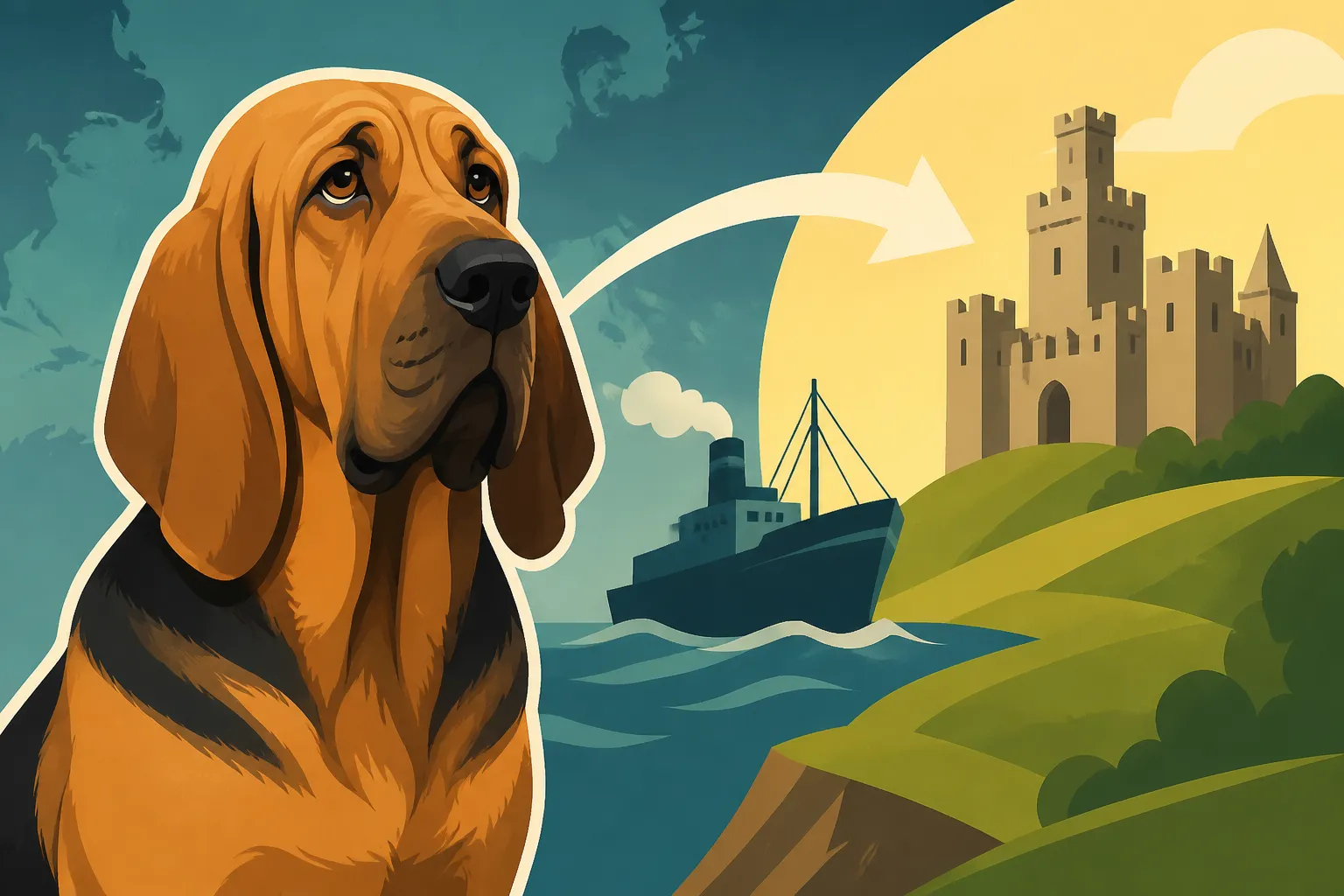
The story of the Bloodhound's arrival in England is inextricably linked with one of the most pivotal events in British history: the Norman Conquest. This violent but ultimately transformative period in the 11th century brought not just new rulers and language, but also new customs, technologies, and, crucially, new breeds of dogs to the island.
William the Conqueror's Hounds
When William the Conqueror successfully invaded England in 1066, he brought with him not only his army but also elements of his Norman culture and way of life. This included his cherished hunting practices and the hounds that made them possible. It is widely believed, and supported by historical accounts and genetic evidence, that among these hounds were types very similar to, if not direct descendants of, the Saint Hubert Hounds. These weren't just any dogs; they were integral to the Norman aristocratic lifestyle, essential for both sport and provisioning.
Imagine the bustling scene as William established his new kingdom, and with it, his royal forests and hunting grounds. His hounds, including those from the Saint Hubert line, would have been immediately put to use. They represented a superior class of hunting dog, capable of feats of scenting that were perhaps unmatched by many of the existing English breeds. Their presence would have solidified the Norman dominance not just in battle, but in the sophisticated art of the chase. The introduction of these hounds wasn't just about bringing dogs; it was about importing a specific, highly valued hunting tradition. For more on this, check out Whether William the Conqueror Brought Bloodhounds Over.
Integration into English Hunting Practices
The arrival of the Norman hounds had a profound effect on English hunting practices. Prior to the Conquest, various native hound types certainly existed, but the Saint Hubert-type dogs likely offered a new level of specialized scenting ability. They weren't just general-purpose hunting dogs; they were trackers. This meant they excelled at following the specific scent of an individual animal, or later, a person, over long distances and difficult terrain, even hours or days after the scent was laid.
Initially, these hounds would have been integrated into the royal hunts, reserved for the nobility. Over time, as their value became undeniable, their influence spread. English breeders would have crossbred them with native hounds, always aiming to preserve and enhance the superior scenting traits for which the Norman dogs were famous. This period marked the beginning of a deliberate selection process within England that would eventually lead to the distinct English Bloodhound. It wasn't about erasing the existing English dog breeds, but about elevating and specializing them, borrowing the best traits from the newly arrived Norman stock to create an even more effective and dedicated scent hound.
Early English Use and Development of the Breed
Once established in England, the ancestors of the modern Bloodhound didn't just maintain their status as noble hunting companions; their roles diversified, and their unique skills became increasingly vital in an evolving society. This period saw the hounds become more than just game trackers, transitioning into something akin to early law enforcement tools.
The Role in Tracking Game and People
In medieval England, the Saint Hubert-type hounds were initially, and perhaps primarily, used for tracking large game. Deer, boar, and other animals were not only hunted for sport but also as a crucial source of food and resources. These hounds were exceptional at following a cold trail, meaning they could track an animal hours after it had passed, a valuable skill in vast forests where game could easily disappear. Their methodical, persistent trailing style was perfectly suited for recovering wounded prey that had fled far from the initial hunt site. You can read more about this early usage in Whether the Bloodhound Was a Deer Hound First.
However, their incredible ability soon found other applications. As society became more organized, and laws needed to be enforced, the idea of using these dogs to track humans began to emerge. They were employed to track down poachers who trespassed on royal lands, thieves who stole livestock, and even escaped criminals. This was a significant shift, highlighting the recognition of their distinct talent for human scent discrimination. It was a gradual but powerful transition, laying the groundwork for the Bloodhound's eventual reputation as the ultimate man-tracker, a role that would solidify its place in legal history. This pivot is beautifully explored in When Bloodhounds Began Trailing People Instead of Game.
Distinction from Other Hounds
As these tracking hounds proved their worth in England, it became essential to distinguish them from other, more general-purpose hunting dogs. English society, with its burgeoning legal system and emphasis on property rights, needed hounds that were specialists, not generalists. The key distinguishing feature was their unwavering focus on a single scent trail, a trait that set them apart from packs of foxhounds or harriers that might chase any moving game.
The concept of a "pure blood" or "blooded" hound began to take root more firmly in England. This wasn't just about lineage; it was about preserving the specific traits that made these dogs such exceptional trackers. Breeders and owners meticulously maintained their lines, understanding that the unique combination of physical characteristics (like those long ears and loose skin) and an unparalleled drive to trail were precious. They were considered a distinct breed, highly valued for their specific utility. This careful distinction ensured that the superior scenting ability brought over by the Normans would not be diluted but rather concentrated and refined over generations of English breeding.
| Characteristic | Chien de Saint Hubert (Continental Ancestor) | Early English Bloodhound (Post-Conquest) |
|---|---|---|
| Primary Use | Tracking large game (deer, boar) for nobility | Tracking game, gradually also poachers/outlaws |
| Scenting Ability | Exceptional, methodical trail following | Retained and further refined; focus on cold trails |
| Physical Traits | Large, heavy, long ears, loose skin, deep voice | Similar, with English selection for distinct look |
| Temperament | Persistent, calm, focused | Calm, dignified, relentless on trail |
| Status | Prized by European royalty and clergy | Valued by English nobility and landowners |
| Lineage | Maintained purity by monks | Deliberate breeding to preserve "pure blood" traits |
The Evolution of the "Blooded" Hound
The name "Bloodhound" itself often conjures dramatic, even fearsome, images for those unfamiliar with the breed. However, the true meaning behind the name is far more rooted in history and lineage than in any sensationalist interpretation. Unpacking this etymology is key to understanding the breed's development in England.
The Meaning of "Bloodhound"
The name "Bloodhound" is one of those terms that has unfortunately been misinterpreted over time, leading to some unfair associations. Many people assume it means a hound that tracks literal blood, perhaps from wounded animals, or even worse, that it implies a bloodthirsty nature. Nothing could be further from the truth. The widely accepted origin of the name points to two primary meanings, both deeply tied to the breed's development in England.
Firstly, and most commonly, "Bloodhound" refers to a "blooded hound," meaning a hound of pure blood or pure breeding. In a time when dog breeding was less formalized, and many hunting dogs were of mixed lineage, the Saint Hubert type was recognized for its carefully maintained ancestry. It was a dog whose pedigree, even if not written down as we know it today, was known and respected for generations. This purity of bloodline was a mark of quality and reliability, ensuring that the exceptional scenting abilities would be passed on consistently. To dive deeper into this, you might find What the Name Bloodhound Actually Means particularly enlightening, and also Whether Bloodhound Once Meant a Hound of Pure Blood.
Secondly, some theories suggest "blood" could also refer to tracking the "blood" (or scent) of a specific animal or person, even when that trail was very old or "cold." This implies a hound that could follow a "cold blood" trail, not literally blood, but a trail that had gone cold. Regardless of the precise nuance, both interpretations emphasize the breed's distinguished lineage and its unparalleled ability to follow a scent with unwavering focus.
English Breeding and Refinement
Over the centuries that followed the Norman Conquest, English breeders took the Saint Hubert-type hounds and further refined them into the Bloodhound we recognize today. This wasn't a sudden transformation but a slow, deliberate process of selective breeding, driven by a desire to enhance their unique tracking capabilities and establish a consistent breed standard. The English were particularly keen on developing dogs that could excel in their specific landscapes and for their evolving needs, which included not just tracking game but also humans for judicial purposes.
This refinement involved emphasizing certain physical traits that were believed to aid in scent work. The loose, pendulous ears, for instance, were thought to help sweep scent towards the nose. The deeply wrinkled skin on the head and face was believed to trap scent particles, keeping them closer to the nose for more thorough analysis. The characteristic "haw" (the drooping lower eyelid) and deep flews (lips) also became distinct features. These traits, while sometimes posing unique challenges for care (we often recommend specialized cleaning supplies from places like Chewy for their ears and folds!), were integral to the visual and functional identity of the emerging English Bloodhound. The focus remained on developing a powerful, persistent, and dignified scent hound, unmatched in its ability to follow the most challenging trails.
Preserving the Lineage: A Legacy of Scent
The journey of the Bloodhound from the monastic kennels of the Ardennes to the fields and courts of England is a testament to the enduring value of its extraordinary nose. This legacy is not just historical; it continues to shape the breed's purpose and our appreciation for its unique abilities today.
Maintaining Purity Through Breeding
The concept of "pure blood" that defined the early Saint Hubert Hounds and gave the Bloodhound its name continued to be a guiding principle for breeders in England and beyond. Unlike many other working breeds that might be crossbred for various traits, the Bloodhound's purity of lineage was paramount because its unique scenting ability was its defining characteristic. Any dilution could compromise this incredible gift. For generations, breeders focused on maintaining a closed gene pool, carefully selecting individuals that exemplified the breed's standard – not just in appearance, but in temperament and, crucially, in scenting drive.
This commitment to purity meant meticulous record-keeping, often stretching back centuries, even before formal breed registries existed. Breeders understood that they were stewards of a living legacy, responsible for passing on the precise combination of genetics that created such an exceptional tracker. This dedication ensured that despite various challenges, including wars and changes in societal needs, the core essence of the Bloodhound – its nose and its relentless drive – remained intact. It's this long-standing commitment that allows us today to connect the modern Bloodhound directly to those ancient European hounds.
The Bloodhound's Enduring Purpose
The historical journey culminated in the Bloodhound we know today: a dog with a noble bearing, a gentle heart, and a nose that remains unmatched in the canine world. This breed isn't just a historical curiosity; it is a living, breathing testament to centuries of selective breeding for a singular, invaluable purpose. While their roles have certainly evolved from tracking medieval game to finding lost children or fugitives, the fundamental skill remains the same.
Today, Bloodhounds continue to serve in search and rescue operations, police departments, and as dedicated companions for those who understand and appreciate their unique nature. Their calm demeanor and unwavering focus on a trail make them indispensable. While the physical traits of loose skin and long ears might require some specific care – like regularly checking for moisture in those magnificent ears or keeping their folds clean – these are small prices to pay for a breed with such a rich history and profound capabilities. Even finding the right grooming tools or a large-breed specific diet for your Bloodhound is much simpler now, with dedicated pet supply retailers like Chewy making it easy to access everything you need to keep your historical hound happy and healthy. The Bloodhound truly belongs to the AKC Hound Group, proudly representing its ancient lineage. The breed stands as a powerful reminder of how deeply dogs have been intertwined with human history, evolving alongside us, and continuously proving their worth through their extraordinary senses.
Disclaimer
This article is for general informational purposes only and does not constitute professional advice. Laws, prices and regulations vary by location and change over time. Consult a qualified professional for guidance on your specific situation.