Whether Bloodhounds Were Used in the Civil War
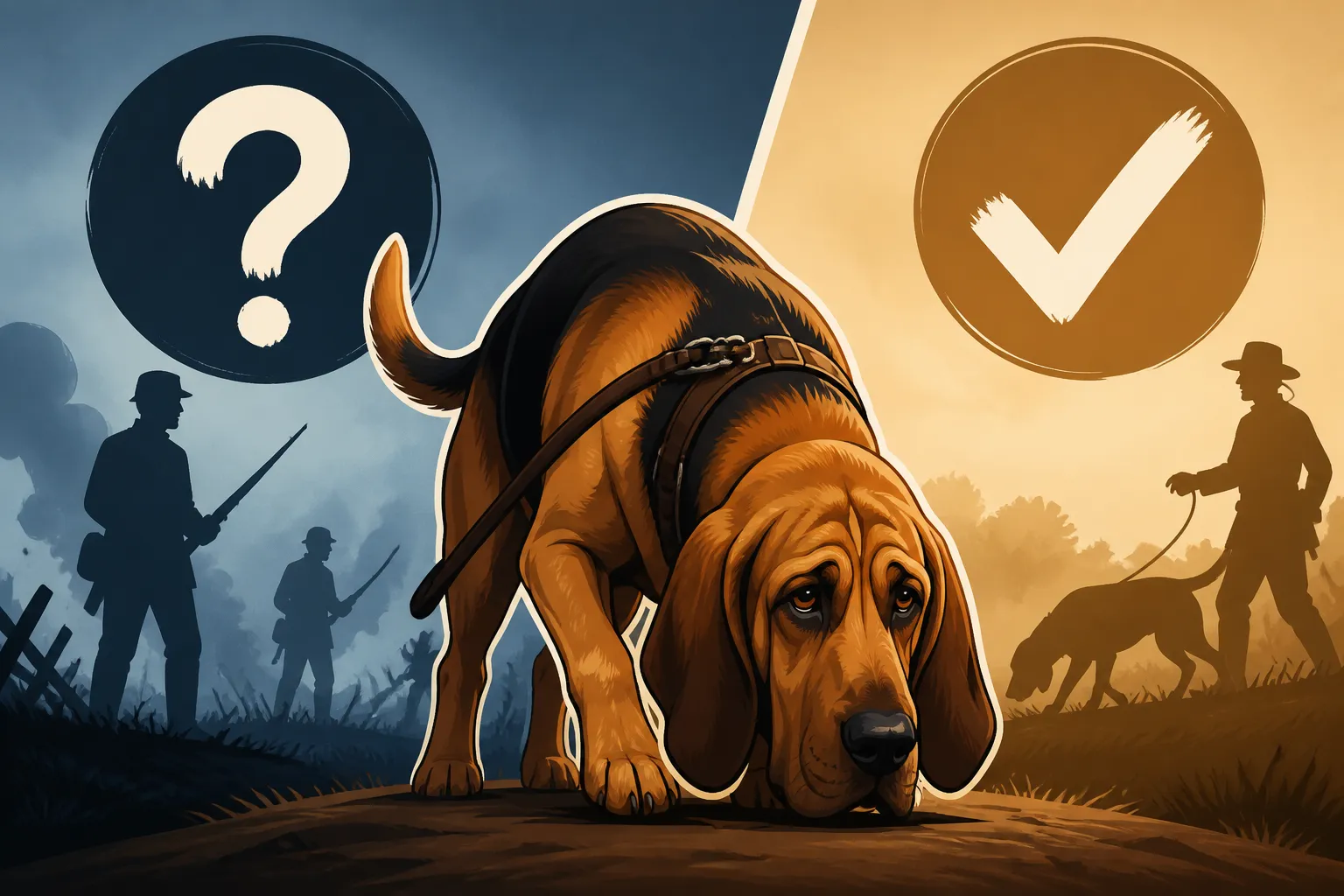
A short answer is yes, but not in the simple, uniform way popular stories sometimes suggest. Dogs called bloodhounds appeared in some Civil War-era accounts of pursuing people, including escaped enslaved people and prisoners. The records do not show that every dog was a modern purebred Bloodhound or that armies used them as a standard battlefield force.
What “bloodhound” meant during the Civil War
A name that did not always identify a precise breed
In the nineteenth century, “bloodhound” could refer to a recognized type of scent hound, but it was also used more loosely for dogs thought capable of following a person’s trail. A wartime newspaper, letter, or memoir might call a dog a bloodhound without documenting its breeding or confirming that it matched the modern breed standard. That makes it difficult to count how many Bloodhounds were actually involved.
The name itself can also mislead. It does not mean a dog that tracks the smell of blood. The term is associated with “blooded” stock, or carefully bred lineage, though historical usage was not always consistent. For background on the name, see What Blooded Stock Meant When the Bloodhound Was Named.
That distinction matters when reading accounts of the Civil War. A description of “bloodhounds” may mean Bloodhounds in the breed sense, a mix of scent hounds, or simply dogs believed to have strong tracking ability. Without details about the animals, it is more accurate to describe them as dogs called bloodhounds in the records than to assume they were all purebred dogs as people understand the breed today.
The dog’s reputation began before the war
Bloodhounds were already associated with tracking people before the Civil War began. In the United States, dogs were used in efforts to pursue enslaved people who escaped bondage, and the word “bloodhound” became especially charged in that context. The practice was not a new military invention of the 1860s; it grew out of a wider history of human tracking, hunting, and coercive pursuit. See When Bloodhounds Began Trailing People Instead of Game and Whether Bloodhounds Were Used to Track Enslaved People.
Popular writing and entertainment helped cement the image of the Bloodhound as a relentless pursuer. Those portrayals often blurred fact and fiction, and they could make the breed seem more vicious or mechanically certain than any real dog is. Whether the Bloodhound's Reputation Was Damaged by Fiction explores how that image developed.
The Civil War did not create the association between Bloodhounds and pursuit. It took place amid an existing culture in which people used dogs to track others, and in which the word “bloodhound” could be used broadly and emotionally. That background helps explain why wartime references need context rather than a quick, literal reading.
How dogs were used in wartime pursuit
Tracking was different from battlefield combat
A scent-trailing dog’s role was to follow a person’s scent, not to fight as an attack dog or charge enemy lines. In accounts describing dogs used during the Civil War, the task was generally pursuit: locating someone who had moved through an area and helping handlers follow the trail. That work could happen away from the immediate clash of battle, in the countryside or along routes used by people trying to escape capture.
The people being pursued could include escaped enslaved people, prisoners, or others authorities wanted to locate. The specific circumstances varied, and descriptions from the period do not always tell us enough to identify the dog, its handler, or the exact purpose of the search. A report that mentions dogs should not automatically be treated as proof of a formal military program.
It is also important not to confuse tracking with a dog independently deciding whom to pursue. Dogs worked with people who directed, handled, or interpreted the search. The handler’s decisions, knowledge of the terrain, and expectations could shape what happened. A dog could lose a trail, follow the wrong scent, or be unable to work under particular conditions; it was never a guaranteed human-tracking machine.
Scattered use is not the same as standard military policy
The safest conclusion is that dogs called bloodhounds were used in some Civil War-era pursuit situations, but they were not a universal or standard feature of Civil War armies. The historical record does not support a picture of every Confederate unit—or every military force—having a trained pack ready for routine tracking. Mentions of dogs are better understood as evidence of particular practices and local circumstances than as proof of widespread, organized deployment.
This distinction can get lost when a dramatic account is retold. A newspaper story may describe a search in vivid terms, while a later retelling turns that incident into a general claim about how armies operated. The further a story travels from its original setting, the easier it is for a specific episode to become a sweeping statement about “the Bloodhound” and the whole war.
| Historical question | Careful interpretation |
|---|---|
| Were dogs called bloodhounds used during the Civil War? | Some accounts describe their use in pursuit and tracking. |
| Were all of them modern purebred Bloodhounds? | The records do not establish that. The term could be used loosely. |
| Were Bloodhounds a standard battlefield weapon? | No broad, routine military deployment is established by the available historical picture. |
| What kinds of people were pursued? | Accounts and the wider history include escaped enslaved people and prisoners, though each incident needs its own context. |
| Did a dog always find the person? | No. A dog’s performance depended on scent, conditions, training, and the handler. |
A useful habit is to ask what a specific account actually says: Who was searching? Who was being pursued? Where did it happen? Does the writer identify a dog’s breed, or only call it a bloodhound? Those questions keep a real but uneven historical record from being flattened into a legend.
What the records can and cannot establish
Historical language needs to be read carefully
Civil War-era accounts were written for different reasons. A newspaper might aim to inform, persuade, or entertain; a memoir might be shaped by memory and hindsight; a military document might record an event without describing the dog in detail. The word “bloodhound” could carry a strong emotional meaning, so it may say as much about the writer’s framing as about the animal’s ancestry.
Descriptions can also reflect the racial politics of the period. Stories about dogs pursuing enslaved people were not neutral accounts of a sporting chase. They were connected to the systems that deprived people of freedom and used force to prevent escape. Describing the dogs’ tracking ability without acknowledging who was being hunted and why would leave out the most important part of the history.
At the same time, caution about terminology should not become a reason to dismiss every account. The careful approach is to say what the evidence supports: some sources describe dogs called bloodhounds being used to pursue people, while the precise breed, frequency, and organization of that use may be unclear. That is more informative than either treating every story as exact or rejecting the subject because the records are imperfect.
Popular culture often turns a complicated history into a simple one
The familiar image of a Bloodhound following a trail without error comes from a mix of real scent-trailing ability and exaggerated storytelling. A dog’s nose can be remarkable, but it does not remove uncertainty from tracking. Weather, age of a trail, ground conditions, crowds, and competing scents can all affect a search. A handler’s assumptions can affect how a dog’s behavior is understood, too.
Stories about dogs pursuing people were also used in public debate long before and during the Civil War. Fictional scenes could intensify fear and reinforce stereotypes about both dogs and the people they were said to pursue. For one example of the cultural conversation around the breed, see Whether Uncle Tom's Cabin Misrepresented the Bloodhound. It is useful to separate a novel’s dramatic role for a dog from evidence of a specific real-world incident.
The breed’s historical identity is also broader than one period or one use. The Bloodhound developed as a scent hound, and its reputation for tracking people grew through many different cultural and practical settings. Which Country the Bloodhound Comes From offers more context on the breed’s origins, while Whether the Bloodhound Is Actually Gentle addresses why a history of pursuit should not be mistaken for a simple description of an individual dog’s temperament.
What to remember about Bloodhounds and the Civil War
The direct answer, with the necessary qualifications
Yes, dogs described as bloodhounds were used in some Civil War-era efforts to track people. Those efforts included the pursuit of escaped enslaved people and prisoners. But the surviving descriptions do not justify saying that every dog was a modern purebred Bloodhound, that the practice was uniform across the war, or that Bloodhounds were a standard combat unit.
The term “bloodhound” was not always precise, and the accounts differ in detail and purpose. Some may refer to specific dogs used in a particular pursuit; others may use the label more generally. A responsible historical answer keeps that uncertainty visible without ignoring the documented connection between dogs, tracking, and coercive pursuit.
Most of all, this history should be discussed in its human context. The dogs’ role was part of searches conducted by people and authorities, and some of those searches aimed to capture people escaping enslavement. Calling the practice merely “tracking” can make it sound neutral when the circumstances were not.
A practical way to evaluate a claim
When you encounter a claim that “Bloodhounds were used in the Civil War,” look for the details behind it. Does the account give a location and date? Does it name a handler or describe the people being pursued? Is “bloodhound” presented as a verified breed or simply as the label used by the writer? Does a later retelling claim widespread use based on one reported event?
These questions are helpful because popular histories often compress several different ideas into one sentence: the breed’s scenting reputation, the use of dogs to pursue people, and a particular Civil War incident. Each idea may have a different level of evidence. Keeping them separate makes the answer more accurate and avoids turning a complicated history into a dramatic breed legend.
The most balanced takeaway is that dogs called bloodhounds did appear in some Civil War-era pursuits, but the historical record is not a basis for imagining a universal military practice or a pack of infallible trackers. The breed’s association with human tracking is real, while the details of particular wartime uses require careful attention to language, context, and the limits of the account.
Disclaimer
This article is for general informational purposes only and does not constitute professional advice. Laws, prices and regulations vary by location and change over time. Consult a qualified professional for guidance on your specific situation.