Whether Nick Carter Trailed a Man Across a River
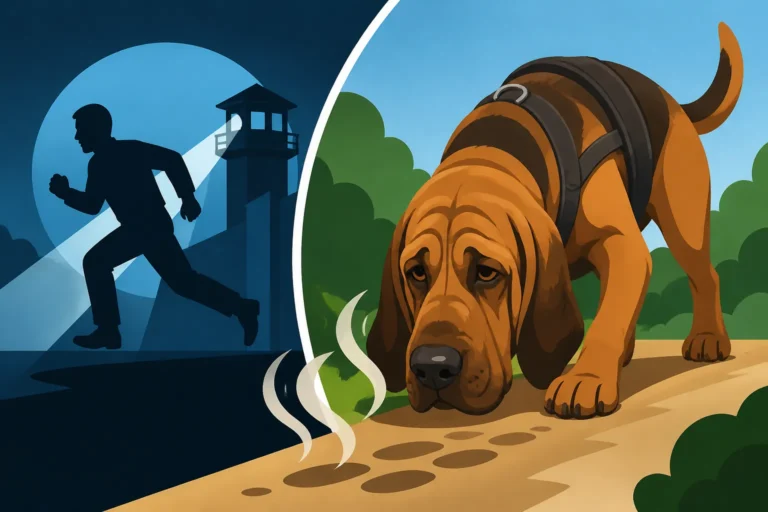
Nick Carter is often remembered for extraordinary tracking feats, including stories that he followed a fugitive across a river. The careful answer is that such a crossing is part of the lore surrounding the celebrated Bloodhound, but the details are not firmly established enough to treat every retelling as a verified case. Here’s what the story can—and cannot—tell us about his tracking ability.
Did Nick Carter really trail a man across a river?
Stories about Nick Carter describe him following human scent across difficult terrain, and some accounts include a river crossing. But the river detail is less secure than the broad reputation: Nick Carter was a famous working Bloodhound whose tracking ability became the subject of public attention. Without a clearly identified case and reliable documentation of the route, it is safest to say that he was reported to have tracked across a river—not that a particular crossing is conclusively proven.
That distinction matters because the story is often repeated as a tidy demonstration of a dog following an unbroken scent path through water. Real tracking is not quite so simple. A dog may lose a scent at a bank, search along the shoreline, and pick it up again where the person left the water. A successful track across a river does not necessarily mean scent travelled straight through the water or that the hound followed a continuous invisible line beneath the surface.
What the river story appears to claim
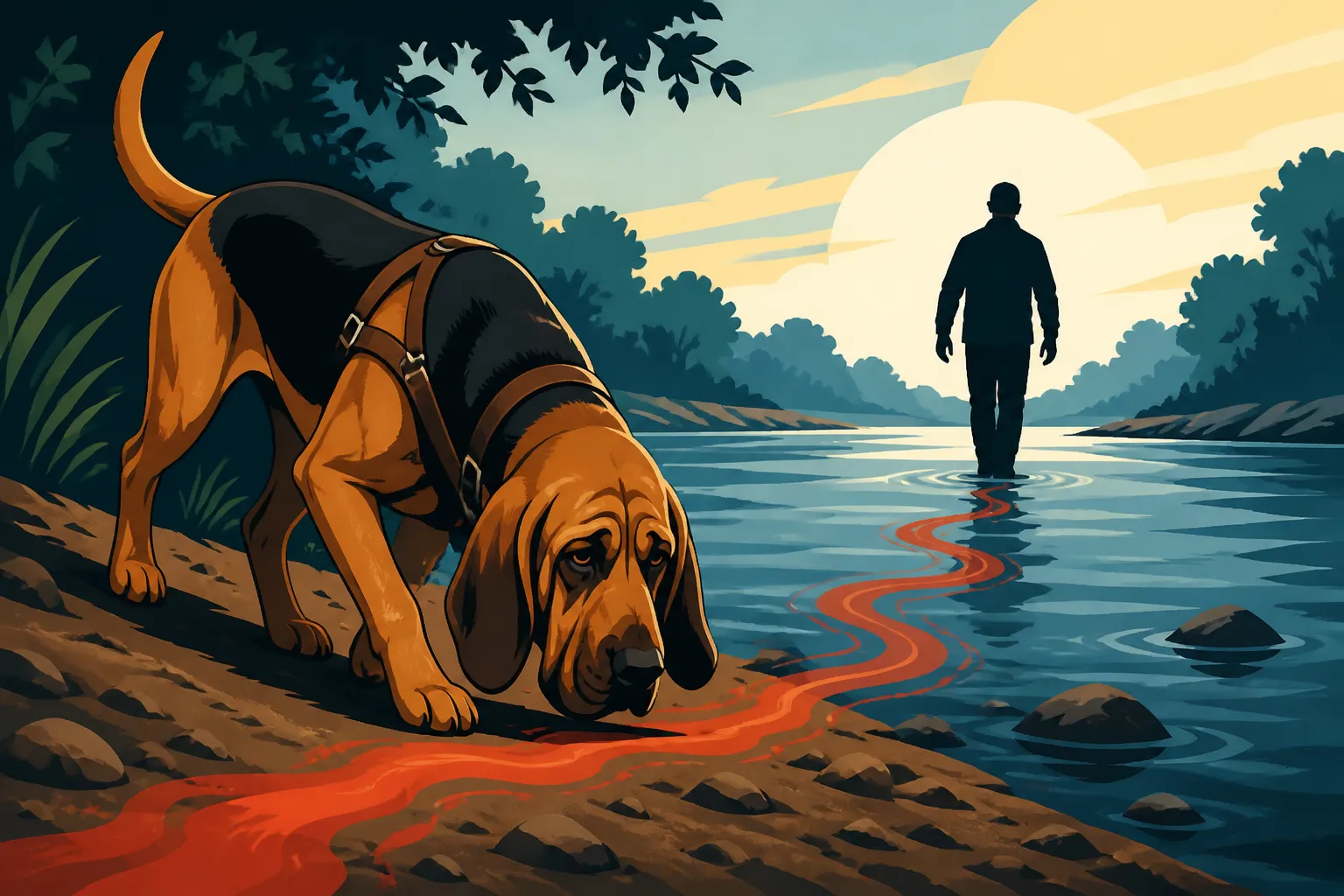
The basic story is that Nick Carter was set on the trail of a person who had crossed a river to avoid pursuit, and that the Bloodhound continued the track on the other side. In popular retellings, the crossing becomes proof of almost uncanny scenting power: the man enters the water, the track disappears to human observers, and the hound finds it again.
The trouble is that retellings of famous tracking feats can leave out the very details needed to assess them. A useful account would identify the person being tracked, the location and conditions, who witnessed the pursuit, how the hound was started, and what happened after the crossing. If those details are missing or inconsistent, the story can still reflect a real reported feat, but it should not be treated as a complete, independently verifiable case history.
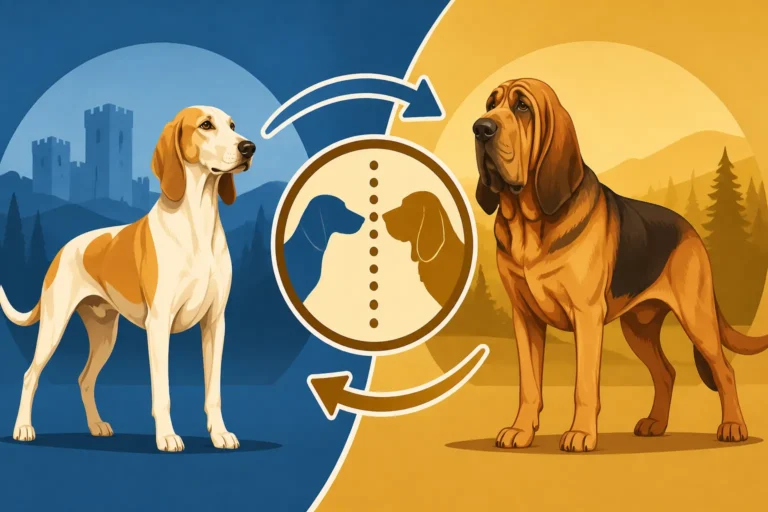
Nick Carter’s reputation is discussed alongside other celebrated stories about his work. For background on the dog and his handler, see Who Owned the Bloodhound Nick Carter and Where Nick Carter Worked. Those details help place the river story in context, but they do not, by themselves, confirm the exact crossing.
What “across a river” can mean in a tracking account
A river crossing may sound like one dramatic event, but there are several ways a hound could resume a trail after a person enters water. The person might wade through a shallow section, use a bridge or boat, or leave the river at a point where scent has settled on the bank. The dog could search the edge and find the point where the person came ashore.
A Bloodhound’s work is not necessarily a nose held inches above one continuous footprint. The dog may investigate an area, cast back and forth, and follow scent carried or deposited by the person. Wind, humidity, the surface, the time elapsed, and activity by other people can all affect what is available. A handler watches the dog’s behavior and manages the search, but the dog is doing the scent work.
That is why an account saying a hound “crossed a river” may describe the overall result rather than every step of the route. It does not tell us whether the dog swam, followed a bridge, searched a bank, or picked up the trail after the person exited the water. Without those particulars, the safest reading is that the hound reportedly continued the track despite a water obstacle.
How could a Bloodhound follow scent near water?
Water can disrupt the physical traces people commonly associate with tracking, such as footprints in soil. It does not necessarily erase every scent cue. A person sheds scent through skin cells and other materials, and scent can remain on ground, vegetation, objects, or places the person touched. A dog may follow a combination of cues rather than a neat line of footprints.
This does not mean a Bloodhound can track any person across any river in any conditions. A broad, fast-moving river, a long period of delay, heavy rain, strong wind, and crowds may make a trail difficult or impossible to work. A modest stream or a route with accessible banks may present a very different challenge. The conditions and the dog’s training matter.
The dog follows human scent, not a map of footprints
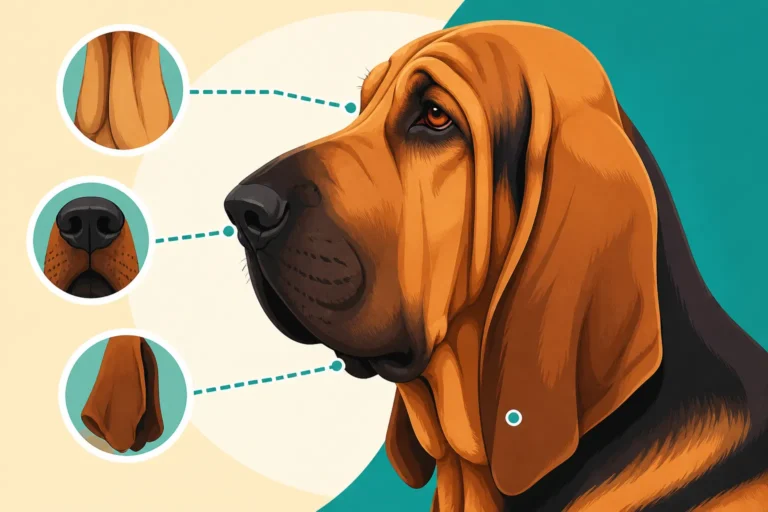
A Bloodhound is trained to work from a scent article associated with a particular person and then search for that person’s scent. What the dog detects is a complex odor picture, not a visual trail. Footprints may help tell a handler where someone travelled, but the hound’s primary task is scent-based. For a fuller explanation, see What a Bloodhound Is Actually Smelling on a Trail.
At a riverbank, the dog may initially show that the trail has become difficult to locate. The handler can allow the hound to search the area rather than pulling the dog toward a presumed route. If scent is found on the far bank, the team may continue from there. That can look like the dog has “solved” the river, though the actual search may have involved careful investigation at both banks.
A dog’s success also depends on the scent article and the conditions under which the track begins. If the hound is given the wrong article or the scent has been contaminated, the result becomes harder to interpret. In historical stories, those practical details are often not included, which makes it difficult to compare one claimed feat with another.
Water is an obstacle, not a magic scent barrier
It is tempting to imagine water as a clean break in a trail: a person steps into the river and all scent vanishes. In real settings, the transition is less absolute. Scent may remain on the bank, on plants or objects, or along the route used to enter and leave the water. The hound may also locate the trail at a downstream or upstream point rather than exactly opposite where the person entered.
The reverse assumption is also a mistake. A Bloodhound does not automatically find a trail just because a person crossed water. If the person continues through deep water, leaves at a difficult location, or the scent is dispersed by current and weather, the dog may not recover it. “A Bloodhound can track across water” is too broad a claim; the fairer point is that water does not always end a track.
For the same reason, a river story should not be used to claim that a Bloodhound can follow a person over any distance, at any age of trail, or under any weather conditions. Accounts of older tracks have their own complexities; How Old a Trail Nick Carter Followed is useful context for understanding why trail age and conditions matter.
What is documented about Nick Carter’s tracking record?
Nick Carter became famous because reports credited him with an exceptional number of successful finds. That reputation is part of the history of working Bloodhounds, but a large claimed tally and a detailed, independently checkable record are not the same thing. A count may include different kinds of searches, and reports can be repeated without preserving the information needed to verify each event.
The river story should therefore be read as one element of a celebrated reputation, not as a standalone scientific test. If a retelling gives no date, location, name, or account of witnesses, it is hard to determine precisely what happened. That does not prove the story false. It does mean readers should distinguish a widely circulated claim from a fully documented case.
The difference between a reported feat and a verified case
A reported feat is an event described in a newspaper, a book, a public demonstration, or a later account. A verified case would ideally have enough independent detail to let someone compare accounts and assess the sequence of events. For a trail, that might include who supplied the scent article, where the track began, how long before the hound started, what route the dog took, and how the person was eventually found.
Those details are especially important when a dog’s work is treated as evidence. A hound may lead a search team to a person, but the trail is not simply self-explanatory. The handler’s training and observations, the scent article, the conditions, and corroborating evidence all matter. Nick Carter’s fame should not be mistaken for proof that every account attributed to him has the same evidentiary strength.
The question of how much of his reputation can be checked is explored in Whether Nick Carter's Finds Were Documented. His reported record is also discussed in How Many Convictions Nick Carter's Nose Produced in 1903 and Whether Nick Carter's Record Has Been Beaten. These are related questions, but none should be collapsed into the river story: a large total of reported finds does not confirm one specific route.
Why famous hound stories grow in the telling
A memorable tracking story is easy to retell and easy to sharpen. “The dog continued after the fugitive crossed a river” may gradually become “the dog followed him through the water without losing the scent.” Each version can sound more definite than the last, even if no new evidence has been added.
This happens with many historical animal stories. A practical achievement—locating a trail after a difficult crossing—can become a dramatic claim about scent powers that seem almost supernatural. The dog’s work can be remarkable without requiring that kind of embellishment. Bloodhounds are exceptionally suited to scent work, but they operate in real conditions, with limits and uncertainty like any working team.
When reading a story about Nick Carter, look for the details that make it testable. Does it name a place and person? Does it distinguish what the handler saw from what later writers inferred? Do separate accounts agree on the route? If not, retain the broad claim as historical lore while avoiding a confident reconstruction of the event.
What the Nick Carter river story tells us about Bloodhounds
The story is useful not because it proves that a Bloodhound can track effortlessly through water, but because it illustrates how the breed’s work is often misunderstood. A hound may recover a trail after it becomes difficult to follow by sight. That is different from sensing a person’s path continuously through a river, and it is different again from succeeding under every set of conditions.
The best interpretation holds two ideas at once: Nick Carter was widely remembered for impressive tracking work, and the river-crossing detail deserves caution unless a particular account supplies enough information to check it. That approach respects the dog’s reputation without turning an old story into a certainty it cannot support.
A careful answer to the question
Did Nick Carter trail a man across a river? Historical accounts and retellings associate him with a river crossing, so it is fair to say that he was reported to have done so. But without a consistently documented case spelling out the person, place, route, and witnesses, it is not responsible to present the exact episode as conclusively established.
If the story is accurate, the likely achievement was that Nick Carter and his handler managed to recover or continue the person’s scent after a water crossing. That is impressive, but it does not demonstrate that the scent remained an uninterrupted track underwater or that every river crossing is within a Bloodhound’s ability.
For modern owners and handlers, the practical lesson is not to test this claim by allowing a dog to follow an unknown trail near water. A working dog needs safe handling, suitable training, and a controlled environment. Rivers introduce risks beyond scent work, including current, cold water, steep banks, and traffic near access points. Historical fame is not a substitute for a safe plan.
Nick Carter’s legacy remains compelling precisely because it sits at the meeting point of real working-dog ability and stories that can become larger with each retelling. The most accurate answer is neither a flat dismissal nor a claim of unquestionable proof: the river crossing is part of his reported tracking lore, while its precise details remain uncertain.
Disclaimer
This article is for general informational purposes only and does not constitute professional advice. Laws, prices and regulations vary by location and change over time. Consult a qualified professional for guidance on your specific situation.